
Show Usage
Show Usage
This fragment is available on index.html
This publication includes IP covered under the following statements.
| Type | Reference | Content |
|---|---|---|
| web | example.org | https://example.org/fhir/Bundle/smp-bundle-1 |
| web | github.com | Standardized Medication Profile (SMP) FHIR IG, published by HL7 International / Pharmacy. This guide is not an authorized publication; it is the continuous build for version 1.0.0 built by the FHIR (HL7® FHIR® Standard) CI Build. This version is based on the current content of https://github.com/HL7/smp-ig/ and changes regularly. See the Directory of published versions |
| web | en.wikipedia.org | Both Bundle.link and Bundle.entry.link are defined to support providing additional context when Bundles are used (e.g. HATEOAS ). |
| web | ihe.net |
XDS metadata equivalent
|
| web | wiki.ihe.net | This is a metadata field from XDS/MHD . |
| web | ncpdp.org | Mapping to NCPDP SCRIPT 10.6 |
| web | fhir.github.io | A validator that can be used to check FHIR resource instance validity |
| web | www.iso.org |
ISO maintains the copyright on the country codes, and controls its use carefully. For further details see the ISO 3166 web page: https://www.iso.org/iso-3166-country-codes.html
Show Usage
|
| web | ucum.org |
The UCUM codes, UCUM table (regardless of format), and UCUM Specification are copyright 1999-2009, Regenstrief Institute, Inc. and the Unified Codes for Units of Measures (UCUM) Organization. All rights reserved. https://ucum.org/trac/wiki/TermsOfUse
Show Usage
|
| web | www.ncpdp.org | This implementation guide was co-developed and balloted with the National Council for Prescription Drug Programs (NCPDP) |
| web | doi.org | Prevalence and Nature of Medication Errors and Medication-Related Harm Following Discharge from Hospital to Community Settings: A Systematic Review. Drug Safety, 43:517-537. DOI: 10.1007/s40264-020-00918-3 |
| web | doi.org | Adverse Events Due to Discontinuations in Drug Use and Dose Changes in Patients Transferred Between Acute and Long-term Care Facilities. Arch Intern Med., 164:545-550. DOI: 10.1001/archinte.164.5.545 |
| web | doi.org | Prescribing Discrepancies Likely to Cause Adverse Drug Events after Patient Transfer. Qual Saf Health Care. 18(1):32-35. DOI: 10.1136/qshc.2007.025957 |
| web | www.ihi.org | Medication Reconciliation to Prevent Adverse Drug Events. Accessed on February 21, 2021, from Medication Reconciliation to Prevent Adverse Drug Events – IHI (Institute for Healthcare Improvement) . |
| web | www.jointcommission.org | National Patient Safety Goals Effective January 2021 for the Hospital Program. Accessed on February 20, 2021, from this link |
| web | doi.org | Adverse Events in Long-term Care Residents Transitioning From Hospital back to Nursing Home. JAMA Internal Medicine: E1-E8. DOI: 10.1001/jamainternmed.2019.2005 |
| web | ldi.upenn.edu | Reducing Rehospitalizations Among Post-Acute Care Patients. LDI (upenn.edu). Accessed on February 20, 2021, from this link . |
| web | www.jointcommission.org | As defined by the Joint Commission , medication reconciliation is "the process of comparing a patient's medication orders to all of the medications that the patient has been taking. This reconciliation is done to avoid medication errors such as omissions, duplications, dosing errors, or drug interactions. MR is separate step from the ordering process. It is a process performed by different care team members that can lead to medication recommendations to the prescriber for the ordering process. The pharmacists MR process is different from other care team members and requires review of several data points, not just the comparison of one list to another. |
struct.svg 
|
tree-filter.png 
|
uc1.png 
|
uc2.png 
|
uc3.png 
|
uc4.png 
|
uc5.png 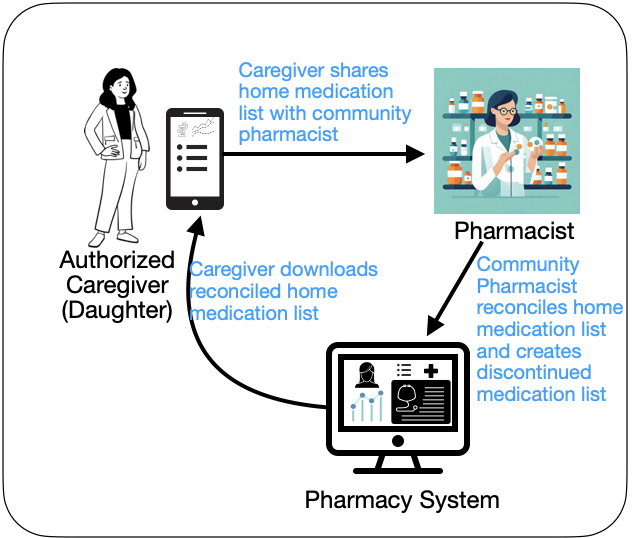
|
usecase-diagram.png 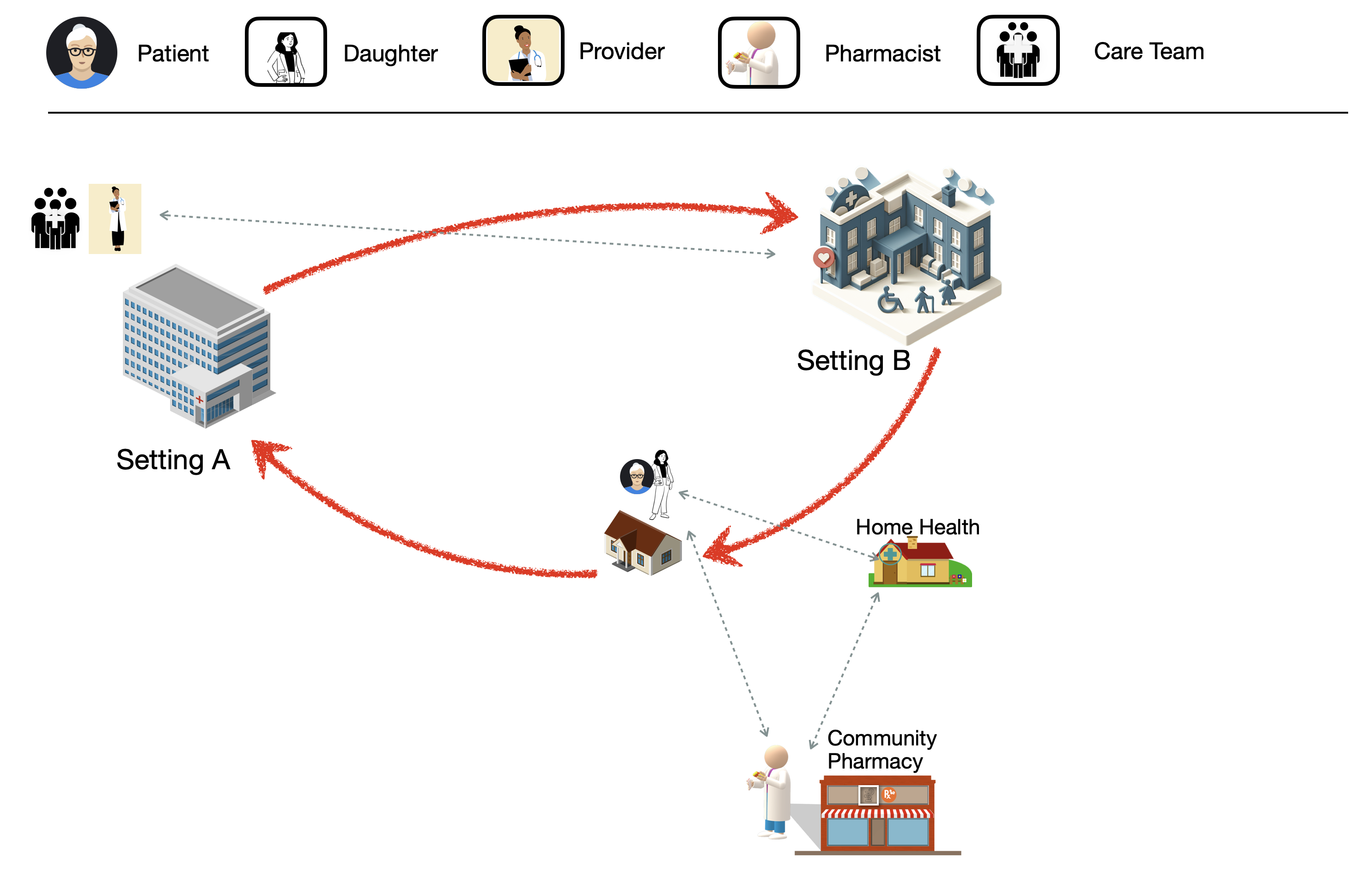
|