
NHS North West Genomics
0.1.0 - ci-build

NHS North West Genomics
0.1.0 - ci-build
NHS North West Genomics, published by NHS North West Genomics. This guide is not an authorized publication; it is the continuous build for version 0.1.0 built by the FHIR (HL7® FHIR® Standard) CI Build. This version is based on the current content of https://github.com/nw-gmsa/nw-gmsa.github.com/ and changes regularly. See the Directory of published versions
Most common method
graph LR
    OrderPlacer[<b>Order Placer</b><br/>EPR] --> |1. General Order<br/>HL7 v2 ORM_O01| OrderFiller
    OrderFiller[<b>Order Filler</b><br/>LIMS] --> |2. Laboratory Report<br/>HL7 v2 ORU_R01| OrderPlacer
graph LR
    OrderPlacer[<b>Order Placer</b><br/>EPR] --> |1. General Order<br/>HL7 v2 OML_O21<br/>IHE LTW LAB-1| OrderFiller
    OrderFiller[<b>Order Filler</b><br/>LIMS] --> |2. Laboratory Report<br/>HL7 v2 ORU_R01<br/>IHE LTW LAB-3| OrderPlacer
FHIR version of the HL7 v2 Message
graph LR
    OrderPlacer[<b>Order Placer</b><br/>EPR] --> |1. General Order<br/>HL7 FHIR Message O21| OrderFiller
    OrderFiller[<b>Order Filler</b><br/>LIMS] --> |2. Laboratory Report<br/>HL7 FHIR Message R01| OrderPlacer
Similar to the previous options but without the definition of payloads.
graph LR
    OrderPlacer[<b>Order Placer</b><br/>EPR] --> |HL7 FHIR RESTful transaction| OrderFiller
    OrderPlacer[<b>Order Placer</b><br/>EPR] --> |HL7 FHIR RESTful GET/POST/PUT| OrderFiller
    OrderFiller[<b>Order Filler</b><br/>LIMS] --> |HL7 FHIR RESTful transaction| OrderPlacer
    OrderFiller[<b>Order Filler</b><br/>LIMS] --> |HL7 FHIR RESTful GET/POST/PUT| OrderPlacer
chatty interface due to lookups (GET) needed for POST or PUT requests.graph LR
DataConsumer[<b>Data Consumer</b>] --> |HL7 FHIR RESTful GET<br/>read only| GenomicDataRepository[<b>Genomic Data Repository</b>]
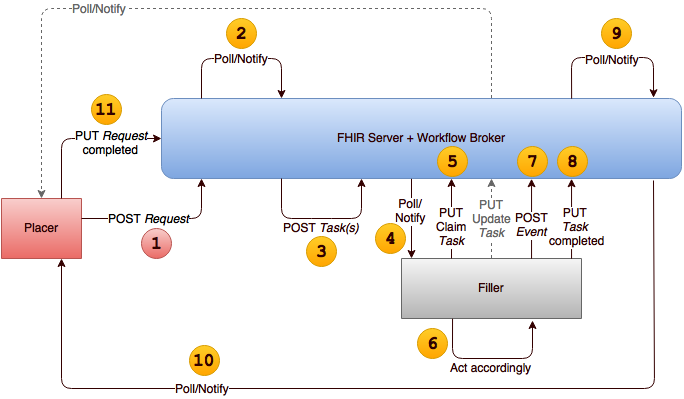
Is a modernisation of all the previous methods, full FHIR workflow requires both the Order Placer and Order Filler to have a FHIR Repository. Examples:
Note: FHIR workflow described is based on the same FHIR Workflow described in FHIR Genomics Implementation Guide - Interactions, in FHIR Worflow documentation this is known as Option H: POST of Task to a workflow broker
sequenceDiagram
    participant OrderPlacer As Order Placer
    participant OrderFiller As Order Filler

    OrderPlacer ->> OrderPlacer: Create OrderPlacer
    OrderPlacer ->> OrderFiller: DiagnosticRequest - Event Notification (FHIR Task (requested))
    OrderFiller ->> OrderPlacer: Retrieve Laboratory Order (FHIR RESTful API Query)
    alt is accepted
        OrderFiller ->> OrderPlacer: Task Diagnostic Request - Event Notification (FHIR Task (accepted))
        Note over OrderFiller: Starts Testing
         OrderFiller ->> OrderPlacer: Task Diagnostic Request - Event Notification (FHIR Task (in-progress))
        Note over OrderFiller: Interpretation of results and write Report
        OrderFiller ->> OrderPlacer: Task DiagnosticRequest - Event Notification (FHIR Task (completed))
        OrderPlacer ->> OrderFiller: Retrieve Laboratory Report (FHIR RESTful API Query)
    else is rejected
        OrderFiller ->> OrderPlacer: Task Diagnostic Request - Event Notification (FHIR Task (rejected))
    end
North West Genomics has used multiple interaction styles to populate the FHIR Repository. This is using a combination of all the above options.
At a high level there are two workflow styles:
Currently, the Health Information Exchange (HIE) is implemented as:
graph TD
    subgraph TIE[NHS Trust TIE]
        OrderPlacer[Order Placer] -->  V2Message1[HL7 V2 Message]
    end

    subgraph HIE[NW Genomics HIE]
        FHIRMessage[FHIR Message]
        V2Message[HL7 v2 Message]
        Transaction[RESTful Transaction and PUT/POST]
        FHIRRepository[FHIR Server/Repository]
        OrderFiller
    end
    V2Message1 --> |Transform to FHIR Message| FHIRMessage
    FHIRMessage--> |Transform to v2| V2Message

    FHIRMessage --> Transaction
    V2Message --> OrderFiller
    Transaction --> |FHIR Workflow Step 1, 2 and Step 3 inferred| FHIRRepository

    classDef pink fill:#F8CECC
    classDef blue fill:#DAE8FC;
    classDef grey fill:#F5F5F5;

    class OrderFiller grey;
    class OrderPlacer pink
    class FHIRRepository blue
The NHS Trust TIE:
The NW Genomics HIE:
For orders originating from Laboratory, the following process is suggested:
graph TD

    subgraph HIE[NW Genomics HIE]

        RetrieveOrder --> |"(c)"| V2Message1[HL7 v2 Message]
        V2Message1 --> OrderFiller[Order Filler]
        OrderFiller[Order Filler]
    end
    subgraph Lab["Workflow Broker (Medicus or NHS England) "]
        Step2[FHIR Workflow Step 4]
        FHIRRepository[FHIR Server/Repository]
    end
    Step2 --> |"Laboratory (a)"| RetrieveOrder[Retrieve Order]
    RetrieveOrder --> |"(b) HL7 FHIR RESTful Query"| FHIRRepository


    classDef pink fill:#F8CECC
    classDef blue fill:#DAE8FC;
    classDef grey fill:#F5F5F5;

    class OrderFiller grey;
    class OrderPlacer pink
    class FHIRRepository blue
The NW Genomics HIE:
A suggestion design for working with the NHS England Genomic Order Management Server (GOMS) is:
graph TD

    subgraph HIE[NW Genomics HIE]
       FHIRMessage[FHIR Message]
       ProcessMessage[Process Message]
       Transaction[RESTful Transactions and Queries]
    end

    subgraph GOMS[NHS England Genomic Order Management Service]
        FHIRRepository[FHIR Server/Repository]
    end

    FHIRMessage --> ProcessMessage
    ProcessMessage --> Transaction
    Transaction --> FHIRRepository
    ProcessMessage --> Step2[FHIR Workflow Step 2]
    Step2 --> |FHIR Workflow Step 3 - FHIR RESTful POST /Task| FHIRRepository

    classDef pink fill:#F8CECC
    classDef blue fill:#DAE8FC;
    classDef grey fill:#F5F5F5;

    class OrderFiller grey;
    class OrderPlacer pink
    class FHIRRepository blue
The NW Genomics HIE:
graph TD

    subgraph HIE[NW Genomics HIE]
        V2Message["HL7 v2 Message Laboratory Report (Step 7)"]
        Transaction[RESTful Transaction and PUT/POST]
        FHIRRepository[FHIR Server/Repository]
        Step10[FHIR Worflow Step 10]
    end
    subgraph TIE[NHS Trust TIE]
        OrderPlacer
        RetrieveReport
        V2Message1[HL7 V2 Message]
    end

    OrderFiller --> |Laboratory Report| V2Message
    V2Message["V2 Message (FHIR Workflow Step 7)"] --> Transaction
    Transaction --> |"FHIR Workflow Step 7 + 8 (inferred)"| FHIRRepository
    FHIRRepository --> Step10
    Step10[FHIR Worflow Step 10] --> |"(a)"| RetrieveReport[Retrieve Report]
    RetrieveReport --> |"(b) HL7 FHIR RESTful Query"| FHIRRepository
    RetrieveReport --> |"(c)"| V2Message1[HL7 v2 Message]
    V2Message1 --> OrderPlacer
    V2Message --> OrderPlacer

    classDef pink fill:#F8CECC
    classDef blue fill:#DAE8FC;
    classDef grey fill:#F5F5F5;

    class OrderFiller grey;
    class OrderPlacer pink
    class FHIRRepository blue
IG © 2024+ NHS North West Genomics. Package fhir.nwgenomics.nhs.uk#0.1.0 based on FHIR 4.0.1. Generated 2026-02-04
Links: Table of Contents |
QA Report
| New Issue | Issues
Version History |
 |
Propose a change
|
Propose a change