


Patient Monitoring Outcome FHIR Implementation Guide
0.1.0 - STU1
BE
Patient Monitoring Outcome FHIR Implementation Guide
0.1.0 - STU1
BE
Patient Monitoring Outcome FHIR Implementation Guide, published by HL7 Belgium. This guide is not an authorized publication; it is the continuous build for version 0.1.0 built by the FHIR (HL7® FHIR® Standard) CI Build. This version is based on the current content of https://github.com/hl7-be/patient-monitoring/ and changes regularly. See the Directory of published versions
Home hospitalization (also known as hospital-at-home) allows patients to receive complex medical treatments - traditionally reserved for an inpatient setting - within the comfort of their own homes.
As of July 1, 2023, home hospitalization in Belgium is a strictly regulated medical activity. The law mandates that the hospital remains the central director (regisseur) of the care.
Healthcare providers must understand that moving the patient to a home setting does not transfer the hospital’s liability. Specific protocols regarding medication monitoring, nurse presence, and digital reporting are now legally required to ensure patient safety and qualify for reimbursement.
To ensure compliance, all stakeholders must adhere to the regulations provided by the following three pillars:
The National Institute for Health and Disability Insurance (RIZIV) defines which treatments are eligible and how the coordination between the hospital and the patient must be structured.
The Federal Agency for Medicines and Health Products (FAGG) regulates the “pharmaceutical chain” and the specific substances allowed for home administration.
The “Omzendbrief” (Circular) provides the technical instructions that hospitals must follow to execute the law, specifically regarding the partnership with home nurses.
Legal Disclaimer: This template serves as an informative guide. For specific medical-legal disputes, always consult the full text of the Royal Decree of June 22, 2023, published in the Belgian Official Gazette.
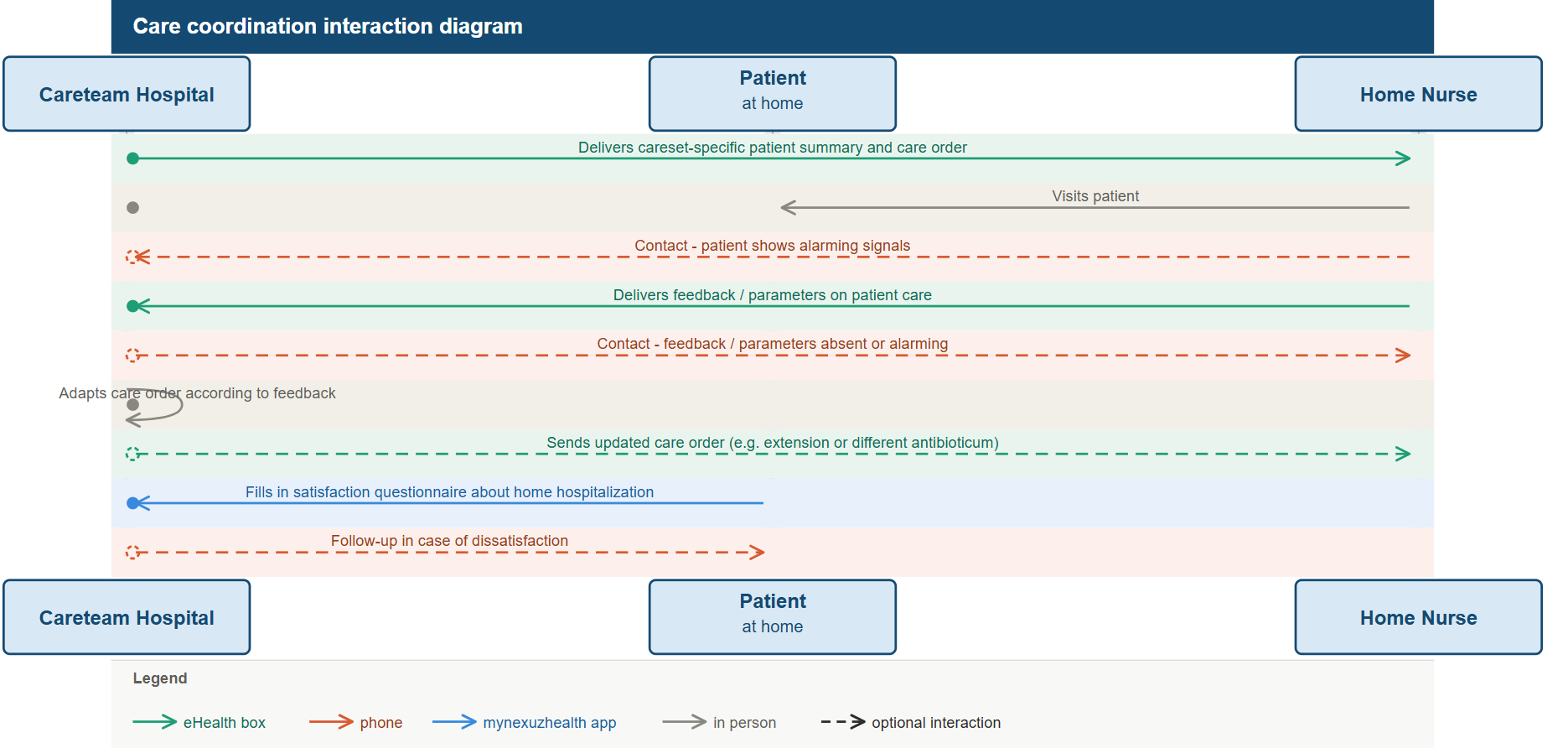
In multiple hospitals and 1st line organizations this home hospitalization framework has been technically implemented for the two most common care paths: OPAT (Outpatient Parenteral Antimicrobial Therapy) and Antitumoral Therapy (Oncology). This technical implementation made sure the clinical flows for both the hospital and 1st line are fully automated and both parties can work in their own EHR. This ensures real-time data exchange between the hospital and 1st-line providers (home nurses/GPs).
See OPAT Careset and Antitumoral Careset for more information about this technical implementation.
IG © 2024+ HL7 Belgium.
Package hl7.fhir.be.patient-monitoring#0.1.0 based on FHIR 4.0.1.
Generated
2026-05-18
Links: Table of Contents |
QA Report |
Version History |
