


Personal Health Records
1.0.0-ballot2 - STU 1 ballot

Personal Health Records
1.0.0-ballot2 - STU 1 ballot
Personal Health Records, published by HL7 International / Patient Empowerment. This guide is not an authorized publication; it is the continuous build for version 1.0.0-ballot2 built by the FHIR (HL7® FHIR® Standard) CI Build. This version is based on the current content of https://github.com/HL7/personal-health-record-format-ig/ and changes regularly. See the Directory of published versions
| Page standards status: Informative |
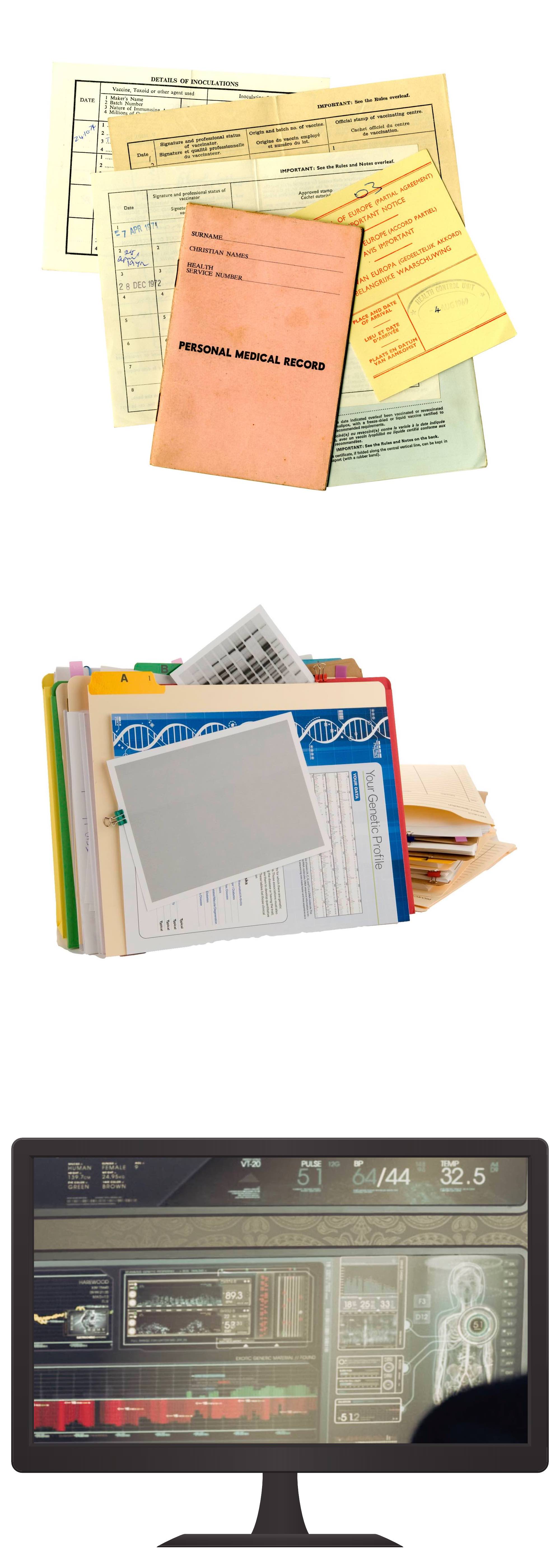
Medical records have been around for as long as there have been practicing physicians. An important precursor to modern standardized health records appeared in the seventeenth century with the Bills of Mortality of London, England. John Graunt's 1662 analysis of these records is generally regarded as the beginning of the statistical study of disease and mortality, and this tradition of classifying causes of death ultimately contributed to the development of the International Classification of Diseases (ICD).1 Later, advances in library and information science introduced increasingly systematic approaches to organizing and retrieving information, including Melvil Dewey's Decimal Classification, first published in 1876.2
The development of electronic digital computers accelerated dramatically during the Second World War. The British Colossus computers, developed at Bletchley Park and operational beginning in 1944, were among the earliest programmable electronic digital computers.3 ENIAC, completed in the United States in 1945, became the first general-purpose electronic digital computer.4 These developments laid the technological foundation for the later application of computers to information management.
By the 1960s, hospitals and academic medical centers were beginning to explore computerized management of clinical and administrative information. At Massachusetts General Hospital, G. Octo Barnett founded the Laboratory of Computer Science in 1964, where MUMPS (Massachusetts General Hospital Utility Multi-Programming System) was developed as a programming language and database environment for medical information systems.5 MUMPS subsequently became the technological foundation for numerous clinical information systems and electronic health record systems.5
Soon after, the personal computing revolution made computers available to individuals and small organizations. During the 1980s, inexpensive desktop and portable microcomputers increasingly became capable of storing and managing medical information outside traditional mainframe and minicomputer environments.6 Patients and technically inclined individuals likewise began experimenting with spreadsheets, databases, and small applications to organize personal information.
Meanwhile, clinical computing systems were proliferating within hospitals, creating an increasing need for systems from different vendors to exchange information. Health Level Seven (HL7) was founded in 1987 with the explicit goal of simplifying interfaces between healthcare computer applications from different and often competing vendors.7 HL7 Version 2 subsequently became one of the most widely deployed standards for exchanging clinical and administrative information between healthcare systems.8
Over time, experience implementing interfaces between heterogeneous systems demonstrated the value of more reusable and consistently defined interoperability interfaces. HL7 Fast Healthcare Interoperability Resources (FHIR) combined concepts developed in earlier HL7 standards with contemporary web technologies to simplify the development of interoperable healthcare applications.9
FHIR and related web-based interoperability approaches have since been widely adopted by healthcare organizations, technology vendors, and governments. In the United States, the 21st Century Cures Act and its implementing regulations significantly strengthened requirements for electronic health information access and interoperability. The ONC Cures Act Final Rule established standardized application programming interface (API) requirements intended to allow patients to securely access their electronic health information using applications of their choice.10 The standardized API certification criterion specifically adopted HL7 FHIR Release 4 and related implementation specifications for patient access.11
This changed legal and technical environment has created opportunities for a new ecosystem of applications, products, and services that incorporate patient health records. By 2022, more than two-thirds of U.S. hospitals reported using HL7 FHIR APIs to enable patient access to health information, illustrating the growing availability of standards-based interfaces through which patient-directed applications can obtain clinical data.12
World Health Organization. International Statistical Classification of Diseases and Related Health Problems, Tenth Revision (ICD-10), Volume 2: Instruction Manual, section 6.1, "Early history." https://iris.who.int/bitstream/handle/10665/42980/9241546530_eng.pdf ↩
Library of Congress. "Of Note: Registering the Dewey Decimal System at the Library of Congress." Unfolding History. https://blogs.loc.gov/manuscripts/2026/04/of-note-registering-the-dewey-decimal-system-at-the-library-of-congress/ ↩
The National Museum of Computing. "Colossus." https://www.tnmoc.org/colossus ↩
Stanford Encyclopedia of Philosophy. "The Modern History of Computing." https://plato.stanford.edu/entries/computing-history/ ↩
Massachusetts General Hospital Laboratory of Computer Science. "Our History." https://www.mgh-lcs.org/about/history ↩ ↩2
Ash SR, Ulrich DK. Portable and desktop microcomputers for patient care charting. Journal of Medical Systems. 1986;10(4):361–373. https://pubmed.ncbi.nlm.nih.gov/3783064/ ↩
Health Level Seven International. HL7 Version 2.9, Chapter 1: Introduction. https://hl7.eu/HL7v2x/v29/std29/ch01.html ↩
U.S. Department of Health and Human Services, Office of the Assistant Secretary for Planning and Evaluation. "Inventory of Health Care Information Standards." https://aspe.hhs.gov/reports/inventory-health-care-information-standards ↩
Health Level Seven International. "HL7 Backgrounder Brief." https://media.hl7.org/hl7-backgrounder-brief/ ↩
Office of the National Coordinator for Health Information Technology. "ONC's Cures Act Final Rule." https://healthit.gov/regulations/cures-act-final-rule/ ↩
Office of the National Coordinator for Health Information Technology. "Cures Act Final Rule: Standards-based Application Programming Interface (API) Certification Criterion." https://www.healthit.gov/sites/default/files/page2/2020-03/APICertificationCriterion.pdf ↩
Office of the National Coordinator for Health Information Technology. "Hospital Use of APIs to Enable Data Sharing Between EHRs and Apps." Data Brief No. 68, September 2023. https://healthit.gov/data/data-briefs/hospital-use-apis-enable-data-sharing-between-ehrs-and-apps/ ↩
IG © 2022+ HL7 International / Patient Empowerment.
Package hl7.fhir.uv.phr#1.0.0-ballot2 based on FHIR 4.0.1.
Generated
2026-10-09
Links: Table of Contents |
QA Report
| Version History |
 |
Propose a change