


US Core Implementation Guide
10.0.0-ballot - STU 10 Ballot

US Core Implementation Guide
10.0.0-ballot - STU 10 Ballot
US Core Implementation Guide, published by HL7 International / Cross-Group Projects. This guide is not an authorized publication; it is the continuous build for version 10.0.0-ballot built by the FHIR (HL7® FHIR® Standard) CI Build. This version is based on the current content of https://github.com/HL7/US-Core/ and changes regularly. See the Directory of published versions
| Page standards status: Trial-use |
This artifact is new for US Core Version 10.0.0-ballot
The U.S. Core Data for Interoperability (USCDI) Adverse Events Data Class comprises two Data Elements, Adverse Event Condition and Adverse Event Outcome. An adverse event condition is a change to a patient's condition that could be an unintended effect of a clinical intervention, such as a rash or a fever. An adverse event outcome is the resulting patient status or consequence following that change, such as hospitalization, recovery, recovery with sequelae, or death.
US Core does not define an AdverseEvent profile and does not use the FHIR AdverseEvent resource. Instead, this page documents how the information the two Data Elements describe is already recorded by existing US Core Profiles, and which profiles to look in.
The distinction this page draws is between two different activities that the same incident can give rise to:
USCDI v7 scopes the Adverse Events Data Class to the first of these. It explicitly excludes the exchange of patient safety analyses, internal risk management documentation, and patient safety work products as defined under the Patient Safety and Quality Improvement Act of 2005 and its implementing regulations, and it excludes Patient Safety Organization investigations, safety reviews, and facility-level reporting activities. US Core follows that boundary: nothing on this page concerns patient safety work product, and no US Core Profile is intended to carry it.
Two consequences follow for implementers:
The following US Core Profiles shown in the figure below record the information the two Data Elements describe. The profiles overlap: the same incident may be recorded in more than one of them, and which one a system uses depends on how the clinician documented it.
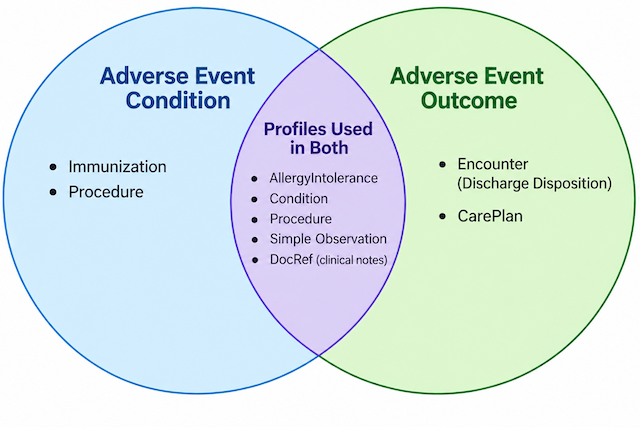
Adverse Event Condition can be recorded by the profiles listed below, and by:
Immunization.reaction, for a reaction following an immunizationAdverse Event Condition and Adverse Event Outcome can be recorded by:
AllergyIntolerance.reaction.manifestation, for a reaction to a substance the patient is sensitive toAdverse Event Outcome can be recorded by the profiles above, and by:
Encounter.hospitalization.dischargeDisposition, where an outcome such as hospitalization or death is recorded as part of the encounterNote the overlap with the USCDI Allergies and Intolerances Data Class. AllergyIntolerance.reaction records a known patient sensitivity and the manifestations it produces; the Adverse Events Data Class describes an occurrence associated with a specific clinical intervention. The same manifestation can appear in both contexts, recorded in the same element.
USCDI names SNOMED CT as an applicable vocabulary standard for Adverse Event Condition. It names no vocabulary standard for Adverse Event Outcome. US Core places no additional binding on any element for this Data Class beyond what the profiles above already require, so the terminology for each element is the terminology that profile already specifies.
This guidance page is a draft for this ballot. Further editing and examples are still pending.
IG © 2027+ HL7 International / Cross-Group Projects. Package hl7.fhir.us.core#10.0.0-ballot based on FHIR 4.0.1. Generated 2026-10-20
Links: Table of Contents |
QA Report
| Version History |
 |
Propose a change