

DK MedCom EKG
2.0.1 - release

DK MedCom EKG
2.0.1 - release
DK MedCom EKG, published by MedCom. This guide is not an authorized publication; it is the continuous build for version 2.0.1 built by the FHIR (HL7® FHIR® Standard) CI Build. This version is based on the current content of https://github.com/medcomdk/dk-medcom-ekg/ and changes regularly. See the Directory of published versions
| Official URL: http://medcomfhir.dk/ig/ekg/ImplementationGuide/medcom.fhir.dk.ekg | Version: 2.0.1 | |||
| Active as of 2026-10-01 | Computable Name: DKMedComEKG | |||
The EKG project has been established with the overall objective of supporting secure, consistent, and nationwide sharing of electrocardiograms (EKGs) across healthcare providers. Today, EKGs are recorded both in general practice and in regional healthcare settings, and there is a clinical and organizational need to make these EKGs accessible across sectors, regardless of the originating system.
As part of the project, it has been decided that EKGs recorded in general practice and regional healthcare services shall be shared as PDF documents. This approach has been chosen to ensure a pragmatic and widely applicable solution that can be supported by existing clinical IT systems while preserving the correct visual representation of the EKG.
Sharing of EKGs will take place via the National Service Platform (NSP) using the Document Sharing Service (DDS), which is already used for national sharing of healthcare documents and thus provides a proven and secure infrastructure.
The FHIR standard will ensure consistent structuring of metadata and clinically relevant information, enabling EKGs to be searched, interpreted, and used correctly by receiving systems and clinicians.
The structure of an EKG Recording is depicted on the following diagram:
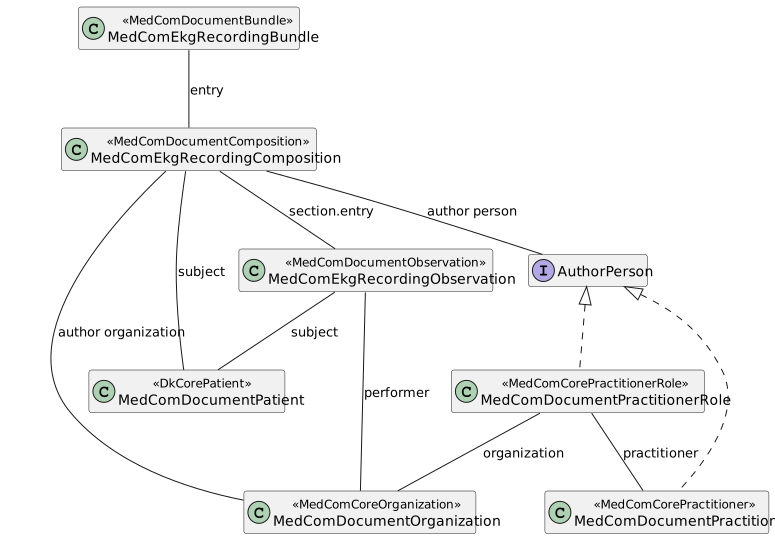
The figure shows the structure of an EKG Recording. It represents the structure and references of a MedCom EKG Recording document Bundle, including the relationships between Bundle, Composition, Observation, Patient, Organization, Practitioner, PractitionerRole, and AuthorPerson.
The Bundle serves as the container for all resources included in the message. All resources are included as entries in the Bundle, and all references between resources are resolved internally within the same Bundle.
The first entry in the Bundle is the Composition, and defines the overall clinical and structural context of the message. The Composition references the Observation resource as its content entry.
In addition to Composition and Observation, the Bundle includes the Patient, Organization, PractitionerRole, and Practitioner resources. These resources provide the clinical subject and the organizational and professional context of the message. The use of PractitionerRole and Practitioner is optional.
The EKG Recording standard follows the general MedCom FHIR Document model.
The IG is designed to represent a complete EKG recording in FHIR, provided as a PDF document with the option to add a note. This note will typically provide guidance to the recipient regarding conditions or details that may have influenced the EKG recording.
In the MedCom Terminology IG all referenced MedCom Terminology code systems and value sets developed by MedCom can be found.
In the MedCom Terminology for XDS Metadata all MedCom code systems and value sets related to metadata can be found.
Note that the IG versions linked may be newer than the versions used as dependencies in this implementation guide. For the exact dependency versions applied, see the Dependencies tab in the top menu under More.
Besides Terminology and metadata IGs, this IG has a dependency to the MedCom Core IG, DK-core, defined by HL7 Denmark, MedCom Document IG, and IHE MHD. Note that the IG versions linked may be newer than the versions used as dependencies in this implementation guide. For the exact dependency versions applied, see the Dependencies tab in the top menu under More.