
xShare Project CarePlan
0.1.0 - qa-preview
150
xShare Project CarePlan
0.1.0 - qa-preview
150
xShare Project CarePlan, published by xShare Project. This guide is not an authorized publication; it is the continuous build for version 0.1.0 built by the FHIR (HL7® FHIR® Standard) CI Build. This version is based on the current content of https://github.com/hl7-eu/xshare-careplan/ and changes regularly. See the Directory of published versions
The data domain describes the Care Plan data model and the FHIR content specifications used to exchange it.
This page brings together the conceptual, logical and implementable content artefacts defined by this guide. It explains how the Care Plan is structured at the information-model level and how that structure is represented using HL7 FHIR.
The Care Plan content model is organised around the information needed to coordinate care over time:
The logical model is intentionally close to the business and application views described elsewhere in this guide. It separates care planning concepts from the technical FHIR representation so that the information model can be reviewed independently from a specific implementation profile.
Conceptually, a Care Plan is a structured coordination object. It connects the patient, the responsible care team, the clinical context, the agreed goals, and the activities that should be performed or have already been performed.
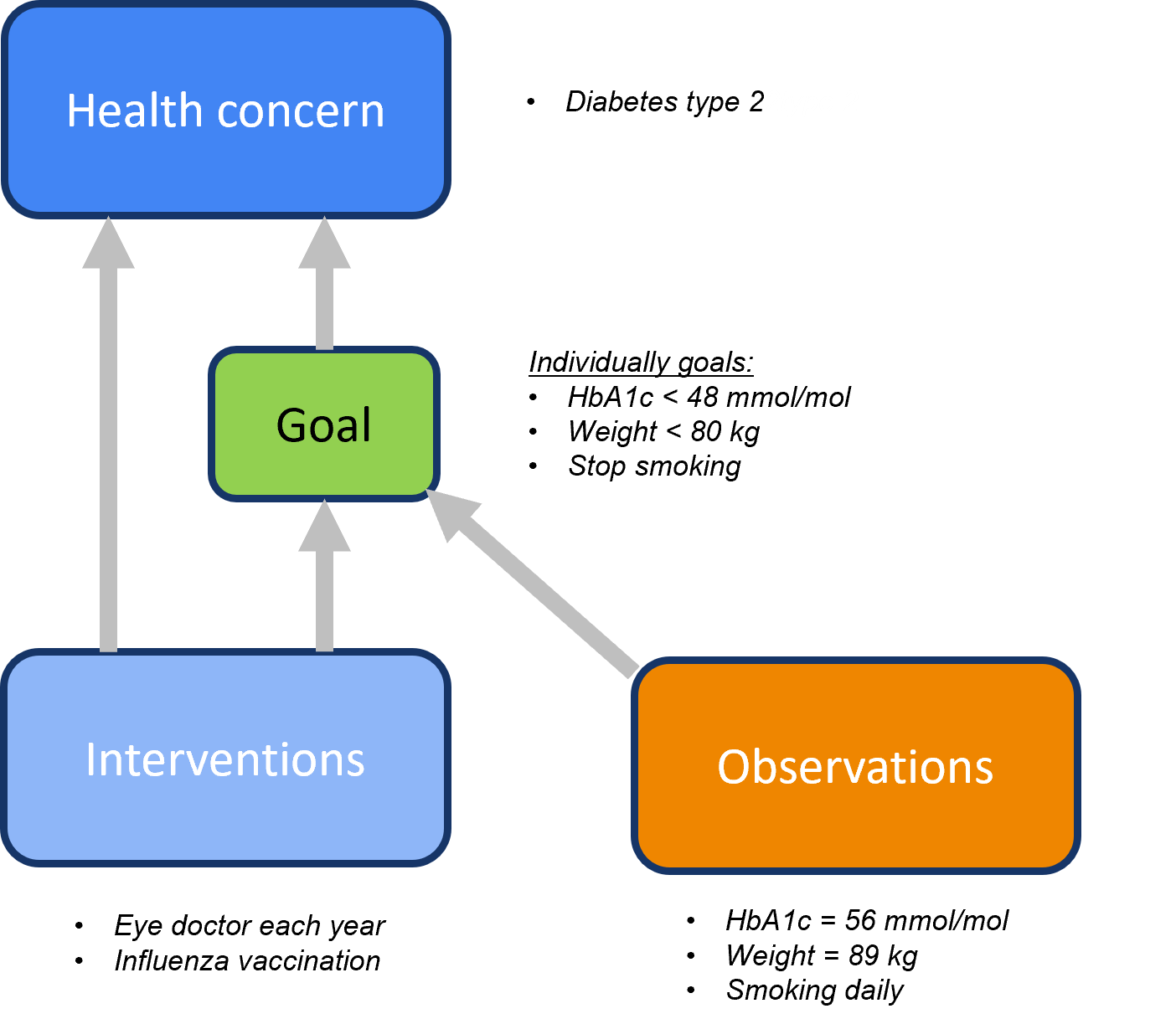
The model supports professional, patient-facing and organisational use cases:
The conceptual view is refined into the logical model described below. The Conceptual to Logical Model Mapping page provides a focused view of how selected conceptual elements, such as patient information, addressed conditions, goals and activities, are represented in the logical model.
The Care Plan logical model defined by this guide refines the Care Plan conceptual model and is based on EHDSDataSet. It represents the care plan as an information structure with header metadata, patient context, care team participation, addressed conditions, goals, supporting information, planned or performed activities, and activity or goal outcomes.
The model adds care-plan-specific structure by:
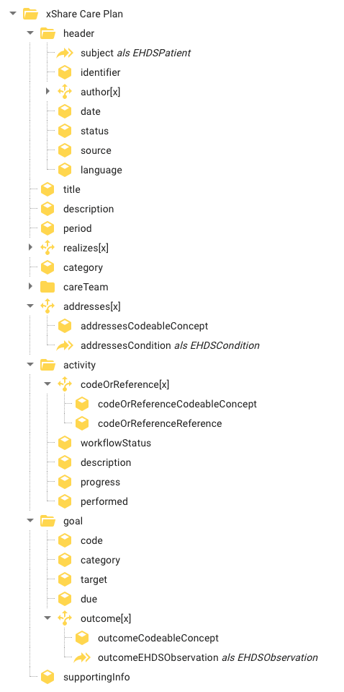
This is a first proposal for review and further refinement. Implementers should treat it as a working model intended to support alignment, not as a frozen semantic specification.
An element-by-element forward mapping has been specified between the Care Plan logical model and the associated HL7 FHIR profiles. Details are provided in the Logical to HL7 FHIR Profile model map page.
The implementable representation uses the xShare Care Plan profile, a profile on the FHIR R4 CarePlan resource. Goals referenced by the Care Plan are represented using the xShare Goal profile, a profile on the FHIR R4 Goal resource.
The Care Plan profile keeps CarePlan as the coordination resource. Some activity details are represented through referenced resources rather than through CarePlan.activity.detail, which is constrained out to support alignment with later FHIR versions where the CarePlan activity structure changes.
The primary content artefacts in this guide are:
| Artefact | Purpose |
|---|---|
| Conceptual to Logical Model Mapping | Shows how selected Care Plan conceptual elements are represented in the logical model. |
| Care Plan logical model | Defines the source information model for the Care Plan domain. |
| xShare Care Plan profile | Defines the implementable FHIR CarePlan representation. |
| xShare Goal profile | Defines the implementable FHIR Goal representation used for care plan goals. |
| Logical to HL7 FHIR Profile model map | Explains how logical model elements map to FHIR resources and elements. |
IG © 2025+ xShare Project. Package hl7.eu.fhir.xshare-careplan#0.1.0 based on FHIR 4.0.1. Generated 2026-06-08
