



EU Health Data API
1.0.0-ballot - ballot
150
EU Health Data API
1.0.0-ballot - ballot
150
EU Health Data API, published by HL7 Europe. This guide is not an authorized publication; it is the continuous build for version 1.0.0-ballot built by the FHIR (HL7® FHIR® Standard) CI Build. This version is based on the current content of https://github.com/euridice-org/eu-health-data-api/ and changes regularly. See the Directory of published versions
Cross-border health-data exchange routes through National Contact Points for eHealth (NCPeHs), called NCPs below, over the MyHealth@EU infrastructure (Art. 23(2)). When a patient from Country A receives care in Country B, the requesting EHR in Country B queries its national infrastructure. The request passes through the two countries' NCPs to Country A's national infrastructure, which obtains the data from the holding EHR and returns it along the chain.
National infrastructure connects EHR systems with their NCP in each country. It represents a logical grouping of services, such as gateways, registries and repositories, rather than a single system. Its organization and routing vary by Member State; see Member State Architectures and Cross-Organization via National Infrastructure.
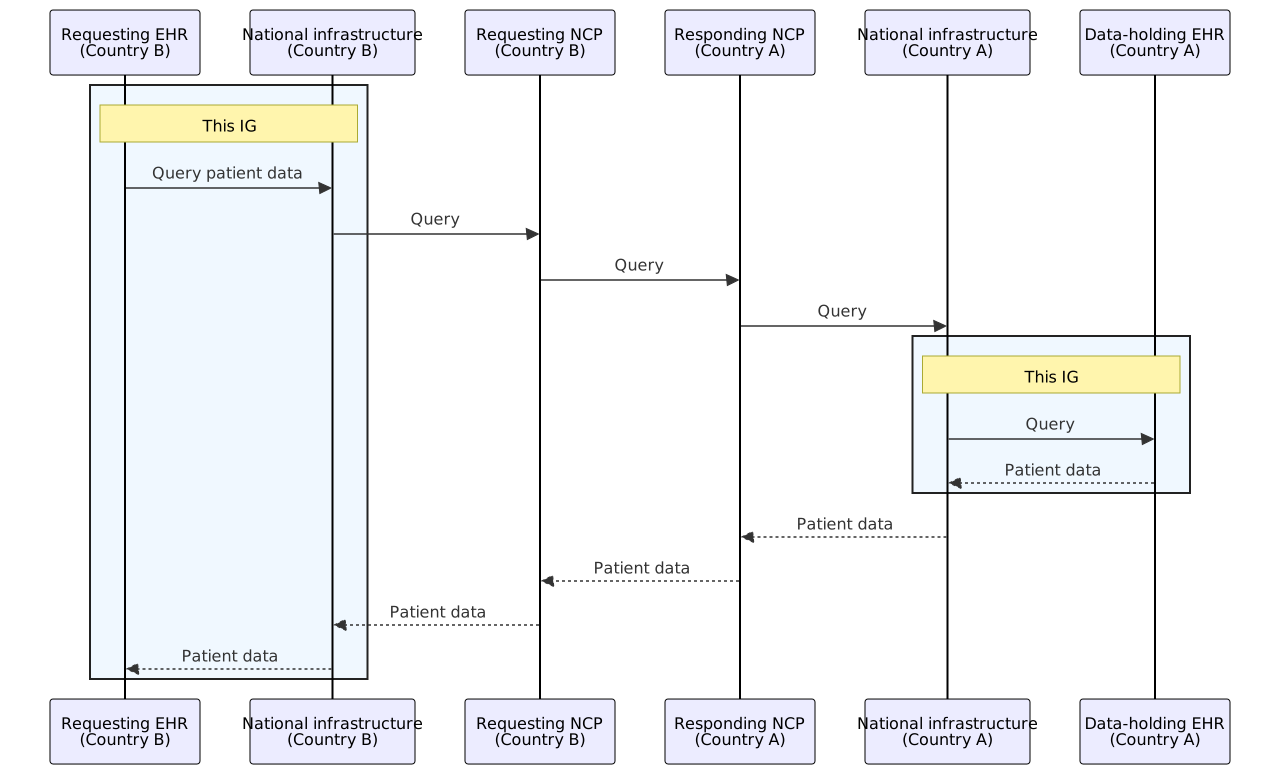
The diagram illustrates the query and response path. National infrastructure is simplified on both sides; deployments may combine components or connect an EHR directly to its NCP. Formats and protocols may differ between interfaces, with translation performed by national services or gateways.
This implementation guide targets the EHR-facing queries highlighted in the diagram:
NCP-to-NCP exchange follows the NCPeH API specification. Interfaces within national infrastructure are defined by Member States.
This example illustrates query and retrieve; other interaction patterns, such as push-based exchange, are not shown.
Cross-border patient consent, health-professional authentication in the requesting country, and authorization at the NCP and national-infrastructure layers are governed by MyHealth@EU and Member State infrastructure — not by this IG. At the highlighted API boundaries, the consumer is an authorized EHR system or national-infrastructure component; how that authorization was established is out of scope here.
At those API boundaries, the consumer is the Health Data API Authorization Client, and the protected EHR endpoint is the Health Data API Resource Server. The Health Data API Authorization Server is a distinct participant.
The final infrastructure-to-EHR hop is separate from NCP-to-NCP exchange. For MyHealth@EU, authorization remains outside this IG; Authorization recommends alignment with IHE IUA. This use case does not select an authorization flow for MyHealth@EU; applicable MyHealth@EU and deployment requirements govern its participants and prerequisites. For a separate National Interoperability Infrastructure hop, IHE IUA is recommended only under the conditions in Authorization. If selected, the generic roles are realized by the IHE IUA Authorization Client, IHE IUA Resource Server, and a distinct IHE IUA Authorization Server; the client obtains a token with ITI-71 and presents it with ITI-72. Any MHD transaction scope depends on the supported interaction and deployment. This use case does not select an IUA transaction or flow for a particular endpoint. The NCPeH API remains the specification for NCP-to-NCP exchange. Cross-border patient consent, health-professional authentication in the requesting country, and authorization at the NCP and national-infrastructure layers are governed by MyHealth@EU and Member State infrastructure. At the EHR-facing API boundaries, the consumer is an authorized EHR system or national-infrastructure component; how that authorization was established is outside the scope of this example.
IG © 2025+ HL7 Europe.
Package hl7.fhir.eu.health-data-api#1.0.0-ballot based on FHIR 4.0.1.
Generated
2026-11-05

