WHO SMART Trust
1.7.5 - ci-build

WHO SMART Trust
1.7.5 - ci-build
WHO SMART Trust, published by WHO. This guide is not an authorized publication; it is the continuous build for version 1.7.5 built by the FHIR (HL7® FHIR® Standard) CI Build. This version is based on the current content of https://github.com/WorldHealthOrganization/smart-trust/ and changes regularly. See the Directory of published versions
This specification describes the publication of Global Digital Health Certification Network (GDHCN) key material as Decentralized Identifier (DID) documents. DIDs are specified by the W3C DID Core Specification. The DID concept summarizes the core drivers and usage of the DID format in scope of GDHCN.
A key to real interoperability among existing trust networks is to find alignment on trust list formats.
| Version | Status | Description |
|---|---|---|
| 2.0.0 | Draft | 2.0.0 is in pre-released state for verification and feedback. On technical level in the API "v2" is used to address DID documents following version two specification |
| 1.0.0 | Released | 1.0.0 is deprecated and will be replaced by version 2.0.0 |
Version 2.0.0 introduces two variants of the trust lists - embedded and by reference.
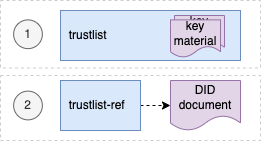
For each of development (DEV), user-acceptence testing (UAT) and production (PROD) environments there is a trust list according to the following table:
| Environment | Variant | URL |
|---|---|---|
| DEV | Embedded | https://tng-cdn-dev.who.int/v2/trustlist/did.json |
| DEV | Reference | https://tng-cdn-dev.who.int/v2/trustlist-ref/did.json |
| UAT | Embedded | https://tng-cdn-uat.who.int/v2/trustlist/did.json |
| UAT | Reference | https://tng-cdn-uat.who.int/v2/trustlist-ref/did.json |
| PROD | Embedded | https://tng-cdn.who.int/v2/trustlist/did.json |
| PROD | Reference | https://tng-cdn.who.int/v2/trustlist-ref/did.json |
The embedded type of trustlist carries the key material directly within the DID documents' verificationMethod property and supports immediate verification. On the root level it contains all keys imported from the trust network gateway (TNG).
The reference type lists link other DID documents, which may contain the actual key material. Therefore reference type trustlists contain only DID ids that can be used to resolve DID documents. This helps to keep the main trustlist documents concise and supports dynamic discovery of DID structures and key material.
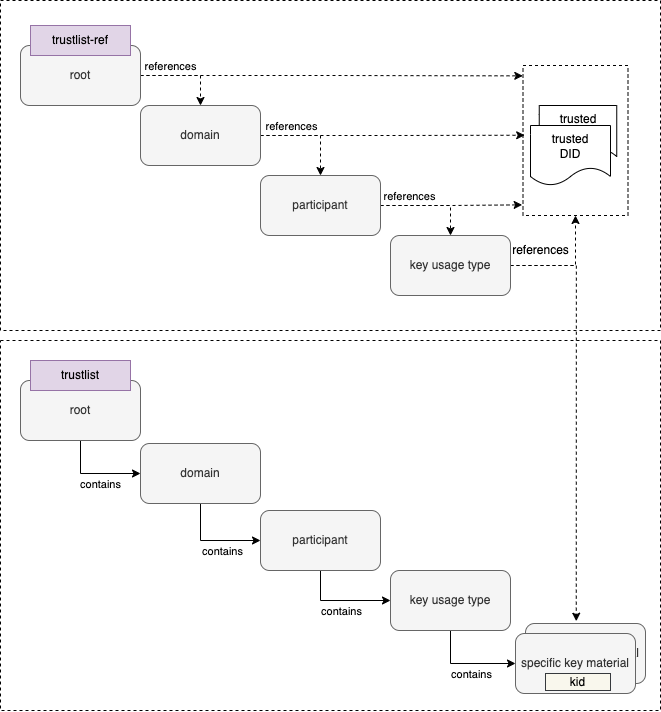
Version 2.0.0 introduces a hierarchical structure for DID documents, to support more fine grained resolution and discovery of key material. These DID documents are parameterized by the following according to the levels in the following table.
| Level | Description |
|---|---|
| root | A fixed parameter for all trusted key material or trusted DID references of GDHCN. |
| $domain | Contains trusted key material or DID references of GDHCN for a supported trust domain. $domain should be one of the codes in the GDHCN Trust Domain Value Set. |
| $participant | Contains trusted key material or DID references of GDHCN for a trusted participant. $participant should be one of the codes in the GDHCN Participant Value Set. |
| $usage | Contains trusted key material or DID references of a supported key usage type. $usage type is one of the key usages codes in the GDHCN Key Usage Value Set. |
The levels are organized hierarchically so that they function as filters following an AND logic operation when resolving or discovering key material. Note that "-" character can be used as a wildcard on each sublevel of root. This allows to omit filtering on the respective level effectively matching all content of that level.
The following examples outline the expected behavior of embedded trustlist:
And the following examples outline the expected behavior of reference type trustlist:
Note: all levels of the reference type trustlist may contain additional DID references linking trusted external DID documents.
The did trustlists structure diagram depicts the reference and contains relations of the trustlist types for the defined levels.
Reference type DID document linking the embedded trustlist for $domain: DCC, $participant: XXA and key $usage type: DSC.
{
    "@context": [
        "https://www.w3.org/ns/did/v1",
        "https://w3id.org/security/suites/jws-2020/v1"
    ],
        "id": "did:web:worldhealthorganization.github.io:tng-cdn-dev:v2:trustlist-ref:DCC:XXA:DSC",
        "controller": "did:web:worldhealthorganization.github.io:tng-cdn-dev:v2:trustlist-ref:DCC:XXA",
        "verificationMethod": [
        "did:web:worldhealthorganization.github.io:tng-cdn-dev:v2:trustlist:DCC:XXA:DSC"
    ],
        "proof": {
        "type": "JsonWebSignature2020",
            "created": "2024-11-10T12:00:35Z",
            "nonce": "SC56sBBcqqTXh0EPdFlaOWDXxSpwupVa",
            "proofPurpose": "assertionMethod",
            "verificationMethod": "did:web:raw.githubusercontent.com:WorldHealthOrganization:tng-participants-dev:main:WHO:signing:DID",
            "jws": "eyJiNjQiOmZhbHNlLCJjcml0IjpbImI2NCJdLCJhbGciOiJFUzI1NiJ9..MEQCICxoXFEI-o0SupgO0U5BhKjRI1AZaAtAtw_byQMgLm6CAiBTtyJYF7ZMgWTlmivMv5A4In3K6LBEF0AXiCYM2VSSIg"
    }
}
Embedded trustlist for $domain: DCC, $participant: XXA and key $usage type: DSC with key matrial:
{
  "@context": [
    "https://www.w3.org/ns/did/v1",
    "https://w3id.org/security/suites/jws-2020/v1"
  ],
  "id": "did:web:worldhealthorganization.github.io:tng-cdn-dev:v2:trustlist:DCC:XXA:DSC",
  "controller": "did:web:worldhealthorganization.github.io:tng-cdn-dev:v2:trustlist:DCC:XXA",
  "verificationMethod": [
    {
      "id": "did:web:worldhealthorganization.github.io:tng-cdn-dev:v2:trustlist:DCC:XXA:DSC#XPjhL9Znd1M=",
      "type": "JsonWebKey2020",
      "controller": "did:web:worldhealthorganization.github.io:tng-cdn-dev:v2:trustlist:DCC:XXA",
      "publicKeyJwk": {
        "kty": "EC",
        "kid": "XPjhL9Znd1M=",
        "x5c": [
          "MIICuTCCAmCgAwIBAgIUD9k1Q64Eav5r07DQ4Gff/7h7r6QwCgYIKoZIzj0EAwIwdDELMAkGA1UEBhMCWEExFDASBgNVBAgMC1hYQSBDb3VudHJ5MRgwFgYDVQQHDA9YQSBDYXBpdG9sIENpdHkxDDAKBgNVBAoMA1dITzEMMAoGA1UECwwDUiZEMRkwFwYDVQQDDBBOYXRpb25YQV9UTlBfU0NBMB4XDTI0MDgwMjEzNDM0M1oXDTI2MDgwMjEzNDM0M1owfzELMAkGA1UEBhMCWEExFDASBgNVBAgMC1hYQSBDb3VudHJ5MRgwFgYDVQQHDA9YQSBDYXBpdG9sIENpdHkxDDAKBgNVBAoMA1dITzEMMAoGA1UECwwDUiZEMSQwIgYDVQQDDBtIZWFsdGggQWRtaW5pc3RyYXRpb24gb2YgWEEwWTATBgcqhkjOPQIBBggqhkjOPQMBBwNCAAT3TVbWYsSYYarCUv8sfvmv2y0GjDEI+PAkm/92na/zAOoV8O2w7rov/Txk3wwz/jMoKvx+IgSfYoyygtGetYEdo4HEMIHBMA4GA1UdDwEB/wQEAwIHgDAdBgNVHQ4EFgQUhjRj4qGi0+rt7ka7GLiol6q2+78wHwYDVR0jBBgwFoAUoir+zkKsSL7OkG8dPyThX49GLtEwPQYDVR0fBDYwNDAyoDCgLoYsaHR0cDovL2NybC5leGFtcGxlZG9tYWluLmV4YW1wbGUvQ1JML1NDQS5jcmwwMAYDVR0lBCkwJwYLKwYBBAGON49lAQEGCysGAQQBjjePZQECBgsrBgEEAY43j2UBAzAKBggqhkjOPQQDAgNHADBEAiATU7uopFD4U3mLHHQn+0ncg4gb5ZazhhrXMXwzAD4NbgIgd3jcskFPyOoBGut8oyXu+nKYKr5zFCqmXkYlILqCo6Q=",
          "MIICMDCCAdWgAwIBAgIUFqWc0xbrcpAettDF8gEymTzDtSkwCgYIKoZIzj0EAwIwdDELMAkGA1UEBhMCWEExFDASBgNVBAgMC1hYQSBDb3VudHJ5MRgwFgYDVQQHDA9YQSBDYXBpdG9sIENpdHkxDDAKBgNVBAoMA1dITzEMMAoGA1UECwwDUiZEMRkwFwYDVQQDDBBOYXRpb25YQV9UTlBfU0NBMB4XDTI0MDgwMjA3MTY0MVoXDTI4MDgwMjA3MTY0MVowdDELMAkGA1UEBhMCWEExFDASBgNVBAgMC1hYQSBDb3VudHJ5MRgwFgYDVQQHDA9YQSBDYXBpdG9sIENpdHkxDDAKBgNVBAoMA1dITzEMMAoGA1UECwwDUiZEMRkwFwYDVQQDDBBOYXRpb25YQV9UTlBfU0NBMFkwEwYHKoZIzj0CAQYIKoZIzj0DAQcDQgAEeKTWEuRQ4ftDRaTBA6++wea8ODmEqCLE/nWTcvcX069g3YlWEokVgEIMEumXcez++bcIayhRYDi4itAqd5DmJ6NFMEMwEgYDVR0TAQH/BAgwBgEB/wIBADAOBgNVHQ8BAf8EBAMCAQYwHQYDVR0OBBYEFKIq/s5CrEi+zpBvHT8k4V+PRi7RMAoGCCqGSM49BAMCA0kAMEYCIQC2+Bl6No20L/uSxr4bJSPDAAJ37UhhH52ppOElxB1dqgIhANbn1ZF0DNWYyH+eKBTrY+14zbzhDxlXWh/Go1OM9ZZ/"
        ],
        "crv": "P-256",
        "x": "APdNVtZixJhhqsJS_yx--a_bLQaMMQj48CSb_3adr_MA",
        "y": "AOoV8O2w7rov_Txk3wwz_jMoKvx-IgSfYoyygtGetYEd"
      }
    }
  ],
  "proof": {
    "type": "JsonWebSignature2020",
    "created": "2024-11-10T12:00:21Z",
    "nonce": "Gp3uOuUTNgAFxm31fIjNy7yYt34aOP0g",
    "proofPurpose": "assertionMethod",
    "verificationMethod": "did:web:raw.githubusercontent.com:WorldHealthOrganization:tng-participants-dev:main:WHO:signing:DID",
    "jws": "eyJiNjQiOmZhbHNlLCJjcml0IjpbImI2NCJdLCJhbGciOiJFUzI1NiJ9..MEYCIQD8AbUnGxHgmkqNQTzl6E0ZJocZ0N-vrziFB9-jgRSXbgIhAJUB0Wq5YUJPcywS15JMdoiVJDV_ubWuEZwRnuM5A8QB"
  }
}
Note: Specific keys use base64 encoded key id (kid) as identifier, It is represented as fragments (#) in verification method id and can be resolved using client side filtering.
Every trust list DID document, embedded or reference, carries a proof. The proof is a JSON Web Signature 2020 Linked Data Proof made with WHO's signing key for the environment. A verifier MUST check this proof before it trusts any key or reference the document lists, and MUST refuse a document whose proof does not verify. Fetching a document over HTTPS from the host its DID names does not replace this check, because a cache or mirror may serve the document.
Note: the example documents above predate the current format. Documents published today also carry the environment's tng-context in @context (for example https://smart.who.int/trust/tng-context/v1-DEV.jsonld), and each verification method also has domain, participant and keyusage members, each an object with a single code.
The signer. proof.verificationMethod names the signer's DID. A verifier MUST compare it with the signer DID it trusts for the environment, configured in advance. A proof that verifies against some other DID establishes nothing.
| Environment | Signer DID |
|---|---|
| DEV | did:web:raw.githubusercontent.com:WorldHealthOrganization:tng-participants-dev:main:WHO:signing:DID |
| UAT | to be confirmed |
| PROD | to be confirmed |
The signer's DID document has one verification method. Its id is the signer DID, its type is JsonWebKey2020, and its publicKeyJwk is an EC P-256 key, so alg is ES256 if present.
The JSON-LD contexts. The proof signs the RDF form of the document, so the signature depends on the exact content of every JSON-LD context. A verifier MUST process the documents with the copies below, held locally. It MUST NOT dereference the context URLs at verification time: if a published copy changed, the same JSON would produce different signed bytes.
| Context URL | Content used by the signer |
|---|---|
https://www.w3.org/ns/did/v1 |
W3C DID v1 context, sha256 4f3eae5568c9c5f036a082088f9e192019ee06faa78973c87ff91d5421b88dad |
https://w3id.org/security/suites/jws-2020/v1 |
JWS 2020 suite context, sha256 d648e05ddc6577827ca2bfd5e931f53e9ebc6e52a57a8da81df4ec8c46ffcd1e |
https://smart.who.int/trust/tng-context/v1-DEV.jsonld, v1-UAT.jsonld, v1.jsonld |
tng-context/v1-DEV.jsonld, v1-UAT.jsonld, v1.jsonld, as published by this guide |
https://w3id.org/security/v3 (proof options only) |
security v3 context as bundled in ld-signatures-java 1.11.0 (security-v3-unstable.jsonld), sha256 311be32772d8e42f96c1a6ae899e3fa15efb06c27cfd207d86e8abb9951a3e74 |
The tng-context maps domain, participant and keyusage to ValueSet IRIs and code to @id. As a result, the codes become IRIs in the signed form, and the same key canonicalizes differently in each environment.
The JWK. In the JsonWebKey2020 context, publicKeyJwk is a JSON literal (@json). It enters the signed form as its RFC 8785 canonical JSON. The members of a trust list JWK are strings or arrays of strings: kty, kid, crv, x, y, n, e and x5c. Because of this, no number formatting arises in the canonical form. A verifier MAY refuse a JWK that has any other kind of member value.
The algorithm.
proof from the document. Canonicalize the rest with RDF Dataset Canonicalization (URDNA2015), using the contexts above, and serialize the result as canonical N-Quads.proof without jws as the proof options, with @context set to https://w3id.org/security/v3. Canonicalize and serialize the options the same way.SHA-256(proof options N-Quads) || SHA-256(document N-Quads).proof.jws is a detached JWS (RFC 7515 Appendix F) with unencoded payload (RFC 7797). Its protected header is exactly {"b64":false,"crit":["b64"],"alg":"ES256"}. Verify the ES256 signature over ASCII(BASE64URL(header)) || '.' || signing input, with the signer's key.SEQUENCE { r, s } (70–72 bytes). RFC 7518 §3.4 requires the 64-byte r || s, and correcting the signer is tracked in tng-key-distribution#85. Until the signer is corrected, verifiers SHOULD accept either form, and SHOULD parse DER strictly.Canonical N-Quads sort lines by Unicode code point. Java's string order (UTF-16 code units) differs only for characters above U+FFFF, and no trust list document contains any. A verifier MAY refuse a document with such characters rather than guess the order.
A worked example, with its canonical N-Quads, the signing input and two independent verifier implementations, is maintained in litlfred/smart-trust-tools (requirement STT-TRU-006).
The trustlists are maintained using GitHub and published via GitHub pages.
| Environment | Repository Link | Pages Link |
|---|---|---|
| Development | https://github.com/WorldHealthOrganization/tng-cdn-dev | https://worldhealthorganization.github.io/tng-cdn-dev |
| UAT | https://github.com/WorldHealthOrganization/tng-cdn-uat | https://tng-cdn-uat.who.int |
| Production | tbd. | https://tng-cdn.who.int |
Initial specification is deprecated.
