


Pharmaceutical Quality (Industry)
1.0.0 - STU1

Pharmaceutical Quality (Industry)
1.0.0 - STU1
Pharmaceutical Quality (Industry), published by HL7 International / Biomedical Research and Regulation. This guide is not an authorized publication; it is the continuous build for version 1.0.0 built by the FHIR (HL7® FHIR® Standard) CI Build. This version is based on the current content of https://github.com/HL7/uv-dx-pq/ and changes regularly. See the Directory of published versions
Stability studies are critical for establishing the shelf-life and storage conditions of pharmaceutical products. This domain standardizes the exchange of stability study designs, conditions, batch testing results, degradation trends, and final conclusions using structured FHIR resources.
Think of creating a Stability Bundle like a manufacturing line for data. Raw data enters from your source systems, gets fabricated into standardized FHIR resources, wired together with references, packaged into a Bundle, and delivered to downstream consumers. The diagram below shows the full pipeline — then read each station for detailed instructions.
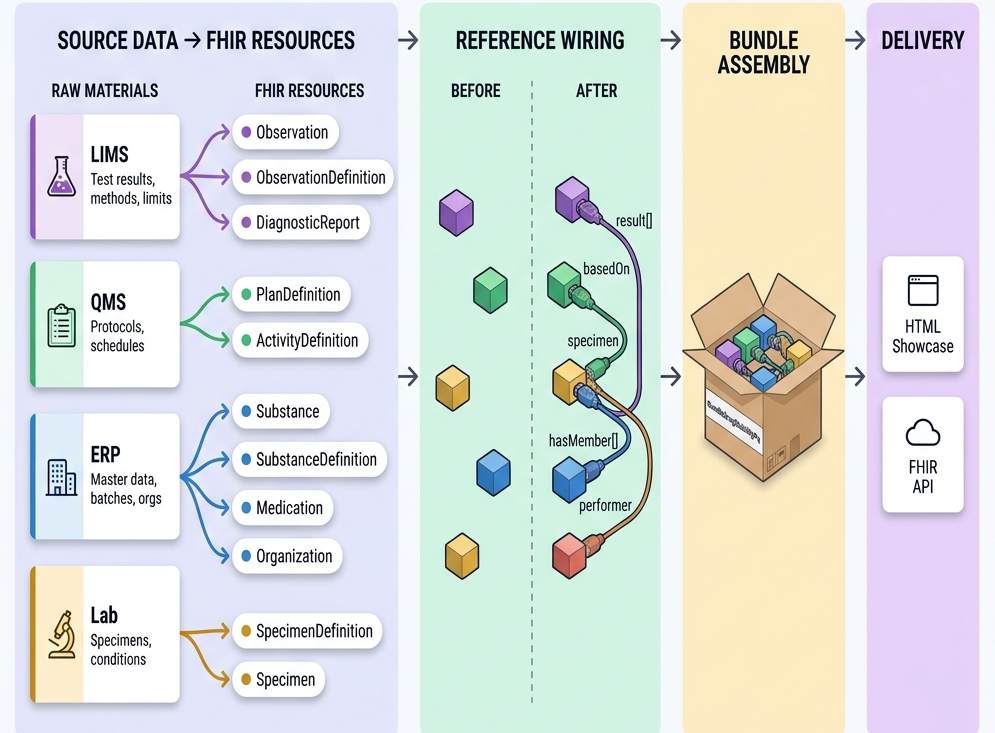
Collect data from your laboratory and quality systems. You need four categories of information:
Map each category of source data into its corresponding FHIR resource type. Build each resource independently and validate it against its profile before moving on. The stability domain uses the following resource types:
Detailed field-level mapping instructions and FSH examples for all 11 required resource types.
Tip: Start with the leaf-level resources (Organization, SpecimenDefinition, ObservationDefinition) and work upward. These have no outbound dependencies.
Think of this step like plugging cables between electrical sockets — each resource has ports that accept Reference() or canonical links to other resources. Before wiring, your resources are standalone and disconnected. After wiring, they form a connected graph. The key connections are:
Assemble all wired resources into a single Bundle of type collection, conforming to the BundleDrugStabilityPq profile. The profile requires at least 12 entries across 13 named slices:
Each entry must include a fullUrl and a resource.
Your validated Bundle is now ready for downstream consumption. Common delivery targets include:
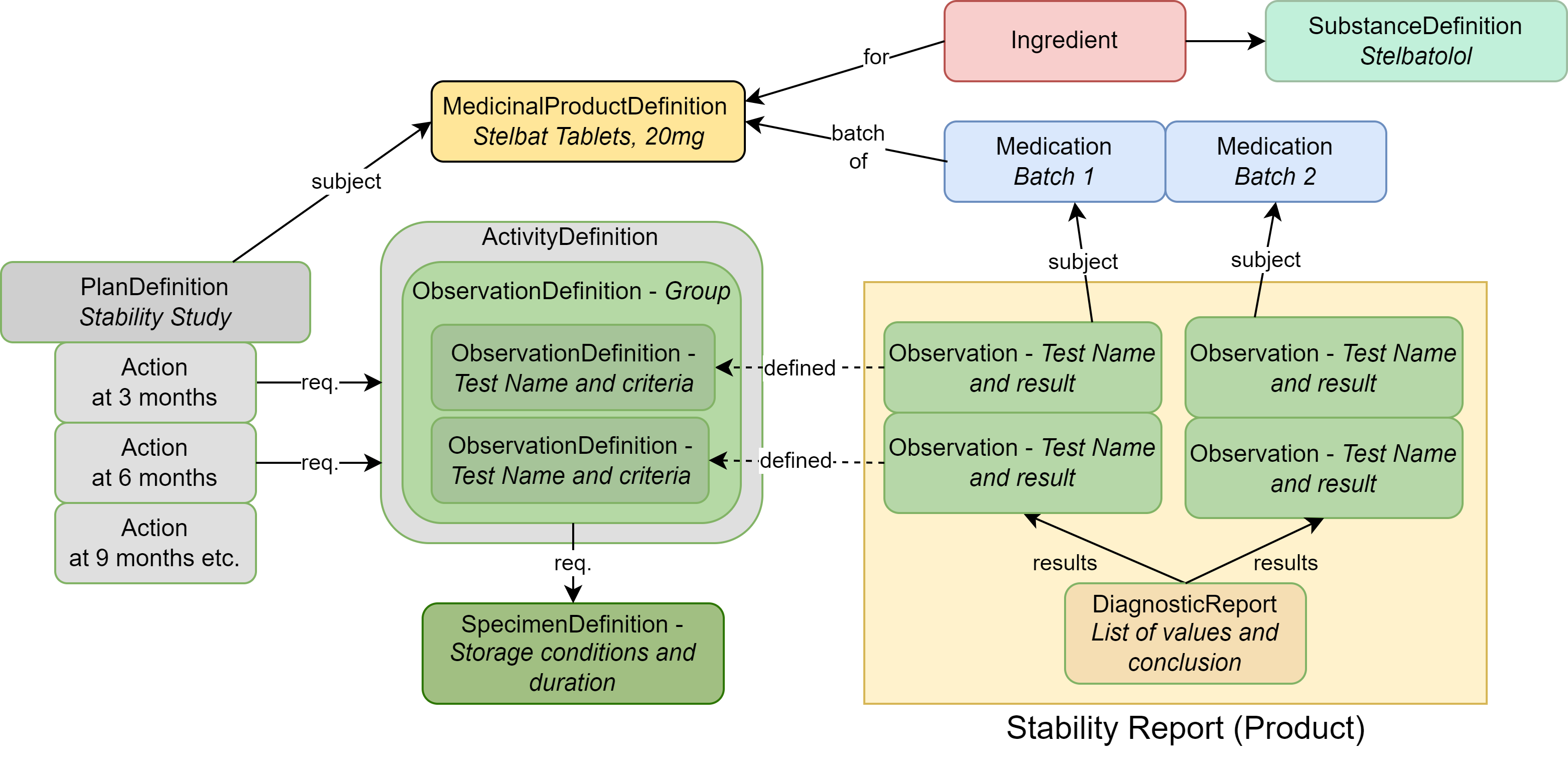
| DiagnosticReport | Contains all results as a group and captures overall conclusions. |
| PlanDefinition | Describes the stability study protocol design and conditions. |
| ObservationDefinition | Defines individual test methods and acceptance criteria. |
| Observation | Captures the specific test results at given timepoints. |
| MedicinalProductDefinition | The drug product (e.g., Stelbat tablets, 20mg). |
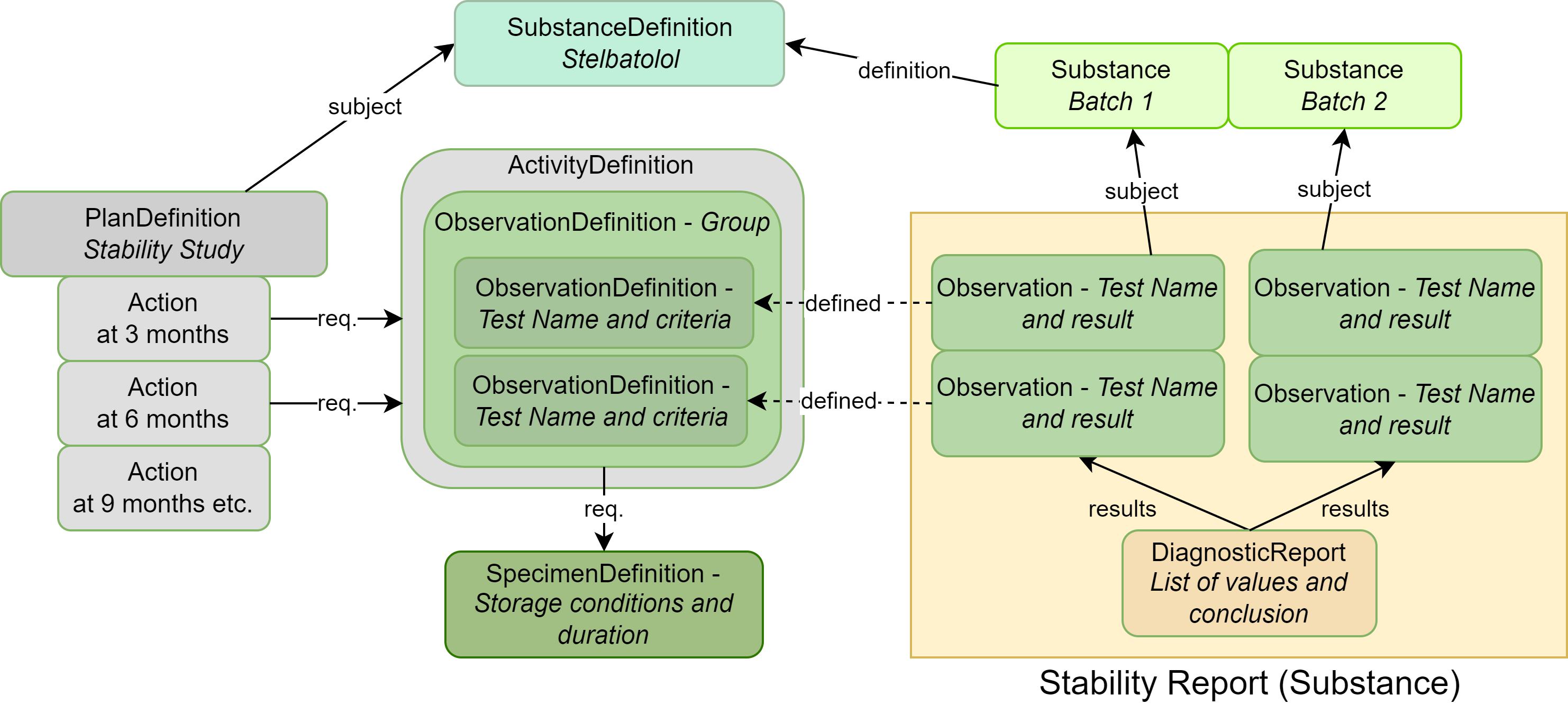
| DiagnosticReport | Contains all results as a group and captures overall conclusions. |
| SpecificationDefinition | Describes the storage conditions and duration for each test. |
| ObservationDefinition | Defines individual test methods and acceptance criteria. |
| Observation | Captures the specific test results at given timepoints. |
| SubstanceDefinition | The substance being tested. |
IG © 2023+ HL7 International / Biomedical Research and Regulation.
Package hl7.fhir.uv.pharm-quality#1.0.0 based on FHIR 5.0.0.
Generated
2026-05-10
Links: Table of Contents |
QA Report
| Version History |
 |
Propose a change
|
Propose a change