


Pharmaceutical Quality (Industry)
1.0.0 - STU1

Pharmaceutical Quality (Industry)
1.0.0 - STU1
Pharmaceutical Quality (Industry), published by HL7 International / Biomedical Research and Regulation. This guide is not an authorized publication; it is the continuous build for version 1.0.0 built by the FHIR (HL7® FHIR® Standard) CI Build. This version is based on the current content of https://github.com/HL7/uv-dx-pq/ and changes regularly. See the Directory of published versions
| Official URL: http://hl7.org/fhir/uv/pharm-quality/ImplementationGuide/hl7.fhir.uv.pharm-quality | Version: 1.0.0 | ||||
| Active as of 2026-05-10 | Computable Name: PharmaceuticalQualityIndustry | ||||
| Other Identifiers: OID:2.16.840.1.113883.4.642.40.41 | |||||
A universal FHIR specification for creating and exchanging structured pharmaceutical quality data internationally — within or between biopharmaceutical companies and their stakeholders.
Get StartedMove from unstructured PDFs and Word documents to a real-time, structured data model.
Reduce pharmaceutical data exchange timelines from months to minutes using FHIR APIs. Enable high-frequency, high-volume data flows between sponsors, CMOs, and labs.
Granular, discrete components — like individual tests — can be centrally maintained, version-controlled, and reused across stability studies, specifications, and products.
Highly granular structured data makes pharmaceutical quality information accessible for ontologies, data science, and artificial intelligence applications.
FHIR XML or JSON bundles can be transformed into any format required by regulators — PDF, Word, or jurisdiction-specific submission formats.
Products regulated as drugs (small and large molecule medicinal products, including functional and non-functional packaging components; prescription, OTC, and hospital products). Developmental and authorized medicinal products. Data exchange within a biopharmaceutical company, between companies, or between companies and their industry stakeholders.
Products regulated as devices and veterinary drugs are out of scope for version 1.0.0. New product lines will be brought in scope in future iterations of the implementation guide.
This implementation guide is based upon FHIR version 5.0.0 and is a Universal Realm Specification. It organizes pharmaceutical quality data into 14 domains designed to maximize structured data use and deliver benefits in flexibility, efficiency, and data reuse.
Medicinal product manufacturers managing quality data across global supply chains.
Contract manufacturing organizations and testing laboratories exchanging structured results.
Developers of LIMS, content management, and regulatory information management solutions.
Business analysts and policy managers involved in biopharmaceutical regulatory affairs.
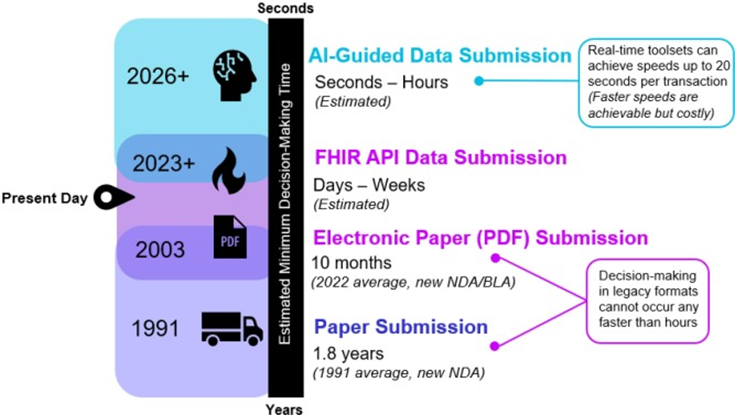
The biopharmaceutical industry is transitioning into its third paradigm of data exchange. This IG accelerates that transition:
Figure: Advancement of the Submission and Decision-Making Ecosystems
 |
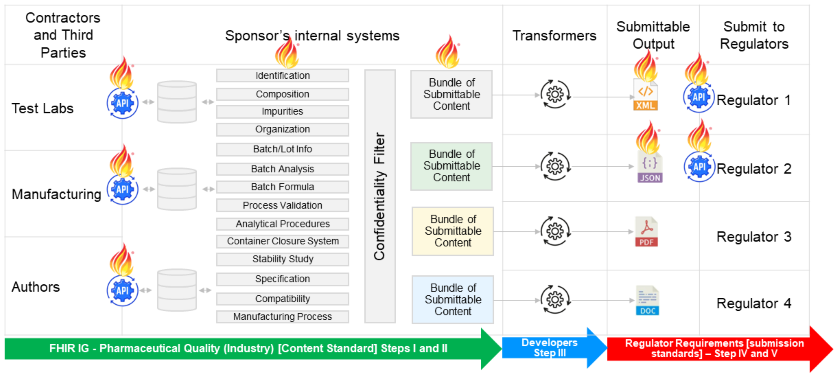
The following figure depicts a potential future data pipeline for implementers and the intended scope of this IG relative to the regulatory submission workflow.
Figure: FHIR Data Pipeline for Pharmaceutical Quality (Industry)
 |
This guide is developed and produced through the efforts of Health Level Seven International (HL7) as part of the Pharmaceutical Quality (Industry) project (Project ID 1800 and Project Scope Statement: PSS-2145).
The project team appreciates the support and sponsorship of the HL7 Public Health Work Group, and all volunteers and staff associated with the creation of this resource. The team appreciates the comments and input from the biopharmaceutical community as well as the HL7 volunteers who participate in the Biomedical Research and Regulation Work Group.
Health Level Seven, HL7, FHIR and the [FLAME DESIGN] are registered trademarks of Health Level Seven International, registered in the US Trademark Office. For acknowledgement of terminology content, please see the IP Statements section.
Please suggest improvements and provide notes about issues through HL7's Jira Software (free account and log-in required).
HL7's Confluence pages provide guidance on submitting Specification Feedback in Jira.
See also the HL7 FHIR Community Chat Zulip stream: Pharm Quality Industry IG for discussion about this FHIR IG.
IG © 2023+ HL7 International / Biomedical Research and Regulation.
Package hl7.fhir.uv.pharm-quality#1.0.0 based on FHIR 5.0.0.
Generated
2026-05-10
Links: Table of Contents |
QA Report
| Version History |
 |
Propose a change
|
Propose a change