|
Type
|
Reference
|
Content
|
|
web
|
github.com
|
Query & Response for Public Health, published by HL7 International / Public Health. This guide is not an authorized publication; it is the continuous build for version 1.0.0 built by the FHIR (HL7® FHIR® Standard) CI Build. This version is based on the current content of https://github.com/HL7/us-helios-QR/
and changes regularly. See the Directory of published versions
|
|
web
|
www.cdcfoundation.org
|
The Data Modernization Implementation Center
program provides funding to drive public health data modernization. Three implementation centers (CRISP Shared Services; Guidehouse; Mathematica) provide support to state, local, and territorial jurisdictions. Chickasaw Health Consulting serves as the Data Modernization Implementation Center supporting Tribes and Tribal-serving organizations. (disclaimer – these links may change over time, but are appropriate and effective at the time of this publication)
|
|
web
|
www.phinfrastructure.org
|
Public Health Agencies who are not already engaged with an Implementation Center can visit the PHIG Partners webside
|
|
web
|
nyehealth.org
|
Data governance for public health FHIR Query and Response is essential to ensure responsible management, access, and exchange of protected health information. It establishes clear policies and procedures for data quality, security, privacy, and interoperability across participating entities. In the context of FHIR-based public health reporting, data governance defines who can query or respond to clinical data requests, the conditions for doing so, and the standards for data validation. A key element of this governance is the use of Data Use Agreements (DUAs) or Participation Agreements, such as New York’s SCPA
, which outline the specific terms under which data may be shared between providers and Public Health Agencies, including permitted uses and security protocols. These agreements ensure compliance with regulations such as HIPAA, clarify roles and responsibilities among partners, and foster trust by safeguarding patient privacy while enabling accurate, timely, and actionable data sharing to enhance public health surveillance and response efforts.
|
|
web
|
rce.sequoiaproject.org
|
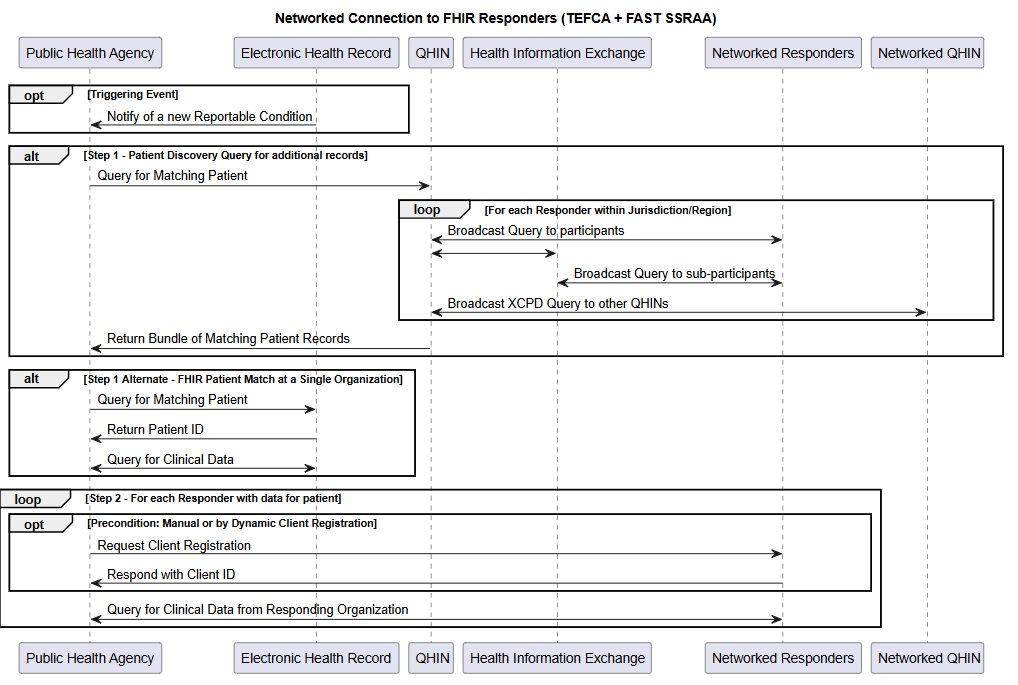
Guidance on using TEFCA
to facilitate queries and TEFCA Exchange Purposes are outlined in the Public Health standard operating procedure (SOP)
.
|
|
web
|
rce.sequoiaproject.org
|
Guidance on using TEFCA
to facilitate queries and TEFCA Exchange Purposes are outlined in the Public Health standard operating procedure (SOP)
.
|
|
web
|
rce.sequoiaproject.org
|
The Common Agreement
authorizes six types of Exchange Purposes (XPs), including Public Health, allowing TEFCA participants to securely share and request information from PHAs. However, due to the complexities and variations in laws regarding public health exchange purposes, the Common Agreement states that PHAs are not required to respond to any queries from requesters, although they are encouraged to do so as appropriate under Applicable Law.
|
|
web
|
www.publichealthlawcenter.org
|
Public Health Law Center Executing DUA Resource Roundup
|
|
web
|
profiles.ihe.net
|
It is understood that QHIN-to-QHIN communication uses IHE-profiled transactions, but QHINs may offer to their participants any number of query mechanisms. Existing implementation guides, such as Mobile Access to Health Documents (MHD)
, can inform the crosswalk between FHIR and IHE standards.
|