This publication includes IP covered under the following statements.
The UCUM codes, UCUM table (regardless of format), and UCUM Specification are copyright 1999-2009, Regenstrief Institute, Inc. and the Unified Codes for Units of Measures (UCUM) Organization. All rights reserved. https://ucum.org/trac/wiki/TermsOfUse
This material contains content that is copyright of SNOMED International. Implementers of these specifications must have the appropriate SNOMED CT Affiliate license - for more information contact https://www.snomed.org/get-snomed
or info@snomed.org
.
Using RxNorm codes of type SAB=RXNORM as this specification describes does not require a UMLS license. Access to the full set of RxNorm definitions, and/or additional use of other RxNorm structures and information requires a UMLS license. The use of RxNorm in this specification is pursuant to HL7's status as a licensee of the NLM UMLS. HL7's license does not convey the right to use RxNorm to any users of this specification; implementers must acquire a license to use RxNorm in their own right.
Code of Federal Regulation 21CFR§1271.290(c) ( src
)
Copyright (c) 2021+ Health Level Seven International and MITRE.org.
Published under the Creative Commons "Attribution 4.0 International" (CC BY 4.0) License ( src
)
Personal Health Records, published by HL7 International / Patient Empowerment. This guide is not an authorized publication; it is the continuous build for version 1.0.0-ballot2 built by the FHIR (HL7® FHIR® Standard) CI Build. This version is based on the current content of https://github.com/HL7/personal-health-record-format-ig/ and changes regularly. See the Directory of published versions ( src
)
Personal Health Records, published by HL7 International / Patient Empowerment. This guide is not an authorized publication; it is the continuous build for version 1.0.0-ballot2 built by the FHIR (HL7® FHIR® Standard) CI Build. This version is based on the current content of https://github.com/HL7/personal-health-record-format-ig/
and changes regularly. See the Directory of published versions
The UCUM codes, UCUM table (regardless of format), and UCUM Specification are copyright 1999-2009, Regenstrief Institute, Inc. and the Unified Codes for Units of Measures (UCUM) Organization. All rights reserved. https://ucum.org/trac/wiki/TermsOfUse
The official term for "file types" is Uniform Type Identifiers (UTIs)
, and the database of UTIs is maintained by Launch Services
. Using the Terminal, you can view the contents of the Launch Services database using the lsregister tool, which is stored at:
The official term for "file types" is Uniform Type Identifiers (UTIs)
, and the database of UTIs is maintained by Launch Services
. Using the Terminal, you can view the contents of the Launch Services database using the lsregister tool, which is stored at:
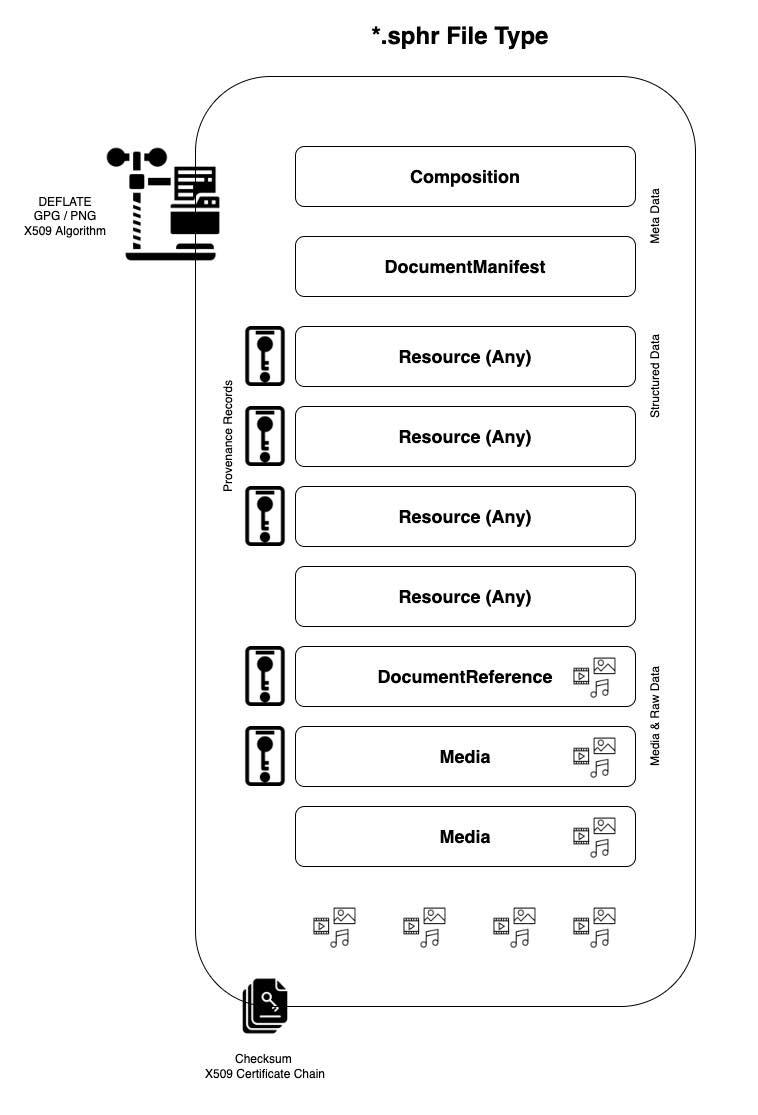
Files containing patient health information MAY be zipped. The .sphr
file extension is an alias for .fhir.zip
or .fhir.gz
. When using compression, systems SHOULD use the DEFLATE
algorithm. DEFLATE is supported by both ZIP and GZIP compression utilities.
This guide does not define file-level encryption or signing for .phr
and .sphr
files. These files are plain NDJSON and zip archives respectively, and are not self-protecting
— protection comes from the environment, not the file. Records at rest SHOULD be protected with operating-system or volume-level encryption; records in transit are protected by TLS or by SMART Health Links
(which encrypt their payload and carry the key in the link itself). Authorship and integrity questions are handled with Provenance
resources inside the record rather than signatures around it. See the Security
page for complete guidance.
SMART Health Links
carry their own encryption: the shared payload is encrypted (A256GCM) and the decryption key travels inside the link/QR code. SHL is the RECOMMENDED mechanism for patient-mediated sharing of records with third parties.