


Electronic Case Reporting (eCR)
3.0.0-ballot - STU 3 Ballot

Electronic Case Reporting (eCR)
3.0.0-ballot - STU 3 Ballot
Electronic Case Reporting (eCR), published by HL7 International / Public Health. This guide is not an authorized publication; it is the continuous build for version 3.0.0-ballot built by the FHIR (HL7® FHIR® Standard) CI Build. This version is based on the current content of https://github.com/HL7/case-reporting/ and changes regularly. See the Directory of published versions
| Page standards status: Informative |
The RR transaction represents a response from public health to healthcare associated with a received eICR.
It can include determination of reportability information, contact information for the involved public health agencies, and requests for case investigation supplemental data that may not have been recorded in the process of care, condition-specific information from public health, and an acknowledgment that report has been successfully conveyed.
When public health reporting rules are distributable to healthcare some of this information will be conveyed in the electronic Reporting & Surveillance Distribution (eRSD) transaction so that it can be accessed by the healthcare rules engine.
The RR is conveyed as a push transaction from public health to healthcare.
There may be several different intermediaries involved in its transmission including Health Information Exchanges and Health Data Networks.
The RR may originate from the Association of Public Health Laboratories (APHL) AIMS platform when public health decision support (the Reportable Condition Knowledge Management System - RCKMS) is used there or directly from a Public Health Agency if they received the eICR directly from healthcare.
In this implementation guide the reference transport transaction is a FHIR POST, but other transport mechanisms may be added or substituted as the data wend their way back to the source of the related eICR.
Once received by healthcare, the RR information is intended to support Providers and Reporters and be attached to patient charts or placed in work queues so as to notify personnel of reportable and possibly reportable conditions.
It also should be provided to EHR System Administrators to confirm reporting and convey error and warning messages.
Some eICRs will have been manually initiated. If the eICR Initiation Type extension is present in the Reportability Response with a code of PHC1464 (Manually Initiated eICR), it indicates a manually initiated eICR, and the appropriate Provider or Reporter should always be notified with the relevant Reportability Response regardless of the reportability determination.
Some eICRs will have been alternately initiated: initiated by the EHR or healthcare site through "programmed-in" logic to meet a transient reporting need (for example, reporting to a registry), rather than by a provider or by a trigger code match. If the eICR Initiation Type extension is present in the Reportability Response with a code of PHC2235 (Alternately Initiated eICR), it indicates an alternately initiated eICR. Alternately initiated eICRs are always sent to the PHA for the jurisdiction in which care was provided, regardless of the reportability determination, and the Reportability Response Summary states the agency to which the eICR was sent. Because alternate initiation is configured by the healthcare organization rather than requested by an individual Provider, it is recommended that the Reportability Response be routed to the Provider, Reporter, or EHR System Administrator responsible for the alternate initiation, so that receipt of the eICR by public health can be confirmed. If a reportable or may be reportable condition is also identified, the appropriate Provider or Reporter should be notified as for any other Reportability Response.
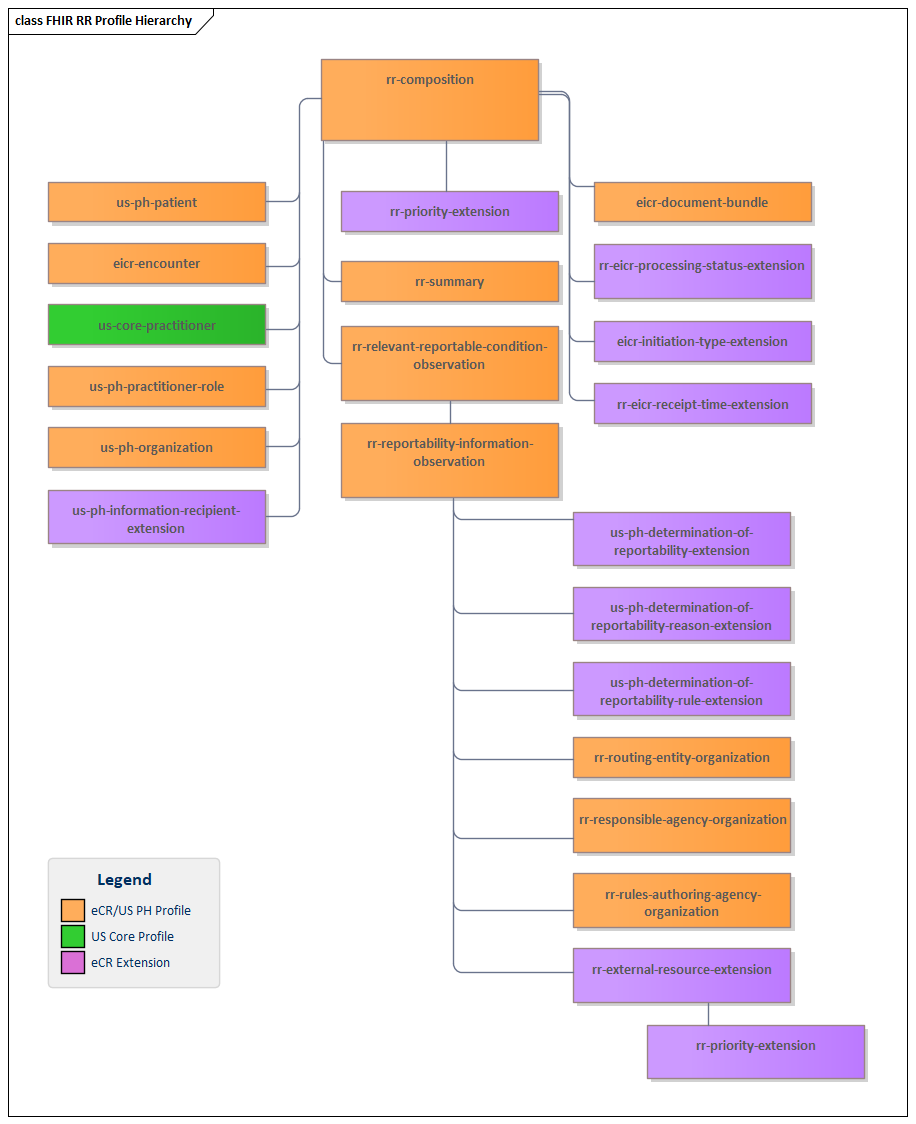
A number of profiles and extensions have been defined for the Reportability Response transactions - see Artifact Index for a listing of these profiles. The Reportability Response Composition profile is the starting point and all the other profiles are referenced from this profile (see diagram below).
 |
IG © 2025+ HL7 International / Public Health.
Package hl7.fhir.us.ecr#3.0.0-ballot based on FHIR 4.0.1.
Generated
2026-11-16
Links: Table of Contents |
QA Report
| Version History |
 |
Propose a change