


Electronic Case Reporting (eCR)
3.0.0-ballot - STU 3 Ballot

Electronic Case Reporting (eCR)
3.0.0-ballot - STU 3 Ballot
Electronic Case Reporting (eCR), published by HL7 International / Public Health. This guide is not an authorized publication; it is the continuous build for version 3.0.0-ballot built by the FHIR (HL7® FHIR® Standard) CI Build. This version is based on the current content of https://github.com/HL7/case-reporting/ and changes regularly. See the Directory of published versions
| Page standards status: Informative |
The eRSD transaction includes a constrained FHIR PlanDefinition resource profile and a family of actions. It supports the distribution of reporting guidance and parameters, trigger code value sets, and more complex reporting rules and clinician / reporter support resources. This work seeks to align with developing public health guidelines that cover the same conditions. The PlanDefinition includes guidance for the overall orchestration of electronic case reporting. Each member of the family of actions defined in the US Public Health PlanDefinition Action Codes code system aligns with what may be different healthcare information systems or modules involved in reporting. The narrative elements of this profile will be used to help structure and guide implementation until EHRs have the ability to automatically consume them.
The distribution of case reporting specifications involves two systems, the Implementing System (typically an Electronic Health Record (EHR)) and the Specification Repository, a repository that manages reporting specifications and the versions of those specifications over time:

Conceptually, there are three transactions involved in the distribution of eRSD specifications:
Notification may be accomplished in multiple ways such as simple email or text notifications.
Similarly, the Request and Response transactions may be implemented in multiple ways, including HTTP file download, as well as API access to a FHIR server acting as a repository.
At this time, this implementation guide is only prescriptive about the payload of the Response transaction, as defined by the following sections. We seek implementer feedback on the usefulness of more formal specification of these transactions.
The eRSD specification is structured into two groups to facilitate two different levels of implementation of suspected reportability criteria:
The contents of each of these specifications at a high level are:
Subsequent sections describe each of these specification components in more detail.
The following diagram illustrates the general process for electronic Case Reporting as triggered from a patient encounter, highlighting each of the components involved in describing the process:
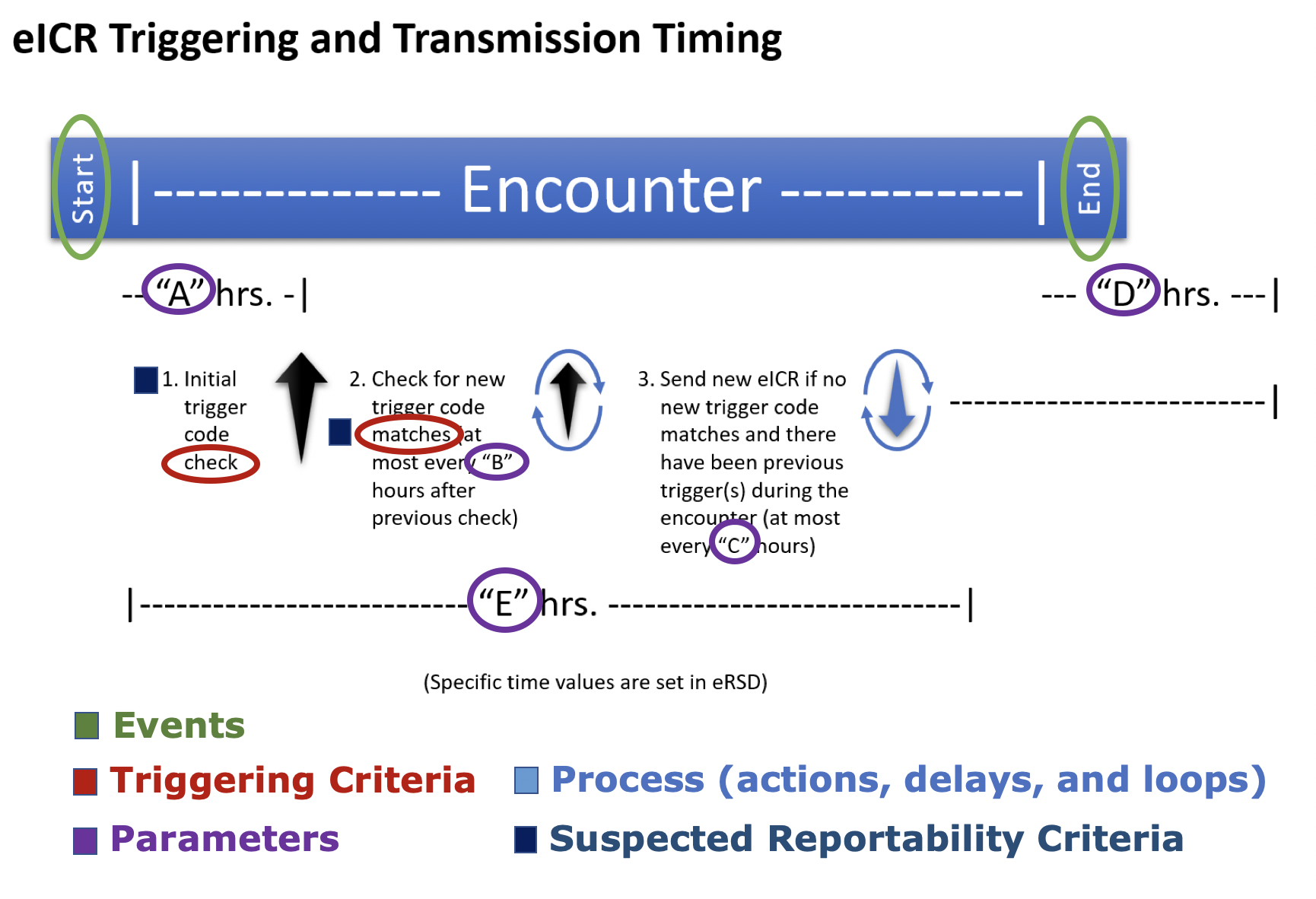
The timing parameters labelled "A" through "E" in the diagram above are defined in the Parameters section below.
The components involved in representing the reporting process are:
These components are represented using different elements of the PlanDefinition resource:
| Component | Represented by |
|---|---|
| Events | action.trigger, using the named-event trigger type |
| Triggering Criteria | action.input, with a codeFilter naming the triggering value set |
| Process | action, nested to form a hierarchy, with action.relatedAction expressing the dependency between one step and the next |
| Parameters | action.relatedAction.offsetDuration, together with the PlanDefinition-level variable extensions that supply the durations |
| Suspected Reportability Criteria | action.condition |
An action therefore takes the following general shape, with each element carrying one of the components above:
<action>
  <id value="..."/>                    <!-- identifies this step -->
  <code value="..."/>                  <!-- the kind of step this is -->
  <trigger>...</trigger>               <!-- Events -->
  <condition>...</condition>           <!-- Suspected Reportability Criteria -->
  <input>...</input>                   <!-- Triggering Criteria -->
  <relatedAction>                      <!-- Process, with Parameters carried on the offset -->
    <actionId value="..."/>
    <relationship value="before-start"/>
    <offsetDuration .../>
  </relatedAction>
  <action>...</action>                 <!-- nested child steps -->
</action>
Not every action uses every element: trigger appears only on the actions that initiate a workflow in response to an event, condition and input on the actions that evaluate reportability, and relatedAction on any action that hands off to another.
Each of these are discussed in more detail in the following sections.
Events are represented with the trigger element, using the named-event trigger type and bound to the US Public Health TriggerDefinition Named Event value set. In addition, since the name element of the trigger definition is a uri, the eRSD profile uses the US Public Health Named Event Type Extension to provide complete binding information for the value set, as illustrated in the eRSDPlanDefinition example:
<trigger id="encounter-start">
  <extension url="http://hl7.org/fhir/us/ph-library/StructureDefinition/us-ph-named-eventtype-extension">
    <valueCodeableConcept>
      <coding>
        <system value="http://hl7.org/fhir/us/ecr/CodeSystem/us-ph-triggerdefinition-namedevents"/>
        <code value="encounter-start"/>
        <display value="Indicates the start of an encounter"/>
      </coding>
    </valueCodeableConcept>
  </extension>
  <type value="named-event"/>
  <name value="encounter-start"/>
</trigger>
Triggering criteria are specified by a combination of the input data elements, and the Reportable Condition Triggering Codes (RCTC) Value Set Library. Note carefully that the RCTC Value Sets included in this IG are examples to illustrate the structure and typical content of the Value Sets.
Note to implementers: canonical URLs shown in the examples on this page use the
hl7.org/fhir/us/ecr/...-exampleform and are illustrative only. The specification distributed in production usesersd.aimsplatform.orgcanonicals for its own artifacts andcts.nlm.nih.govcanonicals for the trigger code value sets.
The triggering value sets will include any number of focus useContext slices to indicate which conditions the triggering codes are associated with. Each value set corresponds to a different type of information that may contain events that are triggers for potentially reportable events. The categories of information are mapped to FHIR resources using the input element. For example, the reportable conditions value set is mapped to the Condition resource:
<input id="conditions">
  <type value="Condition"/>
  <codeFilter>
    <path value="code"/>
    <valueSet value="http://hl7.org/fhir/us/ecr/ValueSet/valueset-diagnosis-problem-triggers-example"/>
  </codeFilter>
</input>
The RCTC library is organised as a set of grouping value sets, each corresponding to one category of information in the eRSD information model. The following groupers are defined, under the base http://ersd.aimsplatform.org/fhir/ValueSet/:
| Code | Category | Primary code systems | Role in the workflow |
|---|---|---|---|
dxtc |
Diagnosis and problem | SNOMED CT, ICD-10-CM | Matched against problem list entries, encounter diagnoses, and encounter reason |
ostc |
Organism and substance | SNOMED CT | Matched against laboratory result values |
lotc |
Laboratory order test | LOINC | Matched against laboratory orders, laboratory tests and diagnostic orders |
lrtc |
Laboratory observation result | LOINC | Matched against laboratory and diagnostic results |
mrtc |
Medication | RxNorm | Matched against medication requests, administrations and statements |
sdtc |
Suspected disorder | SNOMED CT | Drives the immediate reportability check at the start of an encounter |
artc |
All-results trigger codes | LOINC | Identifies conditions that remain reportable even when the result is negative |
eltc |
Extended timing threshold | LOINC, SNOMED CT, ICD-10-CM | Identifies conditions that use an extended evidence window; its membership spans laboratory test names, diagnosis codes and problem codes for the same set of conditions |
iztc |
Immunization | CVX, RxNorm | Matched against immunizations |
Each grouper is referenced from the codeFilter of the input data requirements on the reportability check actions, and the reference is version-pinned so that it is unambiguous which release of the trigger codes an action was authored against. A single check action draws on several groupers at once; for example the main reportability check matches problem list entries and encounter diagnoses against dxtc, laboratory orders against lotc, results against lrtc, result values against ostc, medications against mrtc and immunizations against iztc, and additionally selects the subsets governed by artc and eltc so that the refinements described below can be applied to them.
Provisional value sets. Trigger codes for an emerging condition may need to be distributed before the corresponding value set has completed formal review. These are published as provisional value sets, carrying the literal string PROVISIONAL as their version in place of a date-stamped version. Grouper references resolve them in the same way as any other value set, so no special handling is required beyond accepting the non-numeric version. A provisional value set is replaced by a date-versioned equivalent once review completes.
Note to implementers: The logic used throughout the reporting workflow definition assumes the data provided as input is valid. For example, an Encounter with a status of in-progress is assumed to have a period element with a start date specified. Implementations may account for differences in the way the clinical system represents encounter information by adjusting the data using context in the reporting application to meet these assumptions.
The presence of a code from a triggering value set is the starting point for reportability, not the whole of it. The specification applies a number of additional constraints, which exist to improve the precision of triggering and to reduce the volume of case reports that carry no new information for public health. Implementations that evaluate the conditions in the PlanDefinition will apply these automatically; implementations that reproduce the triggering logic themselves should account for them.
Negative laboratory results do not trigger. A laboratory result whose value or interpretation is coded as SNOMED CT 260385009 (Negative) or 260415000 (Not detected), or whose value is text containing "negative" or "not detected", does not on its own cause a report to be generated.
Some conditions are exempt from that rule. For conditions in the artc value set a negative result remains reportable, because the fact that a test was performed and returned negative is itself of public health interest. The reportability check selects these separately so that the negative result filter is not applied to them.
Refuted and entered-in-error diagnoses do not trigger. A Condition whose verificationStatus is refuted or entered-in-error is excluded from consideration.
Evidence has an age limit. Diagnosis and problem list evidence older than dxTimeboxDuration, and laboratory evidence older than labTimeboxDuration, no longer trigger a report. Conditions in the eltc value set use extendedTimeboxDuration in place of both dxTimeboxDuration and labTimeboxDuration, so the longer window applies to diagnosis and problem list evidence as well as to laboratory evidence. This accommodates conditions with a longer latency between exposure and diagnosis. Evidence with no date at all is not excluded by these limits.
Immunizations can trigger. Immunization.vaccineCode is checked against the iztc value set alongside the other categories of evidence.
Ambulatory and inpatient encounters are treated differently. An ambulatory, virtual or home health encounter (AMB, VR, HH) uses ambulatoryReportingDuration and its own in-progress and termination actions; an inpatient, emergency or observation encounter (IMP, EMER, OBSENC) uses normalReportingDuration. The distinction exists because continuing to re-check a short ambulatory encounter on the cadence appropriate to a multi-day inpatient stay produces load on the clinical system without producing reports.
Process is represented using the action elements of the PlanDefinition. A PlanDefinition can have any number of action elements, and each action may have any number of child action elements, allowing a hierarchy of actions to be constructed. In addition, the relatedAction element of each action allows dependencies between actions to be expressed. For example, action A starts 5 minutes before action B.
To support a broad variety of use cases, the PlanDefinition resource provides a flexible mechanism for representing processes. To facilitate implementation, the US Public Health PlanDefinition profile introduces constraints that limit the set of elements that can be used to:
workflow-definition, to indicate process semantics applynamed-event typeThe eRSD PlanDefinition uses these structures to introduce a "loop" for the creation and submission of reports for a suspected reportable event. The following table describes each action, the code that identifies it, what causes it to run, and what it invokes next. Indented rows are child actions of the action above them.
| Action | Code | Runs when | Invokes next |
|---|---|---|---|
start-workflow |
initiate-reporting-workflow |
encounter-start event |
check-for-immediate-reporting, after "A" |
check-for-immediate-reporting |
execute-reporting-workflow |
invoked by start-workflow |
— |
is-encounter-immediately-reportable |
check-trigger-codes |
suspected disorder, lab order or diagnostic order matches | create-eicr |
continue-check-reportable |
evaluate-condition |
encounter in progress and within the reporting duration | check-reportable, after "B" |
terminate-late-encounter |
terminate-reporting-workflow |
encounter has passed its reporting window | — |
is-late-encounter-completed |
complete-reporting |
encounter finished after its window had elapsed | — |
check-reportable |
execute-reporting-workflow |
invoked by the check loop | — |
is-encounter-reportable |
check-trigger-codes |
encounter data matches the trigger code value sets | create-eicr |
check-update-eicr |
evaluate-condition |
more than "C" since the last eICR was sent | create-eicr |
is-encounter-in-progress |
evaluate-condition |
inpatient encounter still in progress | check-reportable, after "B" |
is-amb-encounter-in-progress |
evaluate-condition |
ambulatory encounter still in progress | check-reportable, after "B" |
terminate-encounter |
terminate-reporting-workflow |
inpatient encounter past its window | — |
terminate-amb-encounter |
terminate-reporting-workflow |
ambulatory encounter past its window | — |
is-encounter-completed |
complete-reporting |
encounter finished | — |
create-eicr |
create-report |
invoked when reportability is determined | validate-eicr |
validate-eicr |
validate-report |
invoked by create-eicr |
route-and-send-eicr |
route-and-send-eicr |
submit-report |
invoked by validate-eicr |
— |
encounter-modified |
initiate-reporting-workflow |
encounter-modified event |
is-modified-encounter-reportable |
is-modified-encounter-reportable |
check-trigger-codes |
modified encounter data matches the trigger code value sets | create-eicr |
Three aspects of this structure are worth drawing out, because they are not evident from the table alone.
The reporting loop. check-reportable re-invokes itself through is-encounter-in-progress or is-amb-encounter-in-progress, with a delay of "B", for as long as the encounter remains in progress and within its reporting duration. This recursion is how periodic re-checking is expressed, rather than a timing structure.
Ambulatory and inpatient encounters follow separate paths. Ambulatory, virtual and home health encounters (AMB, VR, HH) use the ambulatory reporting duration, while inpatient, emergency and observation encounters (IMP, EMER, OBSENC) use the normal reporting duration. The two paths have their own in-progress and termination actions so that a short ambulatory encounter is not re-checked on an inpatient cadence.
Termination and completion are explicit. The terminate-* actions end the reporting workflow for an encounter that has passed its reporting window, and the complete-reporting actions record that an encounter finished. Together these let an implementing system stop scheduling checks for an encounter that can no longer produce a report, rather than relying on implicit completion.
The create-eicr action involves the marshaling of FHIR resources needed to create the eICR profile included in this standard, and produces an eICR document bundle as its output. That output is consumed as the input of validate-eicr, which validates the created eICR against the appropriate profiles and validation rules, and in turn passes it to route-and-send-eicr. The route-and-send-eicr action involves the transmission of the eICR to either a third party platform, a Public Health Agency (PHA), or a Health Information Exchange or Health Data Network on the way to a PHA.
Data gathered by create-eicr. The create-eicr action carries a set of input data requirements that define the data an implementing system gathers in order to construct the eICR. Each input has an id, a resource type, and a default FHIR query supplied by the FHIR query pattern extension, and each is addressable within the action as a % variable using its id. The categories below reflect the specification currently in production; see the eICR Data Elements topic for the corresponding eICR content.
| Category | Inputs |
|---|---|
| Core clinical | patientdata, encounterdata, conditiondata (problem list), encounterDiagnosesData (encounter diagnosis), procdata |
| Medications | mrdata (orders), medAdmdata, medStatementdata, medDispensedata |
| Immunizations | immzdata |
| Laboratory and diagnostics | labOrderdata, labResultdata, diagnosticOrderdata, diagnosticResultdata |
| Occupational data (ODH) | odhData-loinc, odhData-snomed |
| Pregnancy | pregnancyObservations, pregnancyConditions, pregnancy-status, lmp-data, postpartum-status, pregnancy-outcome |
| Social and contextual | travelData-snomed, homeless-data, disability-data, nationality-data, residency-data, vaccine-cred-data |
| Vital signs | vitals-data, scoped to the encounter |
Most inputs carry a query that selects by patient, and several narrow it further by category or by a specific set of codes. Where an input's query names another input rather than a search string, it reuses that input's result set instead of issuing a separate query.
Because of variability in accumulation of data at the start of a patient encounter, the EHR implementer should implement a time-based delay in generating and sending the first encounter eICR to allow time for required data to be captured within the patient chart. This will ensure the eICR is better populated before sending and will reduce the number of case reports that are sent for a single patient encounter.
Timings are carried on the PlanDefinition itself as variable extensions, and are referenced from the action conditions and from the offsetDuration of related actions. Earlier versions of this guide described these timings as parameters "A" through "E"; that mapping is retained below for continuity with the diagram above.
| Variable | Value in production | Formerly | Meaning |
|---|---|---|---|
normalReportingDuration |
14 days | "E" | The reporting duration for an inpatient, emergency or observation encounter. While the encounter is in progress and within this duration, reportability continues to be checked. |
ambulatoryReportingDuration |
1 day | — | The equivalent duration for an ambulatory, virtual or home health encounter. |
dxTimeboxDuration |
30 days | — | How old diagnosis and problem list evidence may be and still trigger a report. |
labTimeboxDuration |
30 days | — | How old laboratory evidence may be and still trigger a report. |
extendedTimeboxDuration |
365 days | — | The evidence window applied in place of the two above for conditions in the eltc value set. |
negativeLabResultValueSet |
canonical | — | The value set of result values treated as negative. |
encounterStartDate |
supplied by context | — | The start of the triggering encounter. |
encounterEndDate |
supplied by context | — | The end of the triggering encounter. |
lastReportSubmissionDate |
supplied by context | — | When an eICR was last submitted for this encounter. |
Not every timing is carried as a variable. Parameters "A" and "B" are expressed as the offsetDuration of a related action: "A", the delay between the start of the encounter and the first reportability check, is one hour; "B", the interval before the reportability check repeats while an encounter remains in progress, is at most six hours for an inpatient encounter and at most 72 hours for an ambulatory one. Parameters "C" and "D" — the interval before an updated eICR is sent when nothing new has triggered, and the window after the encounter ends during which checks continue — are currently fixed at 72 hours in the action conditions themselves and are not configurable.
Note to implementers: the duration variables are defined as plain integers rather than as quantities, and are converted to a duration where they are used, in the form
%encounterStartDate + 1 day * %normalReportingDuration. An implementation reading these variables should expect a number of days, not a quantity with a unit.
Note to implementers: The offset durations specified in related actions here are relative durations, in that they contain a comparator to indicate that the action should be completed at most X. This allows implementations to support scheduling these actions during non-peak times to minimize load on the clinical system.
To facilitate implementation, there are two levels of suspected reportability determination. The first level involves only checking for the existing of events with codes that match a code in the appropriate triggering value set. The second level involves additional filtering criteria that can include other elements of the data (such as status and lab values), as well as jurisdictional configuration.
The first level is generally termed triggering and is supported by the triggering profiles, while the second level is generally termed supplemental and is supported by the supplemental profiles.
The triggering level is represented using the condition element of the check-reportable action:
<condition>
  <kind value="applicability"/>
  <expression>
    <extension snipped/>
    <language value="text/fhirpath"/>
    <expression value="%conditions.exists() or %encounters.exists() or %immunizations.exists() or %procedures.exists() or %procedureOrders.exists() or %labOrders.exists() or %labTests.exists() or %labResults.exists() or %medicationAdministrations.exists() or %medicationOrders.exists() or %medicationDispenses.exists()"/></expression>
</condition>
This level uses a FHIRPath to test for existence of data in any of the input categories. Each input element is accessed by an environment variable using the % syntax in FHIRPath.
The eRSD specification is delivered as an asset collection library (a Library resource with a type of asset-collection) conforming to the US Public Health Specification Library profile. The specification currently in production additionally conforms to the CRMI Manifest Library profile, which is described under CRMI Alignment below.
The eRSD Specification library is composed of the eRSD Plan Definition and the RCTC Library, a Value Set library that conforms to the US Public Health Triggering Value Set Library profile:
<relatedArtifact>
  <type value="composed-of"/>
  <resource value="http://hl7.org/fhir/us/ecr/PlanDefinition/plandefinition-us-public-health-example"/>
</relatedArtifact>
<relatedArtifact>
  <type value="composed-of"/>
  <resource value="http://hl7.org/fhir/us/ecr/Library/library-rctc-example"/>
</relatedArtifact>
Triggering value sets and metadata can be used for EHR implementations whether they are FHIR-based or not.
The CRMIComputableValueset profile describes the requirements for computable representation of value set membership criteria, ensuring that value sets using this profile selectively support only one technique for defining the content of expansions.
The CRMIExpandedValueSet profile provides support for including a persisted point-in-time expansion that SHALL conform to the chosen compositional style for the value set. The included point-in-time expansion can then be used by FHIR implementations that do not have a FHIR terminology service capable of evaluating the value set in real-time with an $expand operation. It also provides all the concepts needed in the expansion so that a complete code system resource is not required.
The value sets distributed in an eRSD package provide both a computable definition and a persisted expansion, so that a system may use the expansion as distributed or recalculate it from the definition. In the specification currently in production the grouping value sets conform to the US Public Health Triggering ValueSet profile, and the leaf value sets that hold the trigger codes conform to ShareableValueSet together with the computable and publishable value set profiles defined by the CQF Measures implementation guide. Alignment of these value sets with the CRMI profiles described above is intended, but has not yet been made; implementations should validate against the profiles the value sets actually declare.
The supplemental level of integration enables sites to participate in the suspected reportability determination by considering additional elements of the event data such as status, lab values, and jurisdiction configuration.
The suspected reportability criteria are also represented with the condition element, but using the CQF Alternative Expression Extension to provide the CQL expression for suspected reportability:
<extension url="http://hl7.org/fhir/StructureDefinition/cqf-alternativeExpression">
  <valueExpression>
    <language value="text/cql-identifier"/>
    <expression value="Is Reportable"/>
    <reference value="http://hl7.org/fhir/us/ecr/Library/library-executable-rule-filters-example|2.1.0"/>
  </valueExpression>
</extension>
This extension indicates that the Is Reportable expression of the library-executable-rule-filters-example library should be used to evaluate whether the event is suspected reportable.
For a complete description of the logic used to determine suspected reportability, refer to the Rule Filter Generation topic.
For a detailed discussion of how jurisdiction is determined, see the Jurisdictions Code System Query topic.
For a detailed discussion of how this code system is structured, see the Jurisdictions Code System Description topic.
The eRSD Supplemental Library is composed of the library-executable-rule-filters-example library and the Supplemental Value Set library, which contains any additional value sets and code systems (including the Jurisdictions code system) beyond the RCTC value sets that are required by the library-executable-rule-filters-example logic:
<relatedArtifact>
  <type value="composed-of"/>
  <resource value="http://hl7.org/fhir/us/ecr/Library/library-executable-rule-filters-example"/>
</relatedArtifact>
<relatedArtifact>
  <type value="composed-of"/>
  <resource value="http://hl7.org/fhir/us/ecr/Library/library-us-ph-supplemental-valueset-library-example"/>
</relatedArtifact>
<relatedArtifact>
  <type value="composed-of"/>
  <resource value="http://hl7.org/fhir/us/ecr/CodeSystem/ersd-jurisdictions-example"/>
</relatedArtifact>
As noted in the overview section above, this implementation is not prescriptive about the absolute mechanisms for distribution, only about the contents of the specification in the form of Library, PlanDefinition, CodeSystem, and ValueSet resources conforming to the required profiles. The complete specification may be distributed via files (e.g. a zip of the specification as a FHIR bundle), via API (e.g. as a Bundle resource directly, or as the result of a packaging operation), or via notification.
When packaging as a Bundle, the Bundle contains the specification library, the resources it is composed of, and the value sets those resources reference. Consumers should locate resources within the Bundle by canonical URL rather than relying on the order in which entries appear. If the specification is too large for one Bundle, it may be split into multiple Bundles. The arrangement of a package, and how to navigate it, is described in the eRSD Package Structure topic. The following examples illustrate complete bundles of both the Specification and Supplemental distributions:
The eRSD release is produced using the operations and conventions defined by the Canonical Resource Management Infrastructure (CRMI) implementation guide. Several characteristics of the distributed package follow from that and are described here so they are not mistaken for eRSD-specific behaviour.
The specification library is a CRMI manifest. In addition to the US Public Health Specification Library profile, the root library conforms to CRMI Manifest Library. A manifest library is the authoritative statement of what constitutes a release: its relatedArtifact entries name every artifact in the package, version-pinned, so a consumer can determine exactly which versions were released together without inspecting the bundle. Entries of type composed-of identify the direct components of the specification, while entries of type depends-on additionally cover the artifacts those components in turn depend upon.
Expansion parameters are carried on the manifest. The manifest carries the cqf-expansionParameters and cqf-inputParameters extensions, which reference contained Parameters resources associated with the value set expansion. The parameters referenced by cqf-inputParameters contain the version pinnings explicitly specified by the content authors at authoring time. The parameters referenced by cqf-expansionParameters include those author-specified pinnings as well as any additional pinnings determined and applied by the $release operation, together with the expansion settings used for the release. This distinction matters to implementations that re-expand the value sets rather than using the expansions as distributed. Re-expanding against different code system versions or with different settings can produce a different set of codes and therefore different triggering behaviour. Implementations that re-expand the value sets should use the parameters referenced by cqf-expansionParameters to reproduce the expansion used for the released content.
The release label distinguishes the release from the artifact version. Released artifacts carry the artifact-releaseLabel extension. This identifies the release the artifact was published as part of, and is distinct from the artifact's own version; the two are not required to match, and in production they do not.
Releases follow the CRMI artifact lifecycle. An eRSD release is drafted, then released, then packaged, using the CRMI $draft, $release and $package operations. A specification must record its approval before it can be released, by way of an approvalDate; CRMI defines an $approve operation for this, though the date may equally be set directly. Two consequences are visible in the distributed package. During authoring the artifacts carry a draft status and a version suffixed to mark them as such; released artifacts carry active status and a clean version. And $release is what resolves the version-pinned relatedArtifact entries described above, which is why those references are pinned in a released package even where the authoring source left them unversioned.
IG © 2025+ HL7 International / Public Health.
Package hl7.fhir.us.ecr#3.0.0-ballot based on FHIR 4.0.1.
Generated
2026-09-30
Links: Table of Contents |
QA Report
| Version History |
 |
Propose a change
|
Propose a change