Netherlands - Generic Functions for data exchange Implementation Guide
0.3.0 - ci-build

Netherlands - Generic Functions for data exchange Implementation Guide
0.3.0 - ci-build
Netherlands - Generic Functions for data exchange Implementation Guide, published by Stichting Nuts. This guide is not an authorized publication; it is the continuous build for version 0.3.0 built by the FHIR (HL7® FHIR® Standard) CI Build. This version is based on the current content of https://github.com/nuts-foundation/nl-generic-functions-ig/ and changes regularly. See the Directory of published versions
| Page standards status: Draft |
This FHIR Implementation Guide specifies the Generic Function 'Medical Record Localization' (GF Localization), a national initiative led by the Dutch Ministry of Health, Welfare and Sport (VWS). GF-Localization provides a standardized framework that enables healthcare professionals to discover which organizations hold relevant patient data of a specific type, ensuring GDPR compliance through proportionality and subsidiarity principles while facilitating secure and efficient health information exchange.
Patient data is divided over multiple data holders. In today’s healthcare landscape organizations rely on several different types of indices to find data concerning a specific patient and context. However, none of these indices are complete and all of these indices have different requirements for usage, hindering interoperability and timely access to health information. GF-Localization addresses this challenge by providing a unified framework that ensures an index of all data holders concerning a specific patient and type is easily and securely accessible.
This guide outlines the technical requirements and architectural principles underlying GF-Localization, with a focus on trust, authenticity, and data integrity. Key design principles include:
By adhering to these principles, this Implementation Guide supports consistent and secure data holder discovery, fostering improved interoperability within the healthcare ecosystem.
GF-Localization is based on the IHE MHD profile and follows the choices made by the MinvWS Localization working group, see GF-Lokalisatie, ADR's. This guide specifies the choices made. Most impactful/striking choice are:
Here is a brief overview of the processes that are involved:
These processes require the use of pseudonyms that are generated and resolved using a national Pseudonymization Service. The Localization service-response provides a list of data holders; the endpoints of these data holders (e.g. FHIR or DICOM-urls) need to be resolved using a Care service (Query) Directory. This process is illustrated in this example.
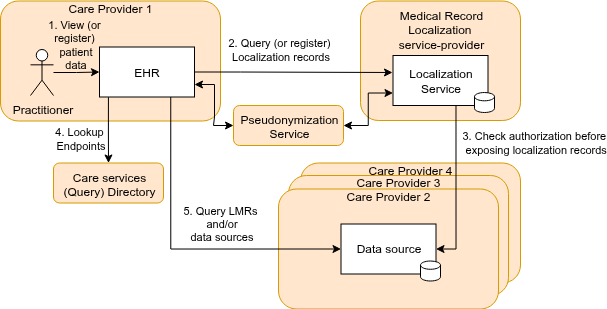
For more detail on the topology of GF-Localization, see GF-Lokalisatie, ADR-2. Each component, data model, and transaction will be discussed in more detail.
A (Medical Record) Localization Service is responsible for managing the registration, maintenance, and publication of localization records. It should be able to create and update localization records. A Localization Service MUST implement these FHIR capabilities
The Pseudonymization Service is responsible for creating and retrieving Polymorphic Pseudonyms of Patient identifiers. More information will follow.
Within GF-Localization the NL-gf-localization-List profile is used to register, search, and validate localization records (NL-GF-IG, ADR#10). This data model basically states "Care provider X has data of type Y for Patient Z". It contains the following elements:
One of things you can do to mitigate privacy risks: Please don't put dates or other privacy-sensitive data into the localization records since it can expose the identity patient
Patient identifier BSN (BurgerServiceNummer) is pseudonymized to enhance patient privacy. The pseudonymization service will ensure that patient identities are protected while still allowing organizations to use a joint index.(GF-Lokalisatie, ADR-1)
Authentication and authorization follows the GF Authorization specification. The required authentication and authorization attributes for Localization Service are:
For POST operations (registering localization records):
For GET operations (querying localization records):
For HEAD operations (checking access for data requester at data holder by localization service):
The 'HEAD operation and use of existing (FHIR) APIs' is evaluated in the Proof of concept phase. Other solutions are discussed on this page
These attributes ensure proper access control and auditing while maintaining the security requirements outlined in the GF Authorization specification.
Scenario: Dr. Carter, a radiologist at a care provider organization, performs an imaging study for a patient. To enable data discovery by other healthcare professionals, Dr. Carter's organization must register the existence of this imaging data in the national localization index (NVI). This process involves pseudonymizing the patient's identifier, creating a localization record, and submitting it to the NVI with the appropriate authorization attributes.
The following diagram illustrates the registration workflow, including interactions between the radiologist, the PACS system and the NVI. For brevity, interactions to the Pseudonymization Service are left out here.
Scenario: Dr. Smith, a cardiologist at Hospital A, is treating a patient who was recently referred from another hospital. She needs to know what imaging data (X-rays, CT scans, MRIs) might be available from other healthcare providers to avoid unnecessary duplicate examinations and to get a complete picture of the patient's medical history.
For brevity, interactions to the Pseudonymization Service are left out here.
Potential future enhancements to the Localization Service include: