GP Chronic Condition Management Plan, published by AEHRC CSIRO. This guide is not an authorized publication; it is the continuous build for version 0.1.0 built by the FHIR (HL7® FHIR® Standard) CI Build. This version is based on the current content of https://github.com/aehrc/gpccmp-fhir-ig/ and changes regularly. See the Directory of published versions
General Requirements
Systems compatible with the GP Chronic Condition Management Plan (GPCCMP) are required to support healthcare client and provider information conforming to profiles, AND implement the interaction requirements of relevant actor's capability statements defined in this implementation guide.
The requirements of the FHIR standard and FHIR Conformance Rules apply, and define the conformance verbs - SHALL, SHALL NOT, SHOULD, SHOULD NOT, MAY.
This page documents how CapabilityStatements declare conformance to the GPCCMP profiles and their FHIR interactions. It also defines the expectations for mandatory and Must Support elements.
Conformance Artifacts
The Artefacts page lists the GPCCMP profiles defined for this implementation guide. Core profile StructureDefinitions define the minimum elements, extensions, vocabularies, and value sets which SHALL be present when using the profile. Many profile pages also contain additional guidance.
The profile elements consist of both mandatory and Must Support elements. Mandatory elements are elements with a minimum cardinality of 1 (min=1). The base FHIR Must Support guidance requires specifications to define the support expected for profile elements labelled Must Support. The sections below explain how these elements are displayed and define the rules for interpreting profile elements and sub-elements labelled mandatory and Must Support for GP CCMP Server and GP CCMP Client.
Capability Statements
The capability statement page lists the capability statements that are to be supported by systems implementing the GPCCMP actors in this IG.
Exchange Format Support
In FHIR, resources are commonly exchanged in multiple formats including JSON and XML. At a minimum JSON SHALL be supported.
Profile and Interaction Support
The GPCCMP systems support the GPCCMP profiles to represent clinical information and the GPCCMP REST API interactions to access that information. Therefore, the GP CCMP Server SHALL implement and support GPCCMP profiles AND interactions to be compatible with a GP CCMP Client.
Profile Support
Profile support refers to the support of the GPCCMP profiles, such that the system exposes FHIR resources that adhere to the GPCCMP profiles' content model. Specifically, a GP CCMP Server with GPCCMP profile support:
- SHALL communicate all profile data elements that are mandatory by that profile's StructureDefinition.
Interaction Support
Interaction support refers to a system that supports the GPCCMP REST API interactions. Specifically, a server with GPCCMP Interaction support:
- SHALL implement the REST API behavior according to the FHIR specification, including read, search, create and update interactions as required, and the required search parameters as defined in the GP CCMP Server CapabilityStatement.
- SHALL specify the full capability details from the GP CCMP Server CapabilityStatement it claims to implement, including mandatory support for FHIR transactions.
Must Support and Obligations
In the context of GPCCMP, Obligations defines how an actor (GP CCMP Server or GP CCMP Client) must “support” a given element. All Must Support elements in this IG are accompanied by an explicit obligation, which identifies structured expectations for a given actor. If a Must Support element has no obligation for a given actor, that element need not be supported by that actor.
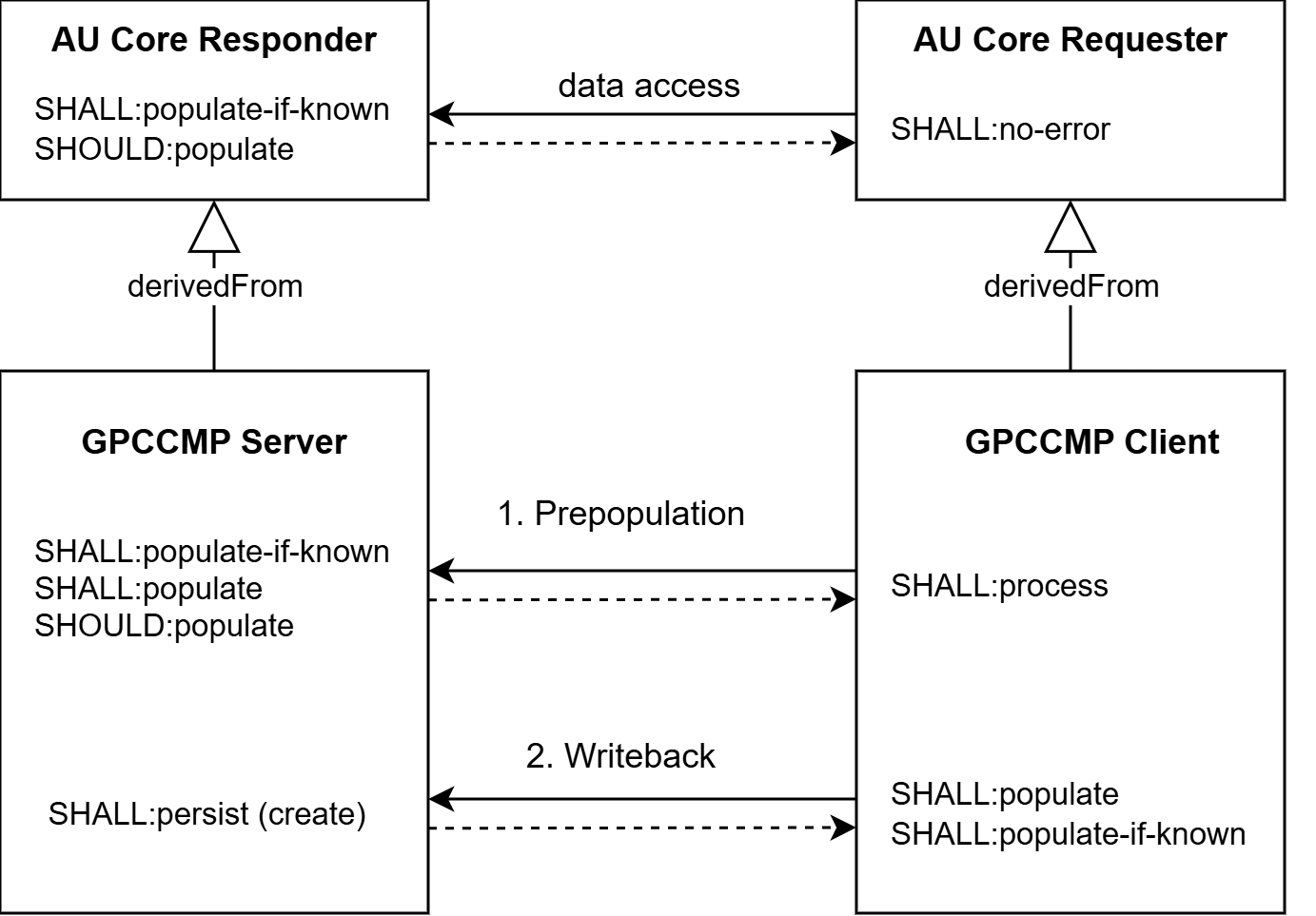
GPCCMP profiles are derived from AU Core profiles, hence any elements flagged as Must Support in AU Core are also Must Support in the GPCCMP profiles of this implementation guide. The GP CCMP Server and GP CCMP Client actors are derived from AU Core Responder and AU Core Requester respectively, hence the actor obligations are inherited from AU Core as the default obligations in the GPCCMP profiles. Additional obligations constrain and augment these defaults as required, to support the prepopulation and writeback requirements of each actor in this implementation guide.
The actor obligations of Must Support elements are specified in the element description of each GPCCMP profile.
Obligation Code Definitions
The Obligation codes are defined in the FHIR Extensions Obligation Codes ValueSet. The Obligation codes used within this implementation guide are summarised below, with descriptions of how the data elements are expected to be supported by each actor.
Obligations are specified for each actor in the context of two sets of interactions:
- data access for prepopulation of the GP CCMP form; and
- writeback of data (QuestionnaireResponse) to the GP CCMP Server.
The figure below illustrates the relationship between the GPCCMP and AU Core actors, the default Must Support Obligations inherited from AU Core actors, and the additional Obligations of each GPCCMP actor specified for the Prepopulation and Writeback interactions.
Obligations for GP CCMP Server
A GP CCMP Server actor SHALL support the data usage expectations specified in the Obligations of the GP CCMP Server actor for each Must Support element.
The GP CCMP Server actor derives from AU Core Responder actor, hence the Must Support elements in GPCCMP profiles that are derived from AU Core profiles inherit the default SHALL:populate-if-known obligation for data access interactions. This requires the GP CCMP Server to populate an element if that element is available. There are a few potential reasons why a Must Support element may not be available, for example:
- a system may not have the capability to collect a data element, therefore is not expected to ever provide a value
- for a particular patient, a value may not be available for a data element, but in some cases a value is provided
- a value is available, but the GP CCMP Client or its user is not authorized to access the data, therefore the value is not provided.
The GPCCMP profiles may specify additional obligations for the GP CCMP Server actor related to data access for prepopulation and writeback interactions. These include:
| Code | Interactions | GP CCMP Server Obligations |
|---|---|---|
| SHALL:populate-if-known | Prepopulation | Indicates the element SHALL be populated where a value is known, it is important for prepopulation, however missing data is allowed. |
| SHALL:populate | Prepopulation | Indicates the element SHALL be capable of being populated when a value is known and allowed to be shared. It is required for search queries or prepopulation and hence always populated. |
| SHOULD:populate | Prepopulation | Indicates the element SHOULD be capable of being populated. It is important for prepopulation, however missing data is allowed. |
| SHALL:persist | Writeback | Indicates where the element is populated, the value SHALL be stored in a persistent store. |
Obligations for GP CCMP Client
The GP CCMP Client actor SHALL support the data usage expectations specified in the Obligations of the GP CCMP Client actor for each Must Support data element. The GP CCMP Client actor derives from the AU Core Requester actor, hence the Must Support elements in GPCCMP profiles that are derived from AU Core profiles inherit the default SHALL:no-error obligation for data access interactions. This requires the GP CCMP Client actor to accept resources containing any valid value for the element without error, including missing data and data absent reason codes and extensions.
The GPCCMP profiles may specify additional obligations for the GP CCMP Client actor related to data access for prepopulation and writeback interactions, these may include:
| Code | Interactions | GP CCMP Client Obligations |
|---|---|---|
| SHALL:process | Prepopulation | Indicates the element SHALL be processed as part of prepopulation. |
| SHALL:populate-if-known | Writeback | Indicates the element SHALL be populated when a value is available, either from prepopulation or user entry. |
| SHALL:populate | Writeback | Indicates the element SHALL be populated as a value will always be known and allowed to be shared. |
Must Support - Resource References
Some elements labelled as Must Support allow references to multiple resource types or profiles (e.g. MedicationStatement.reasonReference). These Must Support elements and their actor obligations could be inherited from the base AU Core profile. Since GP CCMP Server and GP CCMP Client are derived from AU Core Responder and AU Core Requester actors respectively:
- GP CCMP Server SHALL populate a known reference value to at least one resource type or profile allowed by the element
- GP CCMP Client SHALL accept with no error all resource types or profiles allowed by the element.
Additionally, GPCCMP actor obligations that support writeback can be specified on elements that reference multiple resource types or profiles. In this case:
- GP CCMP Server SHALL persist a valid reference for all resource types or profiles allowed by the element
- GP CCMP Client SHALL correctly populate a reference to at least one resource type or profile allowed by the element.
As of this version of the GPCCMP IG, there are no GPCCMP profiles with Must Support element with writeback obligations that allow multiple resource types or profiles. The writeback obligations guidance above is provided in case a future version of this IG does allow a Must Support element with multiple resource types or profiles.
Must Support - Choice of Data Types
Some elements labelled as Must Support allow values of different data types (e.g., Condition.onset[x]). These 'choice elements' can inherit the Must Support label and obligations from the base AU Core profile. Since GP CCMP Server and GP CCMP Client are derived from AU Core Responder and AU Core Requester actors respectively, the GPCCMP actor obligations default to their respective AU Core actor obligations and can have additional obligations specific to them. The following guidance describes how these obligations are to be interpreted for various scenarios.
Inherited AU Core Obligations
Where a 'choice element' (e.g. Condition.onset[x]) has Must Support inherited from AU Core, the following conformance requirements apply:
- GP CCMP Server SHALL populate choice elements using at least one data type if a value is known
- GP CCMP Client SHALL accept with no error for all data types.
For example, when claiming conformance to the GPCCMP Condition:
- GP CCMP Server SHALL populate a known value using either
Condition.onsetDateTime,Condition.onsetAge,Condition.onsetPeriodorCondition.onsetRangedepending on type of data available - GP CCMP Client SHALL accept without error valid data in either
Condition.onsetDateTime,Condition.onsetAge,Condition.onsetPeriodorCondition.onsetRange.
Additional GPCCMP Obligations
Prepopulation
GPCCMP actors can have additional obligations applied to 'choice elements' to support prepopulation requirements.
A 'choice element' with an inherited AU Core Must Support can also label a specific data type as Must Support with GP CCMP Server obligation of SHOULD:populate and GP CCMP Client obligation of SHALL:process. In this case, the:
- GP CCMP Server SHALL populate a known value in the choice element, and SHOULD populate the choice element using the Must Support data type
- GP CCMP Client SHALL accept without error all valid data types, and SHALL process the choice element using the Must Support data type.
For example, when claiming conformance to the GPCCMP Condition:
- GP CCMP Server SHALL populate at least one of
Condition.onsetDateTime,Condition.onsetAge,Condition.onsetPeriodorCondition.onsetRangeif a value is known, and SHOULD populateCondition.onsetDateTime - GP CCMP Client SHALL accept without error valid data in
Condition.onsetDateTime,Condition.onsetAge,Condition.onsetPeriodorCondition.onsetRange, and SHALL processCondition.onsetDateTime.
Writeback
AU Core actors do not have obligation requirements related to writeback, therefore the writeback requirements for GPCCMP Must Support elements will be specified solely using GPCCMP actor obligations.
The current scope of writeback includes the QuestionnaireResponse resource only. The GPCCMP Questionnaire Response does not derive from an AU Core profile (as one does not exist) and hence has no inherited actor obligations. Therefore, this profile's Must Support obligation requirements are defined using GPCCMP actors.
There is only one example of a 'choice element' labelled Must Support in the GPCCMP Questionnaire Response: QuestionnaireResponse.item.answer.value[x]. This element has prepopulation and writeback requirements without any specific Must Support datatype. In this case, the GP CCMP Server obligations of SHALL:populate-if-known and SHALL:persist, and GP CCMP Client obligations of SHALL:process and SHALL:populate-if-known are applicable. For choice elements with prepopulation and writeback requirements:
- GP CCMP Server SHALL correctly populate a known value for the choice element using at least one data type allowed by the element
- GP CCMP Server SHALL persist a valid value for all data types allowed by the element
- GP CCMP Client SHALL process valid data for all data types of the choice element
- GP CCMP Client SHALL correctly populate a known value for the choice element using at least one data type allowed by the element.
When claiming conformance to the GPCCMP Questionnaire Response:
- GP CCMP Server SHALL populate a known value using at least one of types allowed for
QuestionnaireResponse.item.answer.value[x] - GP CCMP Server SHALL persist a valid value for all data types allowed for
QuestionnaireResponse.item.answer.value[x] - GP CCMP Client SHALL process valid value for all data types allowed for
QuestionnaireResponse.item.answer.value[x] - GP CCMP Client SHALL populate a known value using at least one of types allowed for
QuestionnaireResponse.item.answer.value[x].
Missing Data
There are situations when information on a particular data element is missing, and the source system does not know the reason for the absence of data.
Optional And Must Support Elements
If the GP CCMP Server does not have data for an element with a minimum cardinality = 0 (including elements labelled Must Support), the data element SHALL be omitted from the resource.
Required And Must Support Elements
If the GP CCMP Server does not have data to be included, the reason for the absence has to be specified as follows:
- For non-coded data elements, use the DataAbsentReason Extension in the data type.
- For coded data elements:
- example, preferred, or extensible binding strengths (CodeableConcept datatypes):
- if the source systems have text but no coded data, only the text element is used.
- if there is neither text nor codes representing actual (i.e., non-exceptional) concepts:
- use the appropriate exceptional concept code from the value set if available
- use the appropriate concept code from the DataAbsentReason Value Set if the value set does not have it.
- required binding strength (CodeableConcept or code datatypes):
- use the appropriate exceptional concept code from the value set
- example, preferred, or extensible binding strengths (CodeableConcept datatypes):
Accepting and Processing Must Support Elements With Missing Data
A GP CCMP Client SHALL be able to accept resource instances containing data elements asserting missing data without error. This is except for when the Must Support element has a GP CCMP Client obligation of SHALL:process and a GP CCMP Server obligation of SHALL:populate, where the GP CCMP Client MAY report an error due to not being able to perform the prepopulation process.