


Verifiable Health Links
1.0.0-comment - ballot

Verifiable Health Links
1.0.0-comment - ballot
Verifiable Health Links, published by IHE IT Infrastructure Technical Committee. This guide is not an authorized publication; it is the continuous build for version 1.0.0-comment built by the FHIR (HL7® FHIR® Standard) CI Build. This version is based on the current content of https://github.com/IHE/ITI.VHL/ and changes regularly. See the Directory of published versions
As individuals move within or across jurisdictional boundaries, they may wish to provide access to clinical or other health-related documents to a defined set of trusted parties who are authorized to access their records. This access may be granted for a single document or for a set of related documents.
The Verifiable Health Links (VHL) profile defines a set of protocols and patterns that enable health documents to be shared in a verifiable and auditable manner—both within and across jurisdictions. Central to this profile is the concept of the VHL, a signed artifact that an individual (the VHL Holder) can use to authorize access to their health records from an issuer (the VHL Sharer) to a third party (the VHL Receiver). The mechanisms by which the VHL is held by the Holder or transmitted to the VHL Receiver are out of scope for this profile.
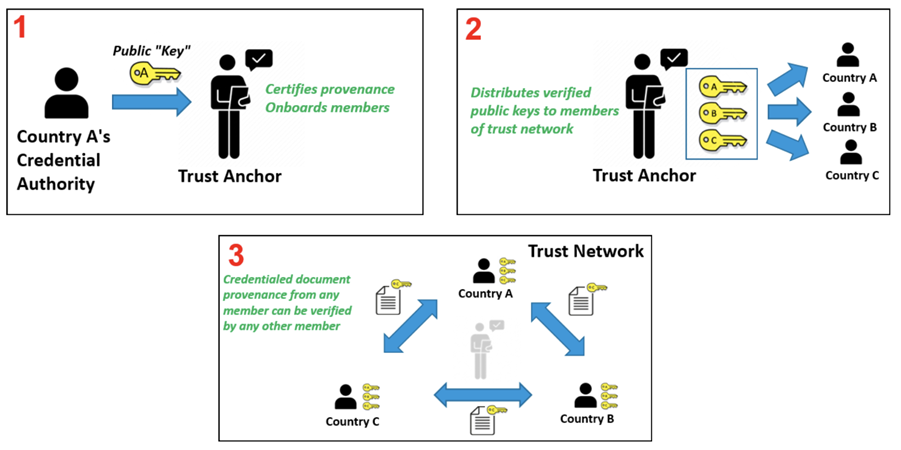
VHL leverages Public Key Infrastructure (PKI) to establish trust among actors and to verify the authenticity and integrity of exchanged artifacts.
Within the VHL trust model, both the VHL Receiver and the VHL Sharer are participants in a shared trust network. This network enables:
The authority to participate in the trust network is governed by each actor's jurisdiction, which determines eligibility and onboarding criteria. A participant's authorization is established through PKI, by validating its certificate chain against material established at onboarding and published by the Trust Anchor.
Jurisdictions may also impose specific regulatory requirements on the privacy and security of health data exchange. These may include mandatory consent verification, audit logging, or other compliance controls that impact how VHL-based exchanges are implemented.
As members of a trust network, both the VHL Receiver and the VHL Sharer publish their own PKI material to the Trust Anchor and retrieve that of other participants from it, typically as a signed Trust List. The precise onboarding and credential issuance processes used to establish trust with the Trust Anchor are implementation-specific and beyond the scope of this profile.
Relationship to SMART® Health Links (SHL):
A VHL adopts the payload format and manifest-request parameters defined in the SMART Health Links specification. The fundamental difference is the trust model: VHL assumes a pre-established trust relationship between the VHL Sharer and the VHL Receiver, verified via PKI material exchanged through Trust Lists, whereas SHL assumes no prior trust, access following from possession of the link and the key it carries. See Appendix A for a side-by-side comparison.
Terminology used in this IG:
- VHL payload — a concrete instance populated by the VHL Sharer and carried by a VHL (inside an HCERT/CWT QR code, or inside a signed Verifiable Credential under the VC Enveloped VHL Option). Instance-level references in this IG say "VHL payload".
- SHL payload format / SHL payload structure — the schema (field names and shapes) that the VHL payload conforms to. Where this IG refers to the inherited schema itself, it uses "SHL payload format".
- SHL-defined manifest parameters —
recipient,passcode,embeddedLengthMax, etc., as defined by the SHL specification and reused here.- Actors in this IG are always the VHL Holder, VHL Sharer, and VHL Receiver — never "SHL Receiver" or "SHL Sharer" (those terms only appear in the comparison at Appendix A).
This profile assumes the reader is familiar with the IHE Technical Frameworks General Introduction and with HL7 FHIR R4. VHL builds on the specifications below, and readers new to any of them should consult them before reading the transaction definitions.
This section defines the actors, transactions, and/or content modules in this profile. Further information about actor and transaction definitions can be found in the IHE Technical Frameworks General Introduction Appendix A: Actors and Appendix B: Transactions.
Trust between the VHL Receiver and the VHL Sharer MAY be established through:
This is illustrated in Figure 1:XX.1-1.
Figure 1:XX.1-1: Trust Network PKI Exchange
The process of a VHL Holder requesting a VHL for a set of health documents from a VHL Sharer and subsequently sharing them to a VHL Receiver is illustrated in Figure 1:XX.1-2.
Figure 1:XX.1-2: VHL Generation, Provision, and Document Retrieval Flow
Table 1:XX.1-1 lists the transactions for each actor directly involved in the VHL Profile. To claim compliance with this profile, an actor shall support all required transactions (labeled "R") and may support the optional transactions (labeled "O").
Table 1:XX.1-1: VHL Profile - Actors and Transactions
| Actors | Transactions | Initiator or Responder | Optionality | Reference |
|---|---|---|---|---|
| Trust Anchor | Submit PKI Material with DID | Responder | R | ITI TF-2: 3.YY1 |
| Retrieve Trust List with DID | Responder | R | ITI TF-2: 3.YY2 | |
| VHL Holder | Generate VHL | Initiator | R | ITI TF-2: 3.YY3 |
| Provide VHL | Initiator | R | ITI TF-2: 3.YY4 | |
| VHL Receiver | Submit PKI Material with DID | Initiator | O | ITI TF-2: 3.YY1 |
| Retrieve Trust List with DID | Initiator | O | ITI TF-2: 3.YY2 | |
| Provide VHL | Responder | R | ITI TF-2: 3.YY4 | |
| Retrieve Manifest | Initiator | R | ITI TF-2: 3.YY5 | |
| VHL Sharer | Submit PKI Material with DID | Initiator | O | ITI TF-2: 3.YY1 |
| Retrieve Trust List with DID | Initiator | O | ITI TF-2: 3.YY2 | |
| Generate VHL | Responder | R | ITI TF-2: 3.YY3 | |
| Retrieve Manifest | Responder | R | ITI TF-2: 3.YY5 |
The actors in this profile are described in more detail in the sections below.
An authorized organization in the trust framework that manages and distributes PKI material—such as public key certificates and revocation lists—to participants in the network. It ensures that this material is trustworthy and available, enabling VHL Sharers and VHL Receivers to verify digital signatures and authenticate the origin of shared data.
This actor fulfills the following requirements:
An individual—typically the patient or their delegate—who possesses a Verifiable Health Link (VHL), a signed data artifact that enables a VHL Receiver to verify its authenticity and access one or more health documents made available by a VHL Sharer.
This actor fulfills the following requirements:
A system or organization that receives a Verifiable Health Link (VHL) from a VHL Holder and uses it to retrieve health documents from a VHL Sharer, after verifying the authenticity and integrity of the VHL.
This actor fulfills the following requirements:
The VHL Sharer generates a VHL in response to a request from a VHL Holder, and responds to requests from a VHL Receiver to utilize the VHL.
This actor fulfills the following requirements:
The transactions in this profile are summarized in the sections below.
This transaction is used by a VHL Receiver or VHL Sharer to submit PKI material to a Trust Anchor using Decentralized Identifiers (DIDs).
For more details, see the detailed transaction description.
This transaction is captured as the following requirements:
This transaction is used by a VHL Receiver or VHL Sharer to retrieve a Trust List from a Trust Anchor containing DID Documents with PKI material.
For more details, see the detailed transaction description.
This transaction is captured as the following requirements:
This transaction is used by a VHL Holder to request that a VHL Sharer generate a VHL. By default the VHL is carried as a QR code encoded as an HCERT/CWT structure; where the VHL Sharer supports the VC Enveloped VHL Option it MAY instead be carried as a signed Verifiable Credential.
For more details, see the detailed transaction description.
This transaction is captured as the following requirements:
This transaction is initiated by a VHL Holder to transmit a VHL to a VHL Receiver, either by displaying a QR code for scanning or, where the VHL Sharer supports the VC Enveloped VHL Option, as a signed Verifiable Credential.
For more details, see the detailed transaction description.
This transaction is captured as the following requirements:
This transaction is initiated by a VHL Receiver to retrieve a document manifest from a VHL Sharer using a previously validated VHL as authorization. The transaction uses standard FHIR search on the List resource, following the same pattern as MHD ITI-66 Find Document Lists.
For more details, see the detailed transaction description.
This transaction is captured as the following requirements:
The documents referenced by the returned manifest are retrieved separately, using MHD ITI-68 Retrieve Document; see Request VHL Document.
Options that may be selected for each actor in this implementation guide are listed in Table 1:XX.2-1 below. Dependencies between options when applicable are specified in notes.
Table 1:XX.2-1: VHL Profile - Actor Options
| Actor | Option Name | Reference |
|---|---|---|
| Trust Anchor | No options defined | – |
| VHL Holder | No options defined | – |
| VHL Sharer | Include DocumentReference | Section 1:XX.2.4 |
| ^ | Sign Manifest Request (HTTP Message Signatures) | Section 1:XX.2.1 |
| ^ | Sign Manifest Request (OAuth with SSRAA) | Section 1:XX.2.2 |
| ^ | Sign Manifest Request (Verifiable Credential) | Section 1:XX.2.3 |
| ^ | VC Enveloped VHL | Section 1:XX.2.6 |
| VHL Receiver | Include DocumentReference | Section 1:XX.2.4 |
| ^ | Sign Manifest Request (HTTP Message Signatures) | Section 1:XX.2.1 |
| ^ | Sign Manifest Request (OAuth with SSRAA) | Section 1:XX.2.2 |
| ^ | Sign Manifest Request (Verifiable Credential) | Section 1:XX.2.3 |
| ^ | Verify Document Signature | Section 1:XX.2.5 |
The three Sign Manifest Request Options differ only in the mechanism by which the VHL Receiver presents its credential. Each is optional for both actors, and each is complementary between them: the VHL Receiver side presents the credential, and the VHL Sharer side verifies it and confirms the VHL Receiver's authorization within the trust network before responding. An option is therefore only effective where both actors claim it. An actor MAY claim more than one, in which case the two agree on which to use for a given exchange.
Any of the three provides:
A VHL Sharer claiming one of these options rejects a request that carries no credential under that option, or whose credential does not verify against the VHL Receiver's key material obtained from the trust list, returning 401 Unauthorized. Where neither actor claims any of the three, the VHL Sharer does not establish the identity of the requester, and access to the manifest follows from possession of the VHL and, where the P flag is set, the passcode. A deployment that requires the identity of the requester to be established — by jurisdictional policy, by regulation, or under a data sharing agreement — therefore requires one of these options of both actors. What the options do and do not establish is set out in 2:3.YY5.1 Scope.
Under this option the VHL Receiver signs selected components of the outgoing HTTP manifest request with its trust-network key per RFC 9421, and the VHL Sharer verifies that signature against the VHL Receiver's public key from the trust list. Authentication is carried entirely within the HTTP request, so neither a token endpoint nor a prior credential exchange is needed.
The option is defined in 2:3.YY5.4.1.4.
Under this option the VHL Receiver presents an OAuth 2.0 access token obtained as defined in the HL7 Security for Scalable Registration, Authentication, and Authorization IG (SSRAA), using OAuth Backend Services with JWT client assertions, and the VHL Sharer validates that token. The two actors complete SSRAA Discovery and Dynamic Client Registration beforehand, and a VHL Sharer claiming this option publishes its FHIR base URL in the VHL payload at Generate VHL [ITI-YY3] so that the VHL Receiver can reach the authorization server.
The option is defined in 2:3.YY5.4.1.5.
Under this option the VHL Receiver self-issues a JSON-LD Verifiable Credential whose subject is the manifest it decoded from the VHL, signs it with its trust-network key as an embedded DataIntegrityProof, and sends that credential as the manifest request body; the VHL Sharer verifies the proof against the trust network. No HTTP-level signing is required, because the credential is the request. This option additionally binds the request to the particular VHL the VHL Receiver decoded, and is the one option in which the VHL Receiver can state, inside the signature, the agreement it acts under and the purpose it asserts.
The option is defined in 2:3.YY5.4.1.6.
The Include DocumentReference Option enables the VHL Sharer to process the _include=List:item parameter in manifest requests and return DocumentReference resources along with the List resource in a single response. A VHL Receiver supporting this option includes _include=List:item in the manifest request; otherwise it retrieves each referenced DocumentReference separately.
Benefits:
Implementation Note: When generating VHLs in ITI-YY3, VHL Sharers supporting this option SHOULD include _include=List:item in the manifest URL. VHL Sharers not supporting this option SHOULD NOT include the _include parameter in the manifest URL.
See ITI-YY5 Section 2:3.YY5.4.2.2 Message Semantics and 2:3.YY5.4.1.3 Expected Actions for detailed behavior.
In this option the VHL Receiver, after receipt of a digitally signed document from a VHL Sharer, shall verify the digital signature using previously retrieved PKI material. This key material may or may not be distributed under the same trust network under which the VHL was distributed. This key material may or may not be the same key material that was used to verify the VHL.
See DSG - Document Digital Signature for a discussion of the relationship of this option to the IHE Document Signature profile.
This option is captured in the following business requirement:
The VC Enveloped VHL Option enables the VHL Sharer to return the VHL as a signed W3C Verifiable Credential (application/vc) instead of a QR code in the ITI-YY3 Generate VHL transaction. The VC is subsequently transmitted to the VHL Receiver via ITI-YY4 Provide VHL as an alternative carrier to the HCERT/CWT QR code.
This option provides:
DataIntegrityProof chains to the same trust anchors used for HCERT/CWT verification (no new trust framework introduced)How It Works:
When the caller of $generate-vhl sets format=vc and the VHL Sharer supports this option, the VHL Sharer returns the VHL as the credentialSubject.id of a VC issued per the W3C Verifiable Credentials Data Model v2, with an embedded DataIntegrityProof signed by the VHL Sharer using its trust-network key. The value carried is the VHL payload as a base64url-encoded vhlink: URI; the QR carrier places the same payload fields at HCERT claim key 5 as a CBOR map, so the two carriers convey the same payload in different encodings. If the option is not supported and format=vc is requested, the VHL Sharer SHALL return an OperationOutcome error.
Naming Note: This option (a Sharer option carrying the VHL) is distinct from the Sign Manifest Request Option (Verifiable Credential), in which the VHL Receiver self-issues a VC as the manifest request body at ITI-YY5.
See ITI-YY3 Section 2:3.YY3.4.1.2.1 Output Carrier Options for VC construction, ITI-YY4 Section 2:3.YY4.4.1.2 Message Semantics for transmission, and ITI-YY4 Section 2:3.YY4.4.1.3 Expected Actions for decoding.
The following actor groupings are required for secure operations within the VHL trust network:
Table 1:XX.3-1: VHL Profile - Required Actor Groupings
| VHL Actor | Grouping Condition | Actor(s) to be grouped with | Reference |
|---|---|---|---|
| VHL Receiver | Required for ITI-YY5 | ITI ATNA / Secure Node or Secure Application | ITI TF-1: 9.1 |
| VHL Sharer | Required for ITI-YY5 | ITI ATNA / Secure Node or Secure Application | ITI TF-1: 9.1 |
| VHL Sharer | Required for serving document binaries referenced from DocumentReference.content.attachment.url |
ITI MHD / Document Responder (ITI-68) | ITI TF-2: 3.68 |
| VHL Receiver | Required for retrieving document binaries referenced from DocumentReference.content.attachment.url |
ITI MHD / Document Consumer (ITI-68) | ITI TF-2: 3.68 |
| Trust Anchor | – | None | – |
| VHL Holder | – | None | – |
Note: The VHL Receiver and VHL Sharer SHALL be grouped with ATNA Secure Node or Secure Application to support the secure channel requirements of the ITI-YY5 Retrieve Manifest transaction.
Note: The VHL Sharer SHALL be grouped with an MHD Document Responder so that the binary referenced from DocumentReference.content.attachment.url can be retrieved via ITI-68 Retrieve Document. The VHL Receiver SHALL be grouped with an MHD Document Consumer to perform that retrieval. Document binaries are encrypted as JWE per RFC 7516/7518 using the key from the VHL payload decoded by the VHL Receiver in ITI-YY4; specific JWE algorithms are selected per Cryptographic Algorithm Selection.
This section shows how the transactions/content modules of the profile are combined to address the use cases.
A Verifiable Health Link (VHL) is a mechanism that enables individuals to share access to health documents in a secure, auditable, and configurable manner. Sharing options may include limited-time access, PIN-protected retrieval, or ongoing access to a longitudinal dataset that may evolve over time. VHLs can be rendered as QR codes or downloaded to a user's device, supporting patient-mediated data sharing and enhancing interoperability across healthcare systems.
The use cases below are illustrative. Each describes a program or deployment that exists independently of this profile, and is presented to show where the VHL transactions apply — not as a statement that the deployment implements this profile as specified here.
Across these use cases the transactions combine in the common pattern shown in Figure 1:XX.4.2-1. The VHL Sharer and the VHL Receiver first onboard to a Trust Anchor, submitting their own PKI material with Submit PKI Material with DID and obtaining the trust list with Retrieve Trust List with DID, or through the jurisdiction-specific mechanisms that may be used in their place. A VHL Holder then obtains a VHL from the VHL Sharer with Generate VHL, and presents it to the VHL Receiver with Provide VHL. The VHL Receiver verifies the VHL against the trust list before redeeming it with Retrieve Manifest, then retrieves the documents the manifest references using ITI-68 Retrieve Document. Individual use cases exercise different subsets of this pattern.
Figure 1:XX.4.2-1: VHL Transactions Applicable Across the Use Cases
The World Health Organization (WHO) operates the Global Digital Health Certification Network (GDHCN), a trust network for public-sector health jurisdictions. The GDHCN provides the infrastructure for the bilateral verification and utilization of Verifiable Digital Health Certificates across participating jurisdictions.
The GDHCN uses the notion of a Trust Domain which is defined by a set of:
How Trust is Established:
Trust in the GDHCN is established through a Public Key Infrastructure (PKI). Each participating jurisdiction submits its PKI material — including Signing Certificate Authority (SCA) certificates and Document Signer Certificates (DSCs) — to the WHO Trust Anchor through a formal onboarding process. The Trust Anchor publishes this key material in trust lists that other participants can retrieve and use to verify the digital signatures on health certificates.
DID-Based Trust List Distribution:
The GDHCN distributes trust lists using Decentralized Identifiers (DIDs). Each participating jurisdiction's key material is represented as a DID Document containing verification methods with the jurisdiction's public keys. These DID Documents are published as endpoints by the Trust Anchor, analogous to how the IHE mCSD Profile distributes service endpoints for Organizations. This enables participants to discover and retrieve the PKI material needed for signature verification through a standardized, cacheable, and federated mechanism.
Trust Network Gateway:
The GDHCN Trust Network Gateway (TNG) provides a federated architecture that enables multiple trust anchors and cross-gateway trust propagation. The TNG supports both an API gateway method and DID-based resolution for trust list distribution, ensuring interoperability across diverse jurisdictional implementations.
The PKI operated by the WHO supports a variety of trust domains, two of which — the Hajj Pilgrimage and the Pan-American Highway for Health — are described below.
This use case has the following business requirements:
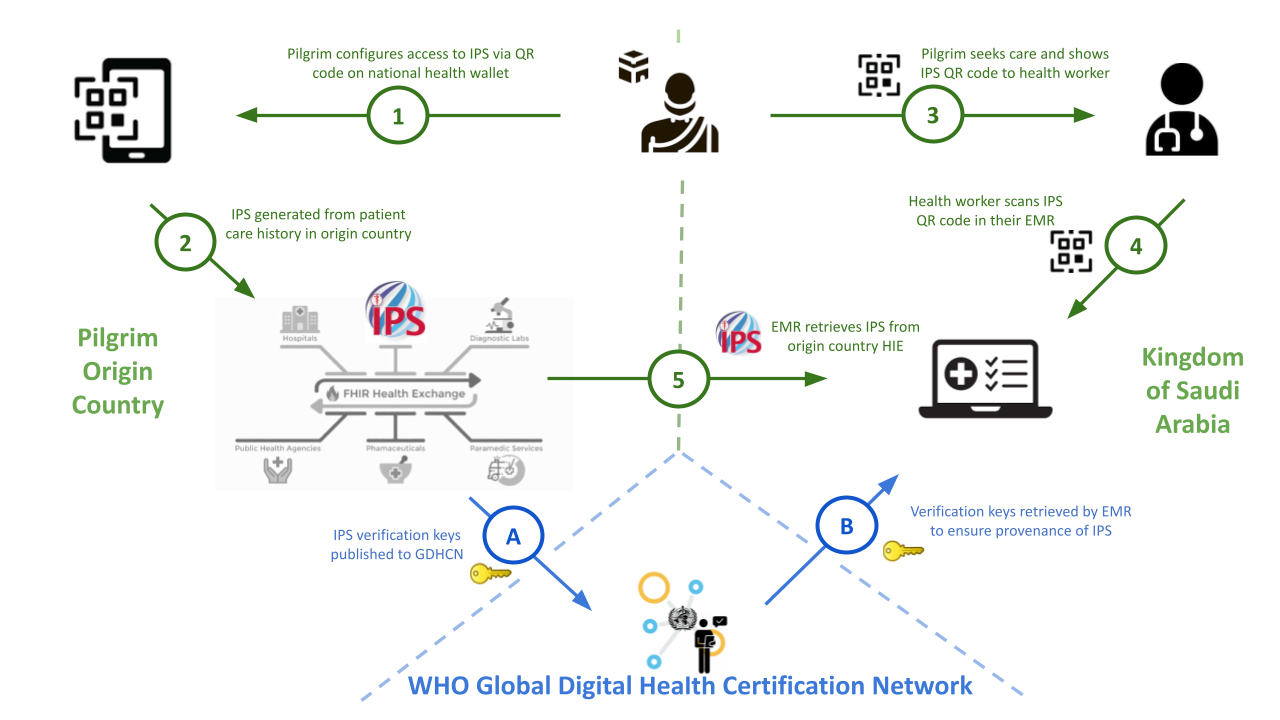
During the Hajj pilgrimage, the Kingdom of Saudi Arabia (KSA) hosts approximately two million pilgrims from across the globe as part of a mass gathering event. Temporary hospitals and clinics, comprising over a thousand beds, are established to provide care to the pilgrims over the four-week period of Hajj.
Starting with Hajj 1445 AH (2024 CE), pilgrims from Oman, Malaysia, and Indonesia were able to share their health records utilizing the International Patient Summary (IPS) with verification of health documents provided through the WHO Global Digital Health Certification Network (GDHCN) infrastructure.
Key Features:
This use case has the following business requirements:
In the region of the Americas, "countries identified several priorities for cross-border digital
health, including optimizing available human resources through international telehealth, validating digital certificates, ensuring continuity of care, and regional resilience to face health emergencies by sharing data for public health. During the IDB-PAHO co-led event, RELACSIS 4.0.1 a plan was launched to strengthen regional digital health services and resilience, through regional data exchange and policy harmonization. Sixteen countries successfully exchanged digital vaccine certificates (COVID-19, Polio, Measles, and Yellow Fever) and critical clinical information (diagnosis, allergy, and prescription information) using international standards during the 2nd Regional LACPASS Connectathon.2 Regional bodies and network such as the Council of Ministers of Health of Central America and the Dominican Republic (COMISCA), The Caribbean Public Health Agency (CARPHA), and the LAC Digital Health Network (RACSEL) have all identified cross-border data sharing as a priority."
footnote
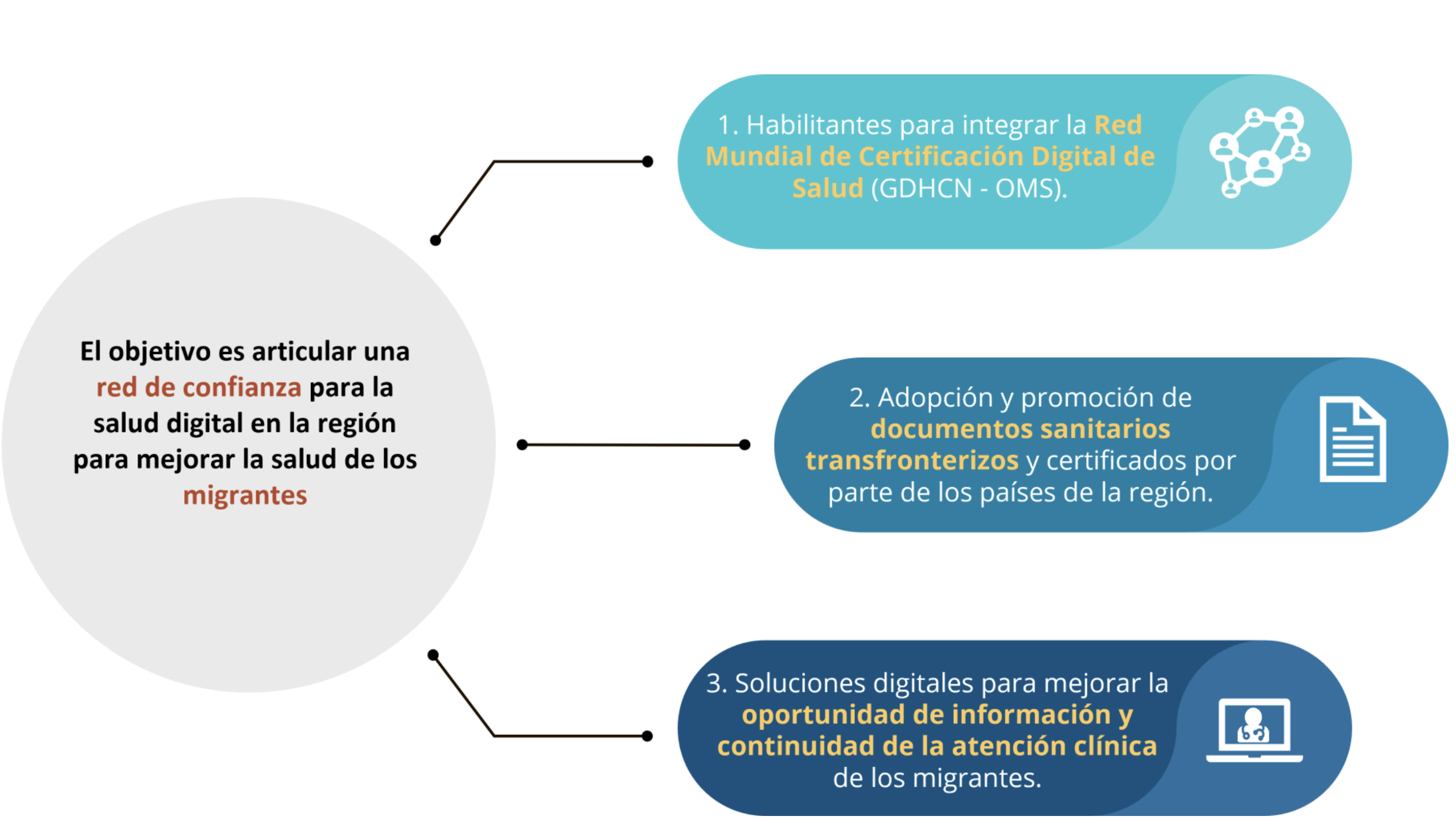
The Pan American Health Organization (PAHO) and the InterAmerican Development Bank (IADB) are supporting the development of policies and digital infrastructrue to support this need. One particular priority is to improve the continuity of care for internal migrants within the region, by ensuring individuals have access to and can share their vaccination records and the International Patient Summary.
The Pan-American Highway for Health (PH4H) "aims to provide patients with better healthcare services, regardless of their location. It will also enhance healthcare for those who move temporarily for work or study, as well as for migrants, by enabling them to share their health history, thus improving their employability and access to education. "
footnote
While there currently there is no single legal framework that broadly enables data sharing across the region, there are sub-regional networks (e.g. COMISCA, CARPHA) that have policies that can be leveraged in the short term while necessary data sharing agreements are developed. Thus, individuals in this region will need to be able to move through overlapping trust networks.
This use case has the following business requirement:
The European Vaccination Card (EVC) is a citizen-held card to foster informed decision-making on vaccination, and improve continuity of care across the EU.
The EVC will allow "Member States to bilaterally verify the authenticity of digital records through an interoperable trust architecture. While similar to the EU Digital COVID Certificate in being a portable vaccination record, the EVC serves a different purpose. Unlike the certificate, which often fulfilled legal or health mandates, the EVC is specifically designed to empower individuals by granting them control over their vaccination information. This empowerment is crucial for ensuring continuity of care for those crossing borders or transitioning between healthcare systems."
The EVC will operate in the context of the European Health Data Spaces that requires detailed information on access the health data to be recorded.
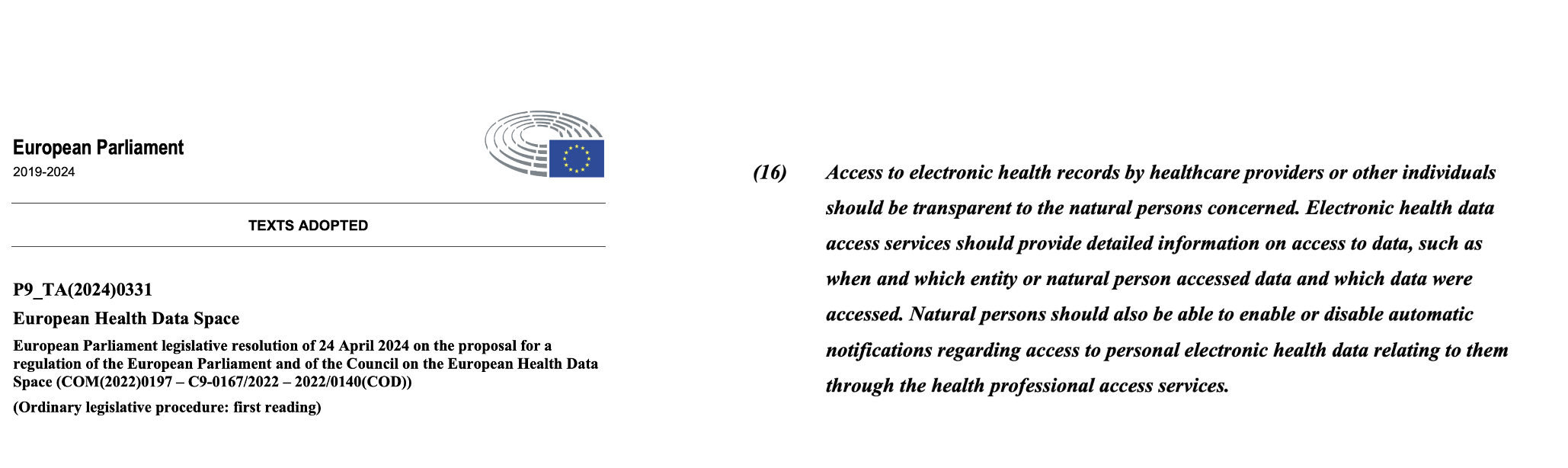
For more information see Regulation (EU) 2025/327 of the European Parliament and of the Council of 11 February 2025 on the European Health Data Space and amending Directive 2011/24/EU and Regulation (EU) 2024/2847. Specifically:
A critical privacy requirement for the EVC is unlinkability: Article 5a(16) of Regulation (EU) No 910/2014 as amended Article 5a(16): The technical framework of the European Digital Identity Wallet shall:
(a) not allow providers of electronic attestations of attributes or any other party, after the issuance of the attestation of attributes, to obtain data that allows transactions or user behaviour to be tracked, linked or correlated, or knowledge of transactions or user behaviour to be otherwise obtained, unless explicitly authorised by the user;
(b) enable privacy preserving techniques which ensure unlinkability, where the attestation of attributes does not require the identification of the user.
The Sign Manifest Request Option (Verifiable Credential) (ITI-YY5 Section 2:3.YY5.4.1.6) is relevant to the EUVAC context: the self-issued VC binds each manifest request cryptographically to the receiver's identity and the specific decoded manifest, ensuring the VHL Sharer can authenticate the receiver without maintaining a persistent session or correlating requests across VHL presentations — supporting the unlinkability requirements above when combined with appropriate key management practices.
This use case has the following business requirement:
The Trusted Exchange Framework and Common Agreement (TEFCA) is a United States initiative established by the Office of the National Coordinator for Health IT (ONC) and operated by the Sequoia Project as the Recognized Coordinating Entity (RCE). TEFCA provides a single on-ramp for nationwide health information exchange by establishing a common set of principles, terms, and conditions that enable nationwide interoperability.
Under TEFCA, Qualified Health Information Networks (QHINs) serve as the primary exchange intermediaries, facilitating data sharing among Health Information Networks (HINs), healthcare providers, payers, and public health agencies. Each QHIN must meet rigorous security, privacy, and technical requirements to participate in the TEFCA ecosystem.
Relevance to VHL:
TEFCA's trust model aligns with the VHL profile's trust network architecture. In the context of VHL:
Sign Manifest Request Option (OAuth with SSRAA):
Organizations already using OAuth with UDAP (via the HL7 SSRAA IG) can leverage VHL for health record sharing without additional authentication infrastructure. TEFCA participants, for example, can use their existing TEFCA-issued X.509 certificates and UDAP Dynamic Client Registration to authenticate VHL exchanges, enabling seamless interoperability within established national-scale health information networks.
This use case has the following business requirements:
VHL is a building block that is meant to be used together with added security measures; otherwise, it is not suitable for exchange in environments where security and provenance cannot be reliably established by other means.
Key security considerations include:
The transactions in this profile (ITI-YY1 through ITI-YY5) rely on cryptographic primitives for digital signatures, message authentication, and content encryption. This IG does not mandate a single algorithm suite for deployment. Implementers select algorithms consistent with the underlying specifications — for example, RFC 9421 (HTTP Message Signatures), RFC 7515/7516/7518 (JWS/JWE/JWA), RFC 8152 (COSE), W3C Data Integrity (Verifiable Credentials), the HL7 SSRAA IG (OAuth with SSRAA), and the WHO SMART Trust specification (HCERT). The preceding list is illustrative, not exhaustive.
Interoperability baseline: For the purpose of interoperability testing, implementations SHALL support ECDSA using curve P-256 and SHA-256 as a common baseline across signature operations. This is ES256 in the JOSE and COSE registries and ecdsa-p256-sha256 in the HTTP Message Signatures registry. A single baseline is possible because this algorithm is expressible in every signature container this profile uses — JWS/JWT, COSE, HTTP Message Signatures, and the W3C Data Integrity ECDSA cryptosuites — and because it is the algorithm the trust networks this profile targets already distribute.
This baseline ensures that two independent conformant implementations can always interoperate during testing. It does not preclude support for — or preferred deployment use of — other algorithms (other ECDSA curves, EdDSA, RSA-PSS, or future post-quantum algorithms).
Where an underlying specification sets its own algorithm requirements, those requirements govern, as listed in Table 1:XX.5.3-1:
Table 1:XX.5.3-1: Algorithm Requirements Set by Underlying Specifications
| Signature operation | Governed by |
|---|---|
| HCERT/CWT signature on the VHL (ITI-YY3, ITI-YY4) | WHO SMART Trust HCERT specification, which defines a primary and a secondary algorithm and requires both to be implemented |
| JWT client assertions and access tokens under the Sign Manifest Request Option (OAuth with SSRAA) at ITI-YY5 | the HL7 Security for Scalable Registration, Authentication, and Authorization IG, which operates on its own X.509 credentials rather than on trust network key material |
DataIntegrityProof on Verifiable Credentials |
the declared cryptosuite, which determines both the canonicalization and the signature algorithm |
| JWE encryption of document binaries (ITI-YY5) | the SMART Health Links encryption convention, which fixes alg=dir and enc=A256GCM so that the symmetric key carried in the VHL payload can be used directly |
Note that a signature algorithm is constrained by the key it is made with: a participant whose trust network key material is an elliptic-curve key cannot produce an RSA signature with it. Implementers selecting algorithms for operations that use trust network keys should begin from the key types their trust framework issues.
Deployment considerations: Implementers SHOULD take into account additional considerations beyond the interoperability baseline when selecting algorithms for production deployments, including but not limited to:
Algorithms named in examples, tables, and code blocks throughout this IG are illustrative. Except for the interoperability baseline stated above, and for the requirements of the underlying specifications listed above, they do not constrain deployment choices. Jurisdictions and trust networks MAY define additional profiles (permitted algorithm lists, minimum key lengths, deprecation schedules) consistent with this guidance.
This section is informative, not normative. It is intended to put this profile in context with other profiles. Any required groupings should have already been described above.
The grouping of the VHL Receiver and the VHL Sharer with an ATNA Secure Node or Secure Application is required for ITI-YY5 and is stated in Section 1:XX.3 Required Actor Groupings. What that grouping brings is Authenticate Node [ITI-19] and the creation of audit records for security-relevant events.
The protection ITI-19 affords depends on which ATNA Secure Transport (STX) option the deployment claims. A Secure Node or Secure Application is required to support at least one STX option, and the available options include STX: No Secure Transport, for which ITI-19 requires no actions because confidentiality is provided by an already-secure network such as an isolated segment or a VPN. Where a TLS option is claimed, ITI-19 specifies mutual authentication using X.509 certificates. The ATNA grouping therefore establishes that the channel is protected by a means the deployment has chosen and declared; it does not by itself establish that TLS, or mutual certificate authentication, is in use.
That protection is distinct from the authentication ITI-YY5 requires. Authenticate Node authenticates the communicating node and secures the channel between nodes; ITI-YY5 authenticates the requesting entity and establishes its authorization within the trust network, and under the Sign Manifest Request Option (Verifiable Credential) additionally binds the request to the particular VHL the VHL Receiver decoded. The authentication options in ITI-YY5 are consequently not made redundant by the ATNA grouping, and an ATNA grouping does not satisfy them.
The IHE Privacy Consent on FHIR (PCF) profile is the recommended companion for capturing, storing, and enforcing patient consent alongside VHL. A VHL Sharer that records consent acts as a PCF Consent Recorder and initiates Access Consent [ITI-108] transactions to record consent declarations by the VHL Holder; this is captured in the Record Consent requirement.
Recommended groupings:
Consent resource when generating a VHL.Consent.provision (actor, purpose, period, class, code).The $generate-vhl operation (ITI-YY3) accepts an optional purposeOfUse input parameter bound (extensible) to the HL7 v3 PurposeOfUse value set. The VHL Sharer persists this value against the generated folder. When the VHL Sharer is grouped with a PCF Consent Recorder or Consent Registry, the value populates Consent.provision.purpose on any Consent created for or bound to the folder. At ITI-YY5, the VHL Sharer MAY reject manifest requests whose purpose claim is inconsistent with the purpose recorded at generation time. Where that claim can travel depends on the Sign Manifest Request Option in use: in the access token or the SSRAA hl7-b2b extension under OAuth with SSRAA, and in credentialSubject.purposeOfUse under the Verifiable Credential option, which also lets the VHL Receiver name the policy it acts under in termsOfUse — a Consent.policyRule among the possibilities. HTTP Message Signatures carry neither.
ITI-YY5 (Retrieve Manifest) reuses the FHIR search machinery of MHD ITI-66 Find Document Lists: the VHL manifest URL constructed at ITI-YY3 is a FHIR List search using the parameters the Document Responder is required to support per ITI-66, and the ITI-YY5 response is an ITI-66 searchset Bundle. Binary retrieval is delegated to MHD ITI-68 Retrieve Document per the required grouping in Section 1:XX.3 Required Actor Groupings.
A trust network needs a way for participants to discover one another's identifiers, and mCSD provides one. A Trust Anchor MAY be grouped with an mCSD Directory so that each participating organization is published as an Organization with an associated Endpoint carrying that participant's DID, and a VHL Receiver or VHL Sharer MAY be grouped with an mCSD Query Client to resolve a participant to its DID by means of Find Matching Care Services [ITI-90]. mCSD states that an endpoint is not limited to a RESTful FHIR server and types it through Endpoint.connectionType, but it defines no connection type for DIDs; a deployment taking this approach therefore establishes that type itself.
This is a discovery mechanism only. The DID so obtained is dereferenced and its contents validated as ITI-YY2 requires, and nothing in an mCSD directory entry confers authority on the key material it leads to.
The Verify Document Signature Option (Section 1:XX.2.5) concerns signatures over the documents themselves, which this profile does not define; the IHE profile that does is Document Digital Signature (DSG). A VHL Receiver supporting the option is correspondingly grouped with a DSG Content Consumer, and a VHL Sharer that signs the documents it shares with a DSG Content Creator.
DSG carries the XML and JSON cases as content modules on those same two actors rather than as separate profiles:
A Content Creator MAY use both. Each actor selects at least one signature form — detached, SubmissionSet, or enveloping — in the XML or JSON variant as applicable.
The key material used for document signature verification may or may not be the same as the key material used to verify the VHL itself, and may or may not be distributed under the same trust network. A VHL Receiver that verifies a document signature is therefore making a second, independent trust decision, and the trust framework that governs the VHL does not necessarily govern the signer of the document.
IG © 2024+ IHE IT Infrastructure Technical Committee. Package ihe.iti.vhl#1.0.0-comment based on FHIR 4.0.1. Generated 2026-11-13
Links: Table of Contents |
QA Report
| New Issue | Issues
Version History |
 |
Propose a change
