|
Type
|
Reference
|
Content
|
|
web
|
github.com
|
FHIR to OMOP FHIR IG, published by HL7 International / Biomedical Research and Regulation. This guide is not an authorized publication; it is the continuous build for version 2.0.0-ballot built by the FHIR (HL7® FHIR® Standard) CI Build. This version is based on the current content of https://github.com/HL7/fhir-omop-ig/
and changes regularly. See the Directory of published versions
|
|
web
|
ohdsi.github.io
|
OMOP Common Data Model Documentation
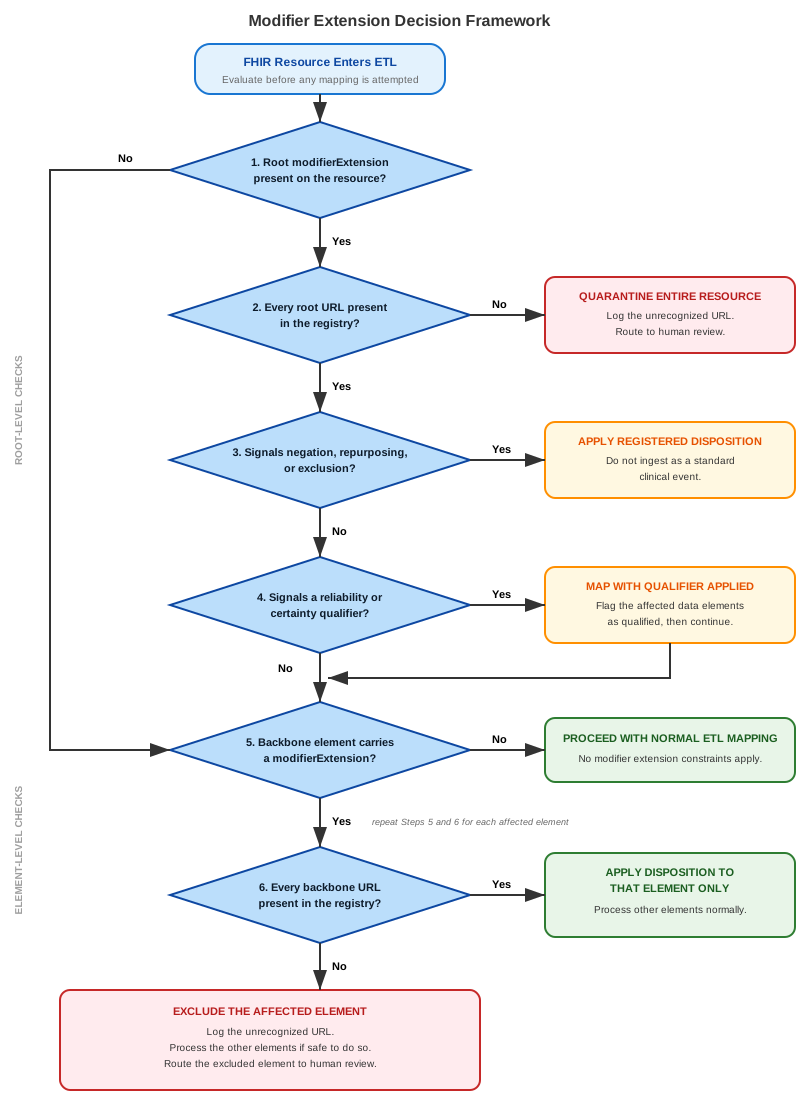
. The field-level specification of the target that these dispositions land in. Every outcome in the decision framework above resolves to a concrete write or a concrete refusal to write: an excluded element, a qualified value, a preserved source value, a concept_id
of 0. Declining to ingest a negated condition is only half a decision. The other half is knowing which CDM table and field would otherwise have received it, and what a downstream analyst will infer from its absence.
|
|
web
|
ohdsi.github.io
|
The OMOP CDM treats race and ethnicity as single-valued demographic attributes on the PERSON
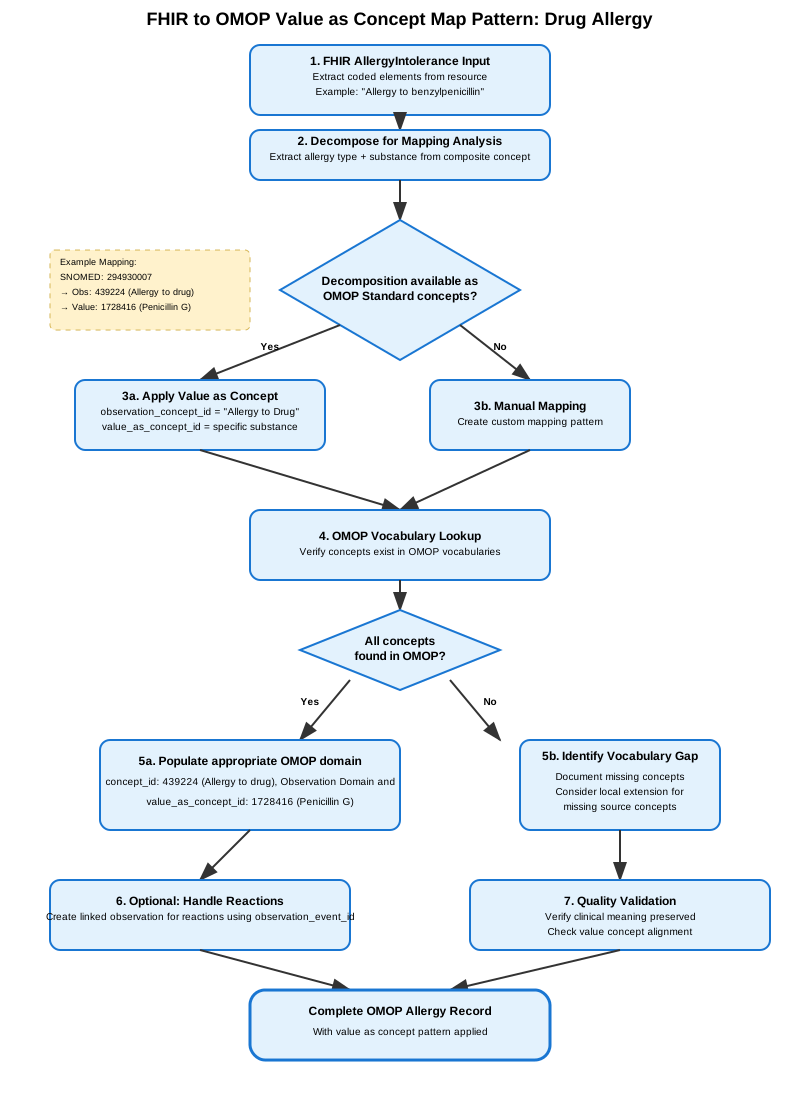
table, populated from a controlled set of Standard concepts in the OHDSI Standardized Vocabularies. When a FHIR source carries a single race value and a single ethnicity value per person, transformation is a direct lookup into the OHDSI Standardized Vocabularies. When a FHIR source carries more than one race value per person, the CDM's single-slot structure is preserved by populating PERSON.race_concept_id
with a designated "more than one race" concept and by capturing each individual race value as a record in the OBSERVATION
table using the Value-as-Concept Pattern
. When a FHIR source carries more than one ethnicity value per person, a structurally parallel pattern applies. Both patterns follow the ratified OHDSI Themis convention for handling multiple races or ethnicities per person
and preserve full downstream analytic access to the individual values while keeping PERSON
compliant with CDM structural rules.
|
|
web
|
athena.ohdsi.org
|
The authoritative, balloted binding for this IG is the OHDSI Race and Ethnicity Value Set described in the next section; the table above identifies the most commonly populated Standard concepts within that value set but is not a substitute for the value set itself. A complete, current listing of Standard race and ethnicity concepts is available through Athena
by filtering on domain_id = 'Race'
or domain_id = 'Ethnicity'
with standard_concept = 'S'
.
|
|
web
|
github.com
|
Open a submission with the OHDSI Themis project at https://github.com/OHDSI/Themis/issues
describing the unmapped source value, so that the mapping gap can be resolved at the vocabulary level rather than worked around in local ETL. This parallels the vocabulary-anomaly reporting pathway described in Reporting Vocabulary Anomalies to the OHDSI Vocabulary Working Group
.
|
|
web
|
athena.ohdsi.org
|
A Standard Concept representing the disease phase, outcome, or other abstraction of which the episode consists. For example, if the EPISODE_CONCEPT_ID is treatment regimen
then the EPISODE_OBJECT_CONCEPT_ID should contain the chemotherapy regimen concept, like Afatinib monotherapy
.
|
|
web
|
athena.ohdsi.org
|
A Standard Concept representing the disease phase, outcome, or other abstraction of which the episode consists. For example, if the EPISODE_CONCEPT_ID is treatment regimen
then the EPISODE_OBJECT_CONCEPT_ID should contain the chemotherapy regimen concept, like Afatinib monotherapy
.
|
|
web
|
athena.ohdsi.org
|
The FACT_RELATIONSHIP table contains records about the relationships between facts stored as records in any table of the CDM. Relationships can be defined between facts from the same domain, or different domains. Examples of Fact Relationships include: Person relationships
(parent-child), care site relationships (hierarchical organizational structure of facilities within a health system), indication relationship (between drug exposures and associated conditions), usage relationships (of devices during the course of an associated procedure), or facts derived from one another (measurements derived from an associated specimen).
|
|
web
|
athena.ohdsi.org
|
The Concept Id representing the country. Values should conform to the Geography
domain.
|
|
web
|
athena.ohdsi.org
|
The meaning of Concept 4172703
for '=' is identical to omission of a OPERATOR_CONCEPT_ID value. Since the use of this field is rare, it's important when devising analyses to not to forget testing for the content of this field for values different from =.
|
|
web
|
ucum.org
|
FHIR Observation units are embedded within the Quantity type structure, typically utilizing standardized systems such as UCUM (Unified Code for Units of Measure)
. The mapping process must preserve unit information through OMOP's unit_concept_id
field in the Measurement table.
|
|
web
|
www.researchallofus.org
|
All collected data are maintained and curated by the All of Us Data and Research Center (DRC)
and are accessible to researchers through the All of Us Researcher Workbench
. The primary data standard and clinical data model utilized by the All of Us Research Program is OMOP.
|
|
web
|
doi.org
|
Renedo, D., Acosta, J. N., Sujijantarat, N., Antonios, J. P., et al. (2022)
. Carotid Artery Disease Among Broadly Defined Underrepresented Groups: The All of Us Research Program.
Stroke, 53. https://doi.org/10.1161/STROKEAHA.121.037554
|
|
web
|
doi.org
|
Khan, M. S., Carroll, R. J. (2022)
. Inference-based correction of multi-site height and weight measurement data in the All of Us Research Program.
Journal of the American Medical Informatics Association, 29(4), 626–630. https://doi.org/10.1093/jamia/ocab251
Additional OMOP concept IDs are included in the article text.
|
|
web
|
doi.org
|
Berman, L., Ostchega, Y., Giannini, J., Anandan, L. P., et al. (2024)
. Application of a Data Quality Framework to Ductal Carcinoma In Situ Using Electronic Health Record Data From the All of Us Research Program.
JCO Clinical Cancer Informatics. https://doi.org/10.1200/CCI.24.00052
|
|
web
|
forums.ohdsi.org
|
Report the gap to the OHDSI vocabulary team via the OHDSI Forums
or the Vocabulary-v5.0 issue tracker
so that the mapping can be added in a future vocabulary release.
|
|
web
|
github.com
|
Report the gap to the OHDSI vocabulary team via the OHDSI Forums
or the Vocabulary-v5.0 issue tracker
so that the mapping can be added in a future vocabulary release.
|
|
web
|
ohdsi.github.io
|
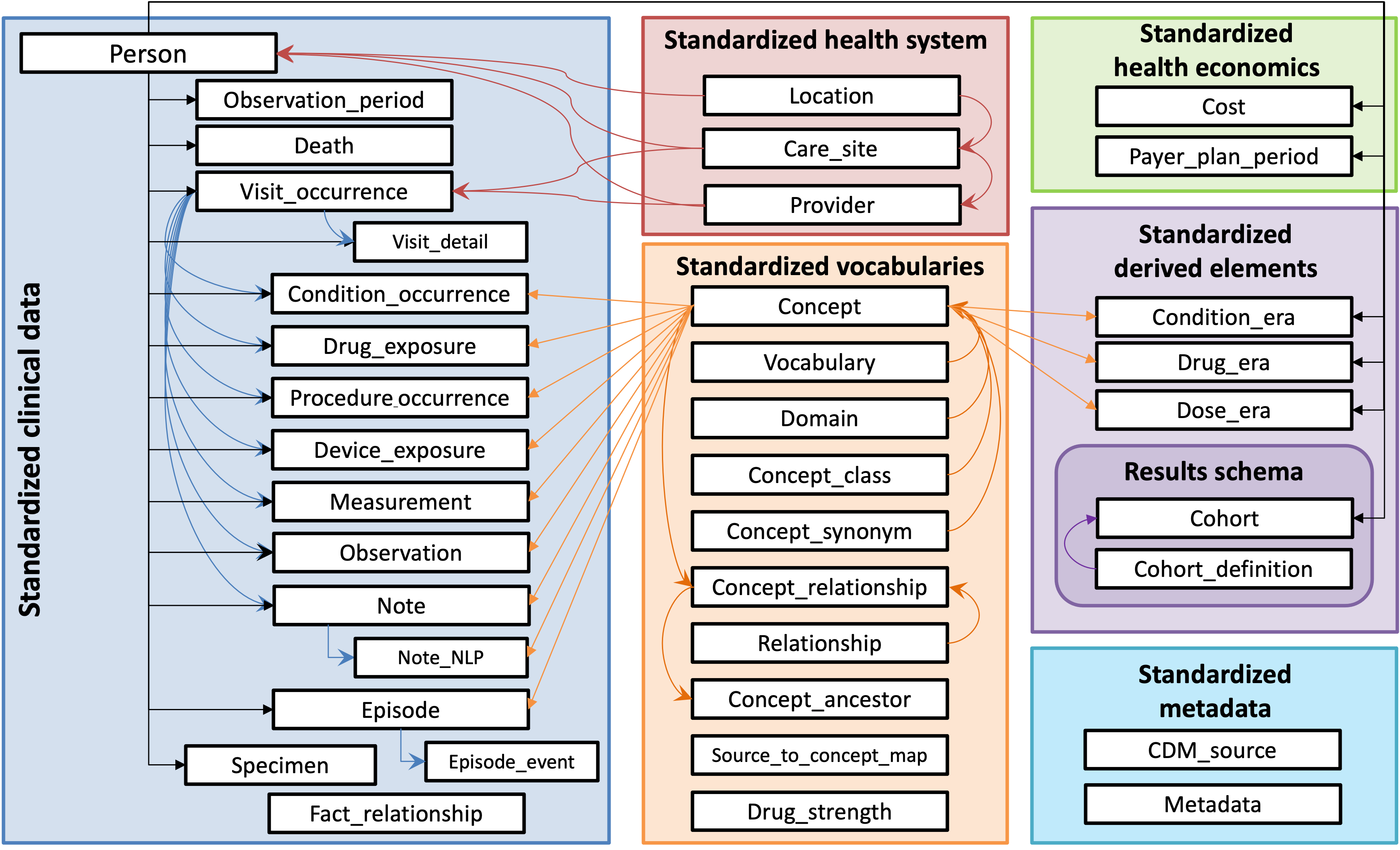
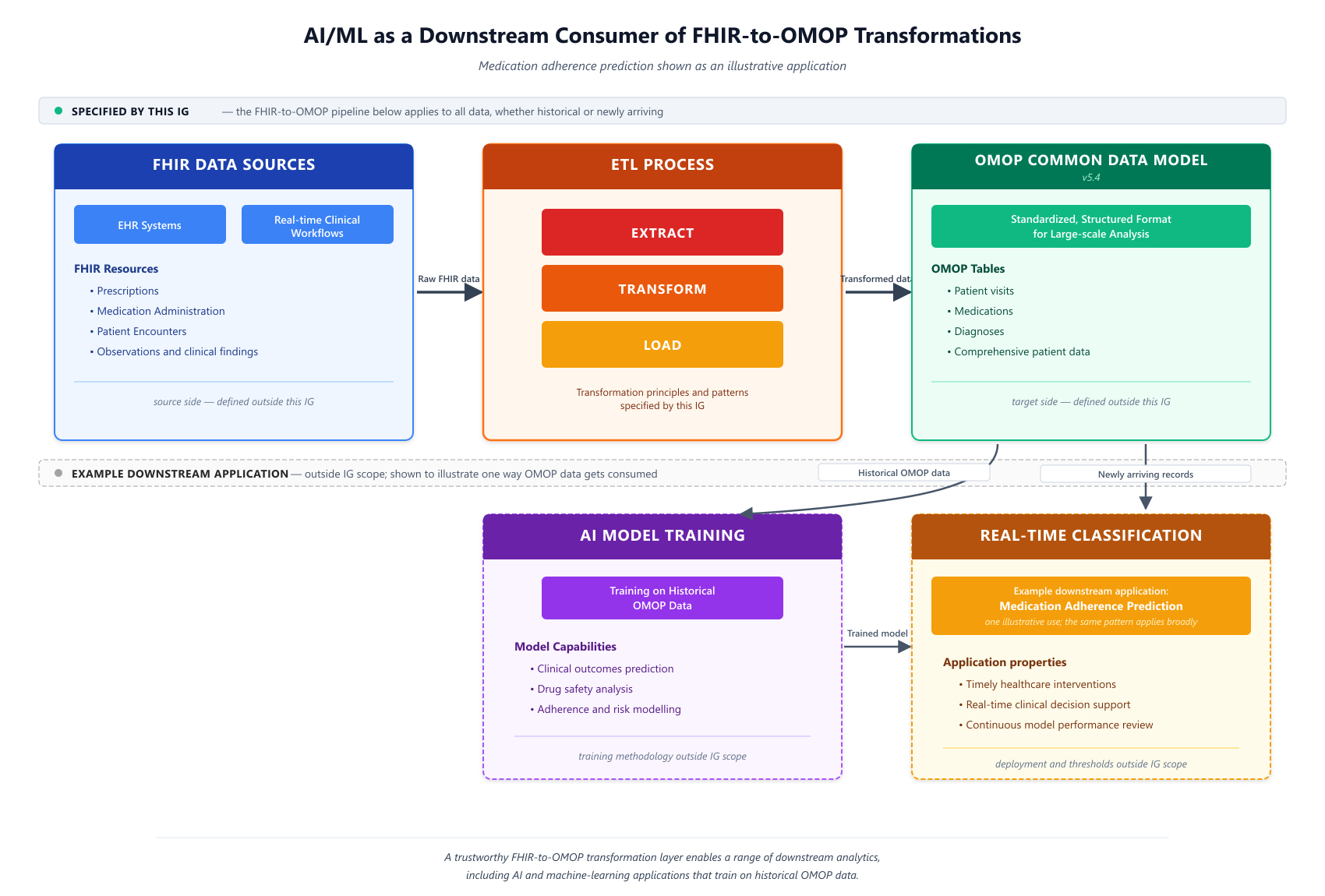
The OMOP CDM is designed for large‑scale aggregation, whether in centralized repositories or distributed research networks. Its domain structure and Standardized Vocabularies allow data from heterogeneous sources, each with distinct schemas and code systems, to be normalized into a single analytic framework. Every concept is assigned a status of Standard
, Non‑Standard
, or Classification
; only one Standard concept exists for each clinical idea within a domain, eliminating ambiguity and enabling cross‑site comparability. (See: OMOP Vocabulary Concept Structure
for additional details)
|
|
web
|
ohdsi.github.io
|
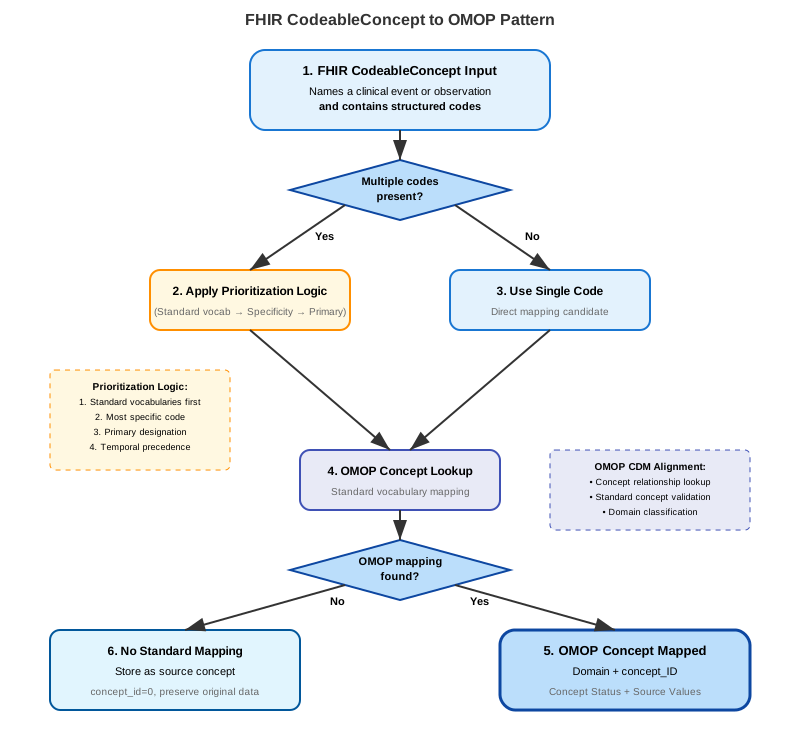
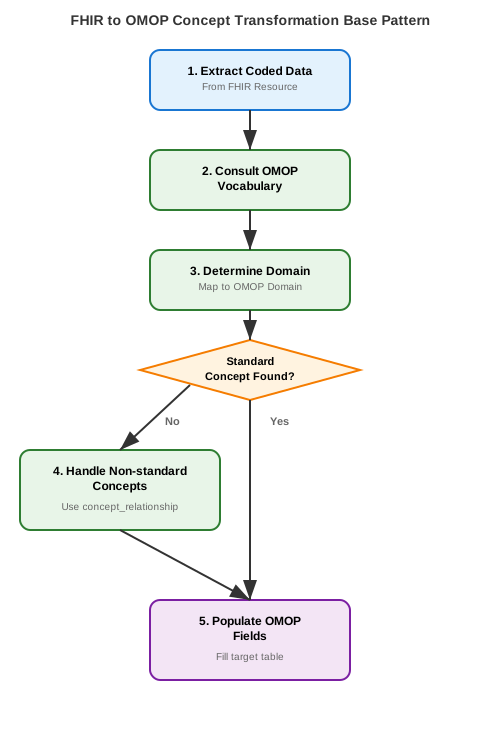
Because a single FHIR resource could contain multiple clinical ideas, each coded element must be evaluated independently. A FHIR Observation could yield Measurement, Condition Occurrence, or Procedure Occurrence records in OMOP, depending on the specific codes it carries. Terminologies commonly used in FHIR, such as LOINC, SNOMED CT, and RxNorm, frequently align with OMOP Standard concepts. In cases where no Standard mapping exists, particularly in cases such as HL7‑maintained value sets, or local codes, extension concepts could be added to the OMOP concept table with concept_id
values of 2,000,000,000 (2 billion) or higher could be created. These “2-billionaires” IDs preserve information without loss and can be retired once the community adopts an official Standard concept. Regular vocabulary updates are therefore essential, both for pipelines ingesting new data and for legacy OMOP datastores. (See: OMOP CDM: Custom Concepts
for more information)
|
|
web
|
athena.ohdsi.org
|
The OHDSI Athena
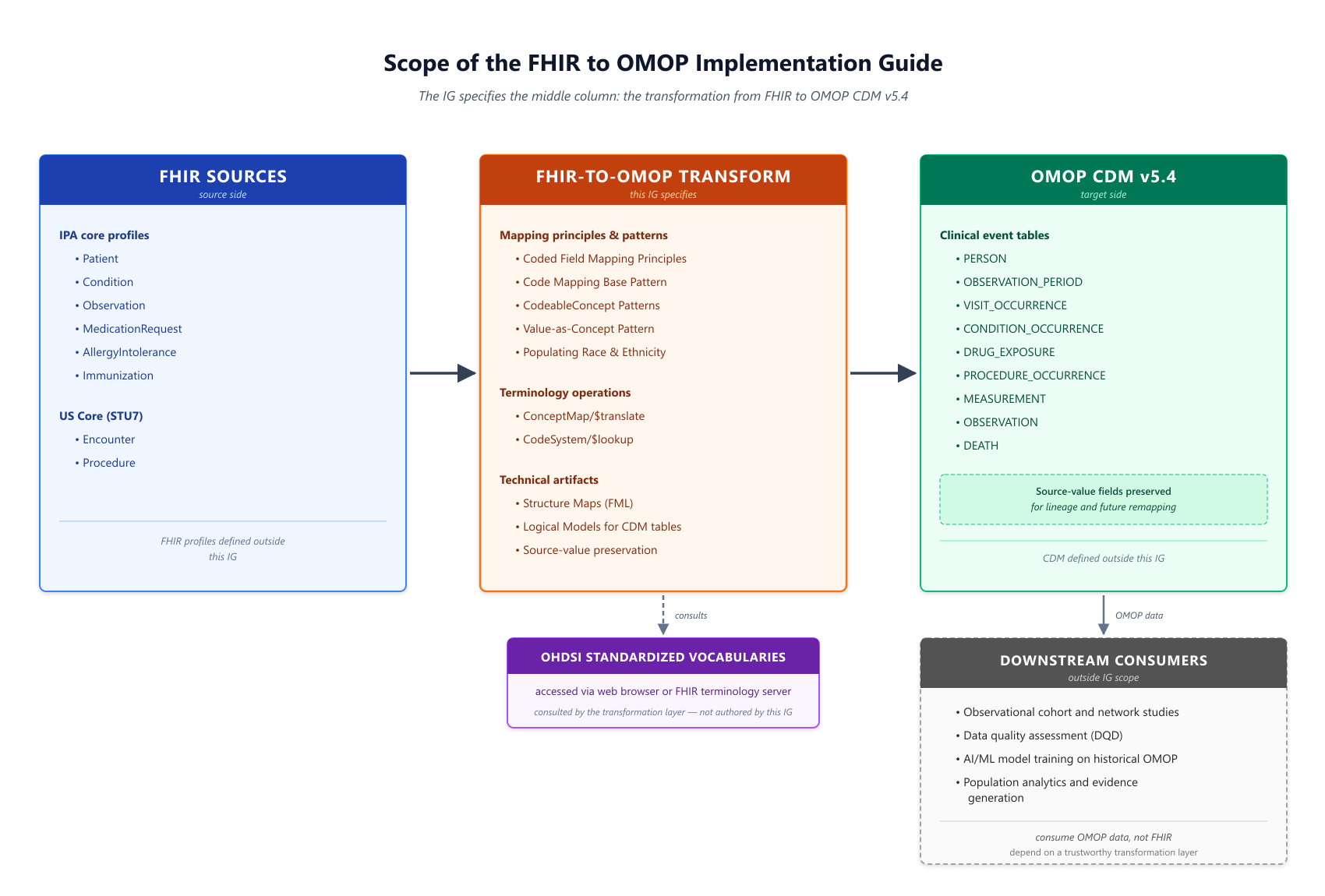
website provides both access to request OHDSI Vocabulary downloads and a comprehensive searchable database that serves dual purposes for mapping activities. Implementers can use this resource to manually browse available vocabularies and identify codes that appropriately match source concepts to Standard OMOP concepts and also receive vocabulary updates when new versions of the OHDSI Stabdardized Vocabularies are published. Utilization of the OHDSI Standardized Vocabularies is essential for validating mappings and resolving complex terminology translation challenges that arise during FHIR to OMOP transformation.
|
|
web
|
github.com
|
Submissions are made through GitHub issues in the OHDSI/Vocabulary-v5.0 repository
, using the templates referenced from the Community Contribution wiki page
. Each submission includes a populated template, submission metadata, and a contributor-completed quality checklist. Contributions approved at least two months before a target release are incorporated into that release, which allows ETL pipelines and legacy OMOP datastores to pick up the corrections as part of their routine vocabulary refresh cycle.
|
|
web
|
github.com
|
Submissions are made through GitHub issues in the OHDSI/Vocabulary-v5.0 repository
, using the templates referenced from the Community Contribution wiki page
. Each submission includes a populated template, submission metadata, and a contributor-completed quality checklist. Contributions approved at least two months before a target release are incorporated into that release, which allows ETL pipelines and legacy OMOP datastores to pick up the corrections as part of their routine vocabulary refresh cycle.
|
|
web
|
athena.ohdsi.org
|
Note the table below is only a partial list. A complete listing of type concepts can be found in the OHDSI Standardized Vocabularies
and a detailed explanation is available on the OHDSI Vocabulary wiki
.
|
|
web
|
github.com
|
Note the table below is only a partial list. A complete listing of type concepts can be found in the OHDSI Standardized Vocabularies
and a detailed explanation is available on the OHDSI Vocabulary wiki
.
|
|
web
|
ohdsi.github.io
|
Drug Exposure
|
|
web
|
ohdsi.github.io
|
Condition Occurrence
|
|
web
|
ohdsi.github.io
|
Procedure Occurrence
|
|
web
|
ohdsi.github.io
|
Visit Occurrence
|
|
web
|
ohdsi.github.io
|
Measurement
|
|
web
|
ohdsi.github.io
|
Observation
|
|
web
|
www.rfc-editor.org
|
The conformance verbs SHALL, SHOULD, and MAY are interpreted per RFC 8174
.
|
|
web
|
www.hl7vulcan.org
|
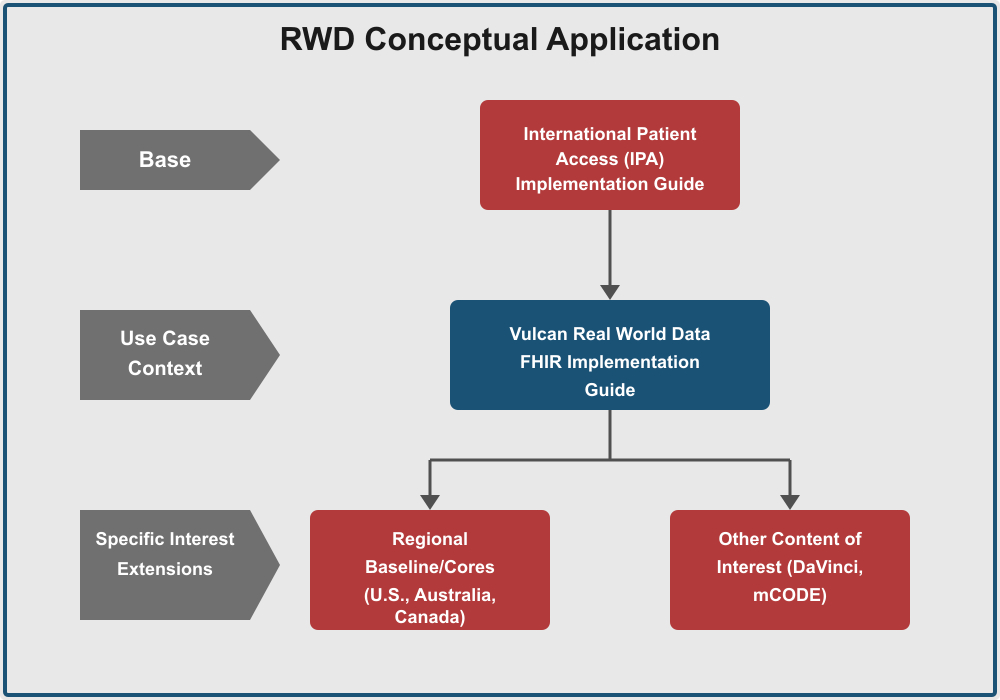
This Implementation Guide was developed under the auspices of the Vulcan
FHIR to OMOP work group.
|
|
web
|
colab.research.google.com
|
Created to support the Vulcan July 2025 Connectathon, this Jupyter notebook
provides basic syntax and specification validation of FHIR JSON and OMOP CSV data for the Vulcan FHIR->OMOP Connectathon. The notebook can be run as-is from within Google Colab (with a Google account) or downloaded and run locally. Upload your FHIR JSON or OMOP CSVs into the colab temporary directory and update the paths accordingly.
|
|
web
|
github.com
|
Workflow 1 used Working-Group reference tooling, maintained by Christopher Roeder and published at https://github.com/croeder-fhir-to-omop
, which served as the gold-standard baseline against which Workflow 2 and Workflow 3 outputs were compared at the event. The tooling is a containerized pipeline in which a FHIR mapping server (matchbox) loads this Implementation Guide's StructureMaps and exposes a $transform
operation for each, resolving clinical codes at runtime against a FHIR terminology server. The default configuration uses a local OMOP-backed terminology server (enchilada) seeded with OHDSI Vocabularies obtained from Athena; a hosted conformant terminology server might be substituted, and participants at the event used the Echidna public terminology service (echidna.fhir.org) in this role. The pipeline drives FHIR test fixtures through the transforms, writes the results into a DuckDB OMOP CDM v5.4 database, and runs the OHDSI Data Quality Dashboard together with a unit-test suite that asserts specific OMOP field values for each StructureMap. Published Docker images allow the stack to be run without cloning source.
|