


FHIR to OMOP FHIR IG
2.0.0-ballot - STU 1 Ballot

FHIR to OMOP FHIR IG
2.0.0-ballot - STU 1 Ballot
FHIR to OMOP FHIR IG, published by HL7 International / Biomedical Research and Regulation. This guide is not an authorized publication; it is the continuous build for version 2.0.0-ballot built by the FHIR (HL7® FHIR® Standard) CI Build. This version is based on the current content of https://github.com/HL7/fhir-omop-ig/ and changes regularly. See the Directory of published versions
| Page standards status: Trial-use |
Certain clinical concepts such as Drug allergies, represent a complex transformation challenge in FHIR-to-OMOP mapping due to their composite nature. It demonstrates the effectiveness of vocabulary-driven mapping over resource-type assumptions: with OMOP concept relationships taking precedence in determining the final analytical structure. In FHIR, an AllergyIntolerance resource typically contains a coded element representing both the allergy type and the specific substance. This is not aligned with OMOP's preference for decomposed, granular concept representation. The Value-as-Concept Map pattern addresses the tension between FHIR's composite coding approach and OMOP's value-as-concept methodology, which separates the observation type (allergy classification) from the specific substance causing the reaction.
NOTE: The OMOP concept identifiers shown in the examples on this page reflect the OHDSI Standardized Vocabularies as they stood when this guide was written. Concept mappings, Standard concept designations, domain assignments, and display names can change between vocabulary releases. Implementers ought to verify these values against the vocabulary version their transformation is bound to rather than copying them forward.
Utilizing an OMOP datastore, this mapping pattern enables comprehensive population-level allergy surveillance through queries that identify all drug allergies regardless of the specific causative substance, while simultaneously supporting granular substance-specific contraindication checking that can pinpoint allergies to particular medications or entire drug classes. The Value-as-Concept Pattern facilitates cross-domain analytics by establishing relationships between drug allergies and other clinical observations within the OMOP ecosystem creating opportunities for epidemiological studies. Employment of source value preservation best practice ensures traceability back to the original FHIR data while enabling future remapping as vocabularies evolve.
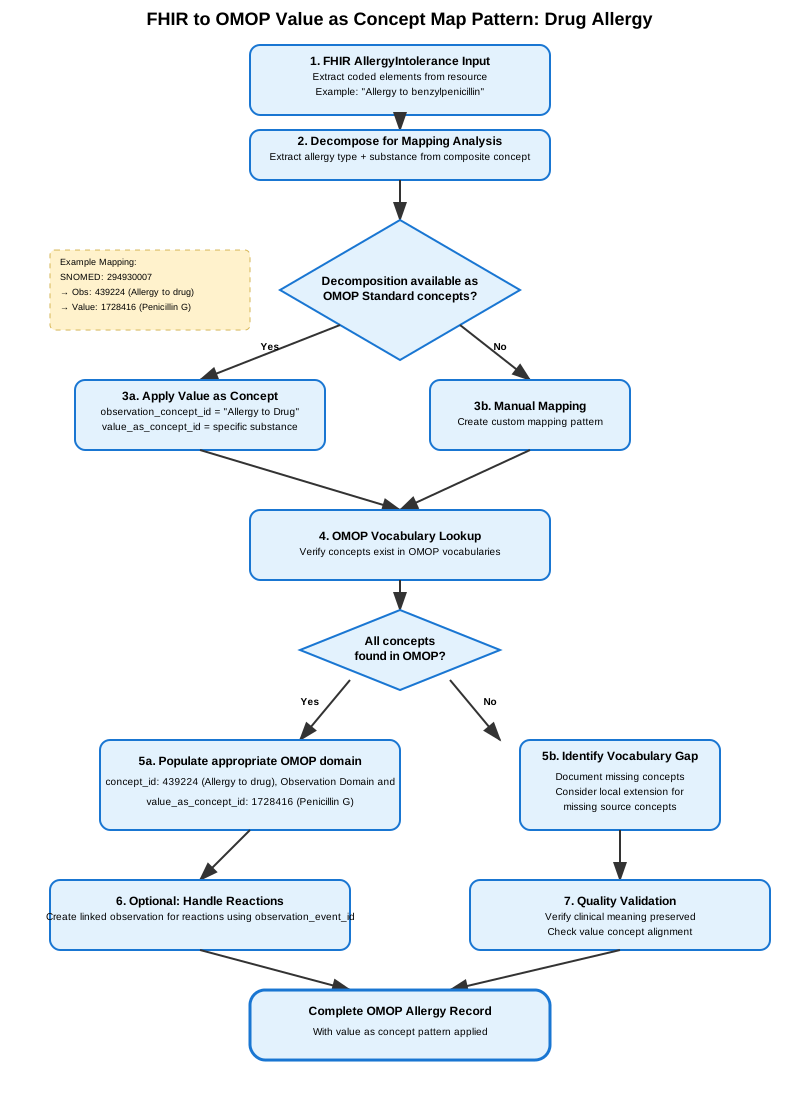
The transformation process begins with analyzing FHIR AllergyIntolerance resources containing composite concepts that combine allergy classification and specific substance identification. Drug allergies exemplify this through structured codes like "Allergy to benzylpenicillin" (SNOMED CT: 294499007), which inherently contains both the allergic reaction type and pharmaceutical substance. This approach assumes structured codes amenable to semantic decomposition, deliberately excluding free-text-only descriptions that present distinct mapping challenges.
Step 1: Composite Concept Analysis
The system evaluates whether composite concepts can be meaningfully separated into constituent components: an observation concept representing the allergy classification and a value concept representing the specific substance. This decomposition process examines semantic structures within codes following "Allergy to [substance]" patterns to identify candidates suitable for value-as-concept transformation while preserving clinical meaning.
Step 2: Decomposition Feasibility
Assessment When composite concepts can be successfully decomposed into standard OMOP concepts for both observation type and substance value, the system proceeds with the value-as-concept approach. If decomposition proves impossible or would compromise clinical meaning, the process routes to alternative mapping strategies.
Steps 3a & 3b: Target Concept Assignment
Mapping Implementation Successful decomposition enables the system to apply the value-as-concept pattern by mapping allergy classifications to observation_concept_id and specific substances to value_as_concept_id. For example, "Allergy to benzylpenicillin" decomposes to observation_concept_id: 439224 ("Allergy to drug") and value_as_concept_id: 1728416 ("Penicillin G"). When automatic decomposition fails, manual mapping preserves clinical meaning while maintaining traceability to original FHIR data.
Step 4: OMOP Vocabulary Validation
The decomposed concepts undergo validation against OHDSI Standardized Vocabularies to confirm existence as Standard OMOP concepts. This validation ensures mapped concepts uphold OMOP conventions and integrate properly with analytics tools, verifying concept status, domain assignment, and relationship mappings.
Step 5: Domain Population and Gap Management
When concepts are successfully validated, the system populates the OMOP Observation domain using the value-as-concept pattern. When a Maps to or Maps to value relationship is not available for the source concept (see Handling vocabulary gaps in Step 4), the corresponding _concept_id is set to 0, the original source values are preserved, and the gap is reported to the OHDSI vocabulary team for future remediation.
Step 6: Optional Enhancement and Validation
For comprehensive data represntation, the system can create linked observations for allergic reactions using observation_event_id to maintain relationships between allergens and reaction manifestations. The transformation process concludes with verification that clinical meaning is preserved and value concept alignment maintains semantic accuracy, ensuring decomposed representations accurately reflect original clinical intent while conforming to OMOP analytical requirements.
The value-as-concept pattern supports analytical capabilities that extend beyond simple direct concept mapping approaches. This pattern demonstrates several strong points in a FHIR-to-OMOP data transformation. The decomposition step supports alignment with the OMOP CDM and detailed analytics by separating a composite clinical concept into analytically useful atomic components while preserving source semantics. Using the target observation concept (439224 - "Allergy to drug") in a analytics database enables population-level allergy surveillance, while splitting-out the value concept (1728416 - "Penicillin G") supports medication-specific contraindication checking.
Source FHIR AllergyIntolerance Resource
{
  "resourceType": "AllergyIntolerance",
  "id": "penicillin-allergy-example",
  "clinicalStatus": {
    "coding": [
      {
        "system": "http://terminology.hl7.org/CodeSystem/allergyintolerance-clinical",
        "code": "active"
      }
    ]
  },
  "code": {
    "coding": [
      {
        "system": "http://snomed.info/sct",
        "code": "294499007",
        "display": "Allergy to benzylpenicillin"
      }
    ]
  },
  "patient": {
    "reference": "Patient/example"
  },
  "recordedDate": "2024-03-15"
}
1: FHIR AllergyIntolerance Input
2: Decompose for Mapping Analysis
3a: Apply Value as Concept
concept_relationship.Maps to from the source conceptconcept_relationship.Maps to value from the source concept4: OMOP Vocabulary Lookup
The observation and value concepts are derived deterministically from the source concept using the OMOP concept_relationship table. This is the authoritative method recommended by the OHDSI vocabulary team and produces reproducible results across implementations.
Step 4a: Resolve the source concept
Locate the source concept in the OMOP concept table using concept_code and vocabulary_id, taken directly from code.coding[].code and code.coding[].system on the FHIR resource.
SELECT concept_id        AS source_concept_id,
       concept_name,
       vocabulary_id,
       standard_concept,
       invalid_reason
FROM   concept
WHERE  concept_code  = '294499007'
  AND  vocabulary_id = 'SNOMED';
Result: source_concept_id = 4167462 ("Allergy to penicillin G", non-standard SNOMED concept). This value is used to populate observation_source_concept_id.
Step 4b: Derive observation_concept_id via the Maps to relationship
SELECT cr.concept_id_2 AS observation_concept_id,
       c2.concept_name,
       c2.domain_id,
       c2.standard_concept
FROM   concept_relationship cr
JOIN   concept c2
       ON c2.concept_id = cr.concept_id_2
WHERE  cr.concept_id_1    = 4167462
  AND  cr.relationship_id = 'Maps to'
  AND  cr.invalid_reason IS NULL;
Result: observation_concept_id = 439224 ("Allergy to drug", Observation domain, standard concept).
Step 4c: Derive value_as_concept_id via the Maps to value relationship
SELECT cr.concept_id_2 AS value_as_concept_id,
       c2.concept_name,
       c2.domain_id,
       c2.standard_concept
FROM   concept_relationship cr
JOIN   concept c2
       ON c2.concept_id = cr.concept_id_2
WHERE  cr.concept_id_1    = 4167462
  AND  cr.relationship_id = 'Maps to value'
  AND  cr.invalid_reason IS NULL;
Result: value_as_concept_id = 1728416 ("Penicillin G", Drug domain, standard concept).
Handling vocabulary gaps
If either the Maps to or the Maps to value lookup returns no row, the source concept has no validated standard mapping in the current OMOP vocabulary release. In that case:
_concept_id field with 0 (the OMOP convention for an unmapped concept).observation_source_value and the display string in value_source_value so the record remains traceable to the source FHIR data.Anti-pattern (do not use). Earlier drafts of this guide suggested locating the observation and value concepts by name using
concept_name LIKEqueries, for example:SELECT concept_id, concept_name, domain_id, vocabulary_id, standard_concept FROM concept WHERE concept_name LIKE '%Penicillin G%' AND vocabulary_id IN ('RxNorm', 'SNOMED') AND standard_concept = 'S';This approach is fragile and non-deterministic. The OMOP vocabulary contains dozens of concepts whose names match "Penicillin G" (ingredients, clinical drugs, branded drugs, different strengths and dose forms, SNOMED substance entries), and selecting the correct row requires an undocumented clinical judgment call that will not produce the same result across implementations. Use the
concept_relationshippattern shown above instead.
5a: Populate Appropriate OMOP Domain
Observation Table Mapping:
INSERT INTO observation (
    observation_id,
    person_id,
    observation_concept_id,
    observation_date,
    observation_datetime,
    observation_type_concept_id,
    value_as_concept_id,
    observation_source_value,
    observation_source_concept_id,
    value_source_value
) VALUES (
    [generated_id],                    -- observation_id
    [mapped_person_id],                -- person_id
    439224,                            -- observation_concept_id (Allergy to drug)
    '2024-03-15',                      -- observation_date
    '2024-03-15T00:00:00',            -- observation_datetime
    32817,                             -- observation_type_concept_id (EHR)
    1728416,                           -- value_as_concept_id (Penicillin G)
    '294499007',                       -- observation_source_value
    4167462,                           -- observation_source_concept_id
    'benzylpenicillin'                 -- value_source_value
);
| OMOP Field | Value | Source | Transformation Notes |
|---|---|---|---|
observation_concept_id |
439224 | `concept_relationship` traversal from source concept 4167462 | Derived via `relationship_id = 'Maps to'`; standard concept for "Allergy to drug" |
value_as_concept_id |
1728416 | `concept_relationship` traversal from source concept 4167462 | Derived via `relationship_id = 'Maps to value'`; standard concept for "Penicillin G" |
observation_source_value |
294499007 | FHIR code.coding[0].code | Original composite SNOMED code preserved |
value_source_value |
benzylpenicillin | FHIR code.coding[0].display | Substance component preserved |
observation_date |
2024-03-15 | FHIR recordedDate | Date of allergy documentation |
IG © 2023+ HL7 International / Biomedical Research and Regulation.
Package hl7.fhir.uv.omop#2.0.0-ballot based on FHIR 5.0.0.
Generated
2026-08-14
Links: Table of Contents |
QA Report
| Version History |
 |
Propose a change
|
Propose a change