


AI Transparency on FHIR
1.0.0-current - STU1 Ballot

AI Transparency on FHIR
1.0.0-current - STU1 Ballot
AI Transparency on FHIR, published by HL7 International / Electronic Health Records. This guide is not an authorized publication; it is the continuous build for version 1.0.0-current built by the FHIR (HL7® FHIR® Standard) CI Build. This version is based on the current content of https://github.com/HL7/aitransparency-ig/ and changes regularly. See the Directory of published versions
| Page standards status: Informative |
Observability of the use of AI in the production or manipulation of health data matters for many reasons. This guide organizes those reasons into use cases. Each is a broad category that covers many more specific scenarios, and each is illustrated below with concrete examples drawn from the artifacts in this guide.
Anyone reviewing health data may want to know whether AI was involved in producing or manipulating that data, to what degree, and whether a human reviewed the result. This is the most common use case, and it applies far beyond the clinician at the bedside — it applies to any actor reviewing FHIR data, including researchers, payers and other administrators, quality and safety reviewers, and legal teams.
The need parallels long-standing practice: just as a reviewer expects to know which human authored a note, their role, and their qualifications, they increasingly need to distinguish content produced by AI, assisted by AI, and produced without any AI involvement.
flowchart LR
    DATA["📄<br/>Data"]
    AI["🤖<br/>AI"]
    AI_DATA["📄🤖<br/>(AI) Data"]
    VIEW["🖥️ 👀<br/>Reviewer"]

    DATA --> AI
    AI --> AI_DATA
    AI_DATA --> VIEW
The same use case takes a different shape depending on who is reviewing the data and why. The table below illustrates a few of the actors and the questions AI attribution helps them answer:
Data Review Questions by Actor
| When this Actor is reviewing data | The key questions may be… |
|---|---|
| Clinician | What is happening (to modify)? Why is it happening? Was the AI output reviewed by a human? |
| Researcher | Is this data suitable for my study, or need AI-influenced data be excluded or stratified? |
| Payer | What matches prior-authorization criteria, and was the determination drafted by AI? |
| Quality Improvement | What matches the desired outcomes, or desired approach to care? |
| Safety Board | Multiple questions for root-cause analysis |
| Legal | Who — or what — is responsible? |
A whole resource produced by AI. The Observation with AI-asserted security labels carries the AIAST label on meta.security, signaling to any reviewer that the entire Observation was AI-asserted.
Only part of a resource produced by AI. The DiagnosticReport with inline AI security labels tags only the conclusion and conclusionCode elements. A reviewer can see that AI asserted the interpretation while the rest of the report was not AI-influenced.
Seeing the degree of involvement and human oversight. Tags signal that AI was involved; the Provenance of an AI-authored Lab Observation shows the detail — the AI Device that authored it and the human verifier who reviewed it (human-in-the-loop).
A non-clinical, administrative reviewer (prior authorization). A health plan uses AI to draft a prior-authorization determination, which a human utilization reviewer verifies before release. The Prior Authorization Determination drafted by AI carries the AIAST label, and its Provenance records the AI author, the human verifier, and the original request as input. This is the same attribution need as the clinician's, applied to administrative data.
A downstream system often needs to include or exclude AI-influenced data based on its own risk tolerance. The right decision differs by consumer: some workflows cannot tolerate AI-influenced inputs, while others can. Because each resource (or element) signals AI involvement through labeling, a consumer can filter accordingly.
Some illustrative consumers and their tolerances:
flowchart LR
    DATA["📄<br/>Data"]
    AI_DATA["📄🤖<br/>(AI) Data"]
    ML(("⚙️<br/>Process"))
    AI["👤<br/>Usage"]

    DATA --> ML
    AI_DATA  -.->|"🚫"| ML
    ML --> AI

    linkStyle 1 stroke:#c00,stroke-width:2px
Model training is one specific instance of this general pattern:
flowchart LR
DATA["📄<br/>Data"]
AI_DATA["📄🤖<br/>(AI) Data"]
ML(("🧑💻<br/>ML Training"))
AI["🤖<br/>AI Model"]
DATA --> ML
AI_DATA -.->|"🚫"| ML
ML --> AI
linkStyle 1 stroke:#c00,stroke-width:2px
Filtering whole resources. The Observation with AI-asserted security labels carries the AIAST label at the resource level. A consumer that cannot tolerate AI-influenced data filters it out by inspecting meta.security; a consumer that can tolerate it keeps it.
Filtering at element granularity. The DiagnosticReport with inline AI security labels tags only the AI-asserted elements. A consumer can drop the AI-asserted conclusion while still using the rest of the report, rather than discarding the whole resource.
While an AI model is in use, it may later be determined to be producing poor or unsafe output. When that happens, one needs to find every resource that model touched so those resources can be reviewed.
Because AI-influenced data links back to the AI through Provenance.agent.who (a reference to the AI Device) — and may also reference the Device directly (e.g. Observation.device) — the problematic model becomes a single point from which all of its output can be traced.
This use case depends on Provenance. The
AIASTlabel is always present and identifies that AI was involved, but it does not identify which model. Tracing output back to a specific model requires that Provenance (or a directDevicereference) was recorded, which this guide leaves optional. Implementers who need this capability should require Provenance in their own policy or profile.
Discovery makes no judgment about the data. Identifying data produced by a model that was later found to be problematic does not mean that data is wrong. It only identifies the data that may warrant review.
sequenceDiagram
    participant AI as AI Model<br/>(Device/TheAI)
    participant S as FHIR Server
    actor R as Reviewer / QA

    Note over AI,S: Production — over time the model writes output to the server
    AI->>S: Create resource + AIProvenance (agent = Device/TheAI)
    AI->>S: Create resource + AIProvenance (agent = Device/TheAI)
    AI->>S: ... more outputs over time

    Note over AI,R: ⚠️ Device/TheAI is later determined to be problematic

    Note over AI,R: Discovery
    R->>S: GET /Provenance?agent=Device/TheAI
    S-->>R: Provenance records authored by Device/TheAI
    R->>S: Resolve each Provenance.target
    S-->>R: Suspect resources (Observation, Procedure, ClaimResponse, ...)
    Note over R: Resources flagged for review — not judged invalid
Suppose the AI System (Device/TheAI) is found to be problematic. Several artifacts in this guide reference it, so a single search surfaces them all:
GET /Provenance?agent=Device/TheAI returns the Provenance records that name it as an agent — including the AI-authored Lab Observation, the AI-authored Procedure element, the AI-generated Lab Results, and the prior-authorization determination. Resolving each Provenance.target yields the suspect resources.GET /Observation?device=Device/TheAI finds resources that reference the Device directly, even where a Provenance is not present.Discovery also discriminates between models. A separate second AI system (Device/TheOtherAI) authored its own Observation; because that work is tied to a different Device, the search for Device/TheAI correctly does not return it. Only data tied to the problematic model is flagged.
Just as a model can later be found problematic, so can an input. Inputs — the context provided to the AI, such as a prompt or a source document — are recorded as Provenance.entity. If an input is later determined to be flawed, every output derived from it can be traced and reviewed.
As with Use Case 3, this discovery makes no judgment about the validity of the outputs. It only identifies the data that may warrant review. It likewise depends on Provenance having been recorded, which is optional in this guide.
sequenceDiagram
    participant C as Input / Context<br/>(e.g. DocumentReference)
    participant AI as AI Model
    participant S as FHIR Server
    actor R as Reviewer / QA

    Note over C,S: Production — the input drives AI output written to the server
    C->>AI: Provide context (source document / prompt)
    AI->>S: Create output + AIProvenance (entity = the input)
    C->>AI: Input reused on another request
    AI->>S: Create output + AIProvenance (entity = the input)

    Note over C,R: ⚠️ The input is later determined to be flawed

    Note over C,R: Discovery
    R->>S: GET /Provenance?entity=DocumentReference/Lab-Results-PDF
    S-->>R: Provenance records that used the flawed input
    R->>S: Resolve each Provenance.target
    S-->>R: Suspect outputs (Bundle, Patient, Observation, ...)
    Note over R: Outputs flagged for review — not judged invalid
A flawed source document. The Lab Results PDF is the source input recorded by the Provenance of the AI-generated Lab Results. If that source is later found to be unreliable, GET /Provenance?entity=DocumentReference/Lab-Results-PDF surfaces the Provenance, whose target is the generated Bundle of Patient and Observation resources. Because the input is recorded as a shared, externally referenced resource, the search finds every Provenance — and therefore every output — that used it.
A flawed prompt. The same pattern applies when the flawed input is a prompt. The Input Prompt to create a Patient is recorded as an entity by the Provenance of creating a Patient from that prompt; resolving that Provenance's target yields the Patient the AI generated. In this particular example the prompt is carried inline (a contained resource within the Provenance), so it is discovered while examining the Provenance rather than by an independent reference search — recording a prompt as a shared, externally referenced DocumentReference makes it directly searchable like the source document above.
There are also automated guardrails. An automated system is engaged to check the results of the AI. This system can take many different forms. It is often intended to reduce bias, ensure more equitable healthcare outcomes, catch unacceptable outputs, such as inappropriate word usage, or do general validation, such as running a FHIR validator on the resource to ensure conformity. These orchestrated systems might be captured as additional Devices as reviewers on the Provenance, but this level of detail is not explicitly covered by this IG.
AI Models do not exist in a vacuum, in addition to the context / inputs, there needs to be a system that calls the AI, supplies the inputs, and gets the result. This result may then be used as-is, supplied to another AI, verified by an automated system, verified by a human, or any number of other activities. Understanding this process may be very important to end users and downstream systems. For example, if the results of the AI were verified by a human (human-in-the-loop) then an end user may be able to rely on the results with less scrutiny.
This is an additional example provided that shows how this IG can be applied.
Use Case: A provider receives a PDF of lab result(s) for a patient. This PDF is examined by an AI which generates a Bundle with a Patient resource and Observation resource(s).
In the attached example the patient's name is Alton Walsh and the lab test is an HbA1C. All the FHIR resources in the bundle have been created by the AI, so they would be tagged accordingly.
This scenario illustrates how AI transparency supports accountability when AI is used in patient care. It does not endorse AI use for patient appointments; it shows how the AI's involvement can be made visible and traceable.
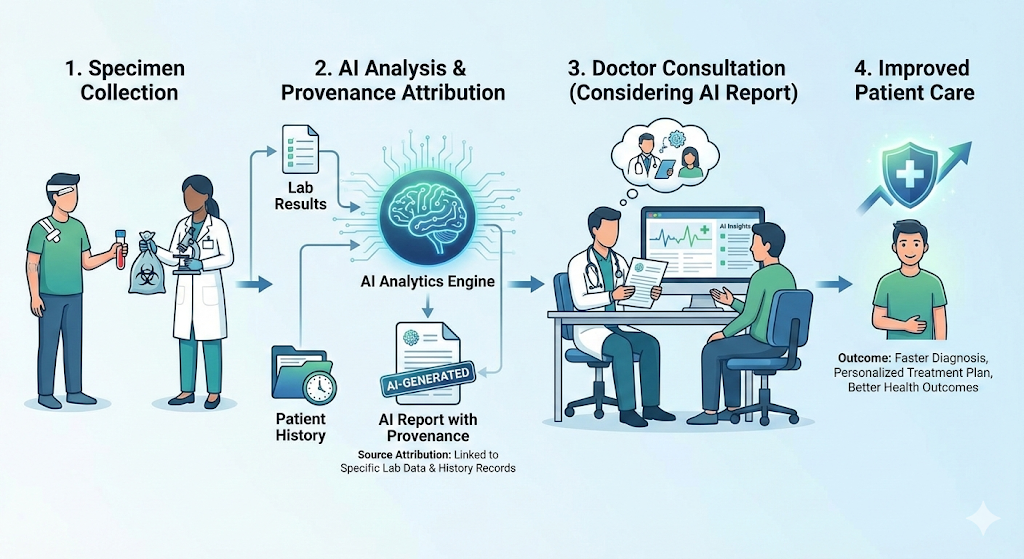
The persisted appointment report is authored by the clinician with AI assistance and is labeled to indicate that AI was involved. It identifies the patient history, conditions, medications, laboratory results, and family history considered in the analysis. Recommendations include their rationale, patient-specific evidence, relevant medical literature or guidelines, and relevant benefits, risks, and side effects. The temporary AI analysis that informed the report is not retained as a separate patient-record artifact.
Provenance records the information the AI actually used to assist with the persisted appointment report, including the AI model and version, the relevant patient data, and the settings or parameters used for the analysis. It identifies both the clinician author and the AI system that assisted with the report, supporting clear attribution and accountability without retaining the temporary AI analysis as a separate artifact.
graph LR
  subgraph CLINICAL_INPUTS
    NEW_LABS["New Lab Test Results"]
    PRIOR_LABS["Prior Lab Test Results"]
    HISTORY["Patient Medical History"]
    CONDITIONS["Conditions"]
    MEDICATIONS["Medications"]
    FAMILY_HISTORY["Family Medical History"]
  end

    AI_SYSTEM["AI System<br/>model, version,<br/>provider"]
    AI_PROMPT["AI Prompt"]
    CLINICIAN["Clinician<br/>Practitioner"]
    PROVENANCE["Provenance Record<br/>activity: AI assisted<br/>2025-12-06 16:13"]
    REPORT["Patient Report<br/>DiagnosticReport<br/>meta.security=AIAST"]

    NEW_LABS -->|entity| PROVENANCE
    PRIOR_LABS -->|entity| PROVENANCE
    HISTORY -->|entity| PROVENANCE
    CONDITIONS -->|entity| PROVENANCE
    MEDICATIONS -->|entity| PROVENANCE
    FAMILY_HISTORY -->|entity| PROVENANCE
    AI_PROMPT -->|entity aiPrompt| PROVENANCE
    AI_SYSTEM -->|agent aiDevice| PROVENANCE
    CLINICIAN -->|agent| PROVENANCE
    PROVENANCE -->|target| REPORT

    style CLINICAL_INPUTS fill:#FFFDE0,stroke:#999
    style NEW_LABS fill:#FFF5BA,stroke:#999,color:#555
    style PRIOR_LABS fill:#FFF5BA,stroke:#999,color:#555
    style HISTORY fill:#FFF5BA,stroke:#999,color:#555
    style CONDITIONS fill:#FFF5BA,stroke:#999,color:#555
    style MEDICATIONS fill:#FFF5BA,stroke:#999,color:#555
    style FAMILY_HISTORY fill:#FFF5BA,stroke:#999,color:#555
    style AI_SYSTEM fill:#EE82EE,stroke:#999,color:#555
    style AI_PROMPT fill:#EE82EE,stroke:#999,color:#555
    style CLINICIAN fill:#87CEEB,stroke:#999,color:#555
    style PROVENANCE fill:#FF7F00,stroke:#999,color:#555
    style REPORT fill:#DFF0D8,stroke:#999,color:#555
An audit trail complements provenance by recording the AI's broader activity, including searches used to gather information and access-control denials. For example, an audit record can show that the AI searched the full medical history, while provenance records only the information the AI determined was relevant and used in its analysis. The audit trail also records the AI-assisted creation of the persisted appointment report. The AuditEvent is not profiled or defined in this IG.
If an AI model or configured prompt is later found to produce poor results for a class of laboratory findings, the organization can search Provenance records for outputs associated with that model or prompt. The resulting patient-care artifacts can be reviewed and affected patients contacted when remediation is needed. When new AI software, models, or prompts are deployed, representing the new configuration as a Device and referencing it from subsequent Provenance records preserves the same traceability.
IG © 2024+ HL7 International / Electronic Health Records.
Package hl7.fhir.uv.aitransparency#1.0.0-current based on FHIR 4.0.1.
Generated
2026-09-11
Links: Table of Contents |
QA Report
| Version History |
 |
Propose a change
|
Propose a change