


Clinical Practice Guidelines
3.0.0-ballot - STU 3 Ballot

Clinical Practice Guidelines
3.0.0-ballot - STU 3 Ballot
Clinical Practice Guidelines, published by HL7 International / Clinical Decision Support. This guide is not an authorized publication; it is the continuous build for version 3.0.0-ballot built by the FHIR (HL7® FHIR® Standard) CI Build. This version is based on the current content of https://github.com/HL7/cqf-recommendations/ and changes regularly. See the Directory of published versions
| Page standards status: Informative |
This page was reorganized from the single Methodology page of the previous version of this guide, and its guidance was expanded (see the change log).
Use the selected recommendation, source rationale, and delivery assumptions to write a decision specification that clinicians can review before authoring FHIR artifacts and logic. The specification connects clinical concepts to criteria and example cases and shows how the recommendation reaches people in the care process.
The represent step involves taking the narrative input from the select step, the who, what, when, where, and why, and further refining it to produce a data dictionary of concepts, functional descriptions of the criteria involved in the recommendations, and flow diagrams illustrating how the recommendations should be applied in a clinical context, to create semi-structured (L2) content that is domain-specific (i.e. clinician-oriented), but informed by health informatics concerns to ensure accurate and unambiguous communication of guideline intent. This step is typically performed by a cross-functional team consisting of at least:
At this step, concepts referred to by the narrative are identified and represented as data elements within a data dictionary. This content typically takes the form of a spreadsheet, or even a table within a text document, and identifies, for each data element:
Build a data dictionary that explains each input's clinical meaning, context, source or collection method, datatype, units, timing, and candidate code or representation. The terminologist proposes mappings and records where they cover only part of the intended meaning. Clinical reviewers resolve ambiguities about what counts for the decision, and the local data owner confirms how the facts are captured. Work on WHO operational specifications surfaced ambiguous and composite concepts that required clinical review during mapping. Pretty et al., 2023
This historical Opioid Prescribing Guideline excerpt illustrates the structure of a data dictionary. Read its clinical content in the context of the source guideline and version.
| Definition | Answer to Proceed | Details | Data (Terminology) Requirement |
|---|---|---|---|
| Order for opioid analgesic with ambulatory misuse potential | Yes | Order for opioid analgesics with ambulatory misuse potential | Opioid analgesics with ambulatory misuse potential |
| Opioid review useful? | Yes | Apply Opioid Review Useful Sub-routine | |
| Calculate MME for prescription + active opioids | N/A | Current calculation uses known order (prescription) data. Note - for as needed (PRN) medication, the daily dose assumes the maximum dose the patient may take any given day if a range is present. Ideally, dispensed data could be used to determine the medication dispensed to the patient | |
| MME≥50? | Yes | MME result is ≥ 50 |
When defining a feature, agree on the terminology, units, source, time window, number of expected values, and selection rule. For weight, the admission value and the latest measurement in an encounter answer different questions. Specify what to do with missing, stale, and conflicting records. The WHO Digital Adaptation Kits illustrate this kind of semi-structured, reviewable specification.
Write the inclusion and exclusion criteria, timing, exceptions, and expected result in terms of the dictionary. Tie each criterion to the source passage or to a documented interpretation. If a criterion depends on a result within a time window, have the clinical reviewer specify what happens at the boundary and when the result is absent or conflicts with another result. Record any open question with the person who can resolve it. Agree on the rationale and expected output for example cases before testing implementation behavior.
This historical example shows one way to express the decision criteria and response options for review. The When/Then block is illustrative pseudocode.
When
Then
This functional description provides a clear representation of what should happen, when, where, to whom, and by whom, tying together all the aspects of the recommendation, and facilitating communication of those aspects to the knowledge engineers in the translate step.
There are a wide variety of methods and approaches available for representing and communicating the details of a workflow. One of the simplest, and most widely used is the flowchart, a versatile diagramming tool with virtually ubiquitous authoring and viewing support, and that is immediately understandable. For these reasons, this methodology focuses on the use of flowcharts to visually represent processes. In particular, the processes that have been most useful are simple flow diagrams that provide a visual representation of the functional description.
Of particular importance at this step is representing the selected level of enablement for the processes and activities involved in the recommendations, as discussed in the following sections.
Sketch who supplies the inputs, when the decision arises, who sees the result, and what they can do with it. Link each decision in the sketch to the written criteria so reviewers can check both its clinical meaning and its place in the workflow. Work with the local workflow owner to establish which parts of the process the implementation can support.
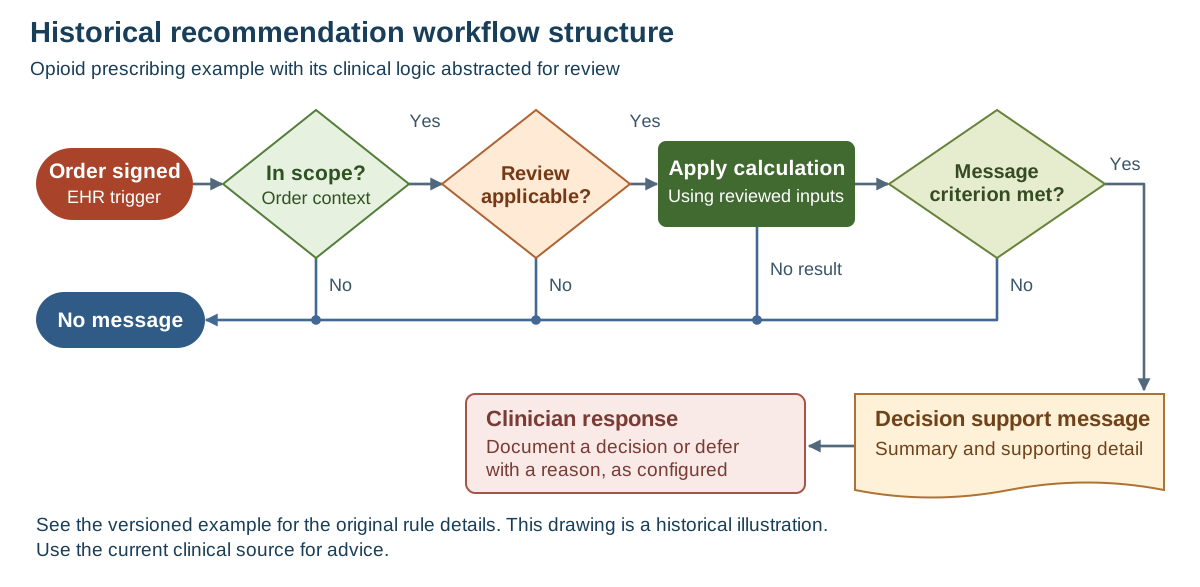
When the intended intervention is a notification, specify the message, recipient, timing, and patient context that helps the recipient interpret it.
At this level of enablement, recommendation content is delivered as contextualized narrative, or informational messages. This is typically represented simply by the Send message activity. For example, if the intended delivery for Opioid Guideline recommendation 4 is just an alert statement, like a reminder or notification, then all that is needed is the Send message activity.
If the intervention proposes an action, describe the proposed request, who can accept it, and what resulting event would indicate fulfillment. A delivery that ends at the request can still describe the expected event for later assessment.
At this level of enablement, recommendation content is delivered as a structured activity that can be understood and acted upon by the consuming system. For example, the Opioid Guideline recommendation 4 at this level of enablement might be an updated order with a reduced dosage, or a recommendation to order an alternative non-opioid therapy. This level of enablement can use any of the available activity types, but only specifies integration at the request level. In other words, the result of the decision support is a proposal for a recommended activity, but whether and how that proposal is accepted and fulfilled is not specified by the computable content, rather implementation sites determine how a request becomes an event.
If the implementation also tracks fulfillment, describe who acts, what event is recorded, and how it is linked to the request. The local workflow owner confirms what the system and authorized users can do. Activity flow
At this level of enablement, recommendation content is delivered not only as structured activities using the request resources, but the content also describes expected fulfillment workflow to get from the request to the actual event. For example, the content for recommendation 4 might include the process not only for prescribing the alternative non-opioid therapy, but for fulfilling that request by actually filling the prescription. Specifying recommendations to this level of enablement is significantly more involved because of the variability of fulfillment workflows across sites.
Clinical reviewers confirm the interpretation and expected cases. The knowledge engineer carries the reviewed data dictionary, criteria, workflow sketch, and cases into Translate, with unresolved questions and their owners visible alongside them. Use the L2 checklist to review the structured specification.
IG © 2023+ HL7 International / Clinical Decision Support.
Package hl7.fhir.uv.cpg#3.0.0-ballot based on FHIR 4.0.1.
Generated
2026-11-20
Links: Table of Contents |
QA Report
| Version History |
 |
Propose a change