


Clinical Practice Guidelines
3.0.0-ballot - STU 3 Ballot

Clinical Practice Guidelines
3.0.0-ballot - STU 3 Ballot
Clinical Practice Guidelines, published by HL7 International / Clinical Decision Support. This guide is not an authorized publication; it is the continuous build for version 3.0.0-ballot built by the FHIR (HL7® FHIR® Standard) CI Build. This version is based on the current content of https://github.com/HL7/cqf-recommendations/ and changes regularly. See the Directory of published versions
| Page standards status: Informative |
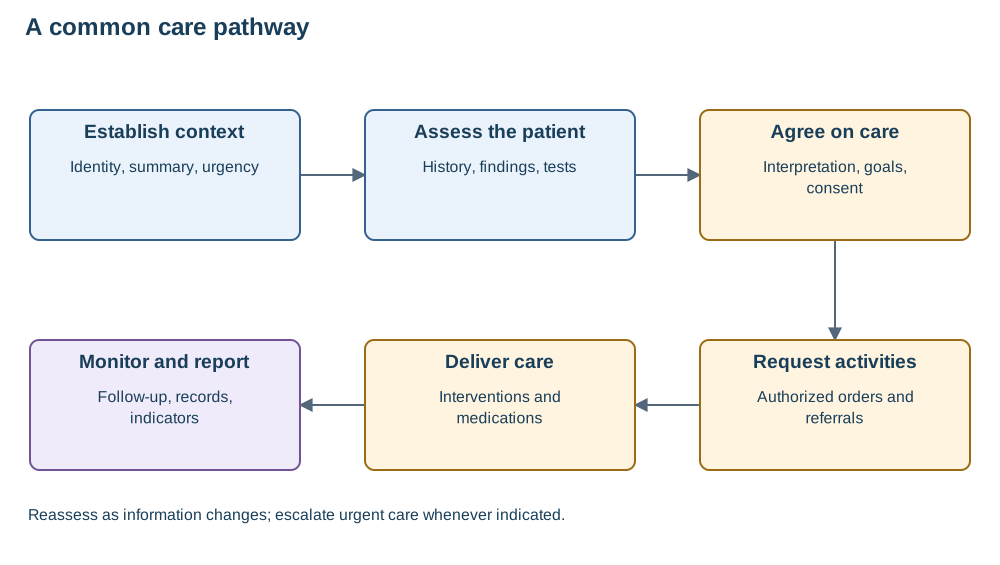
This proposed ambulatory pathway is an example for organizing guideline-supported care. Adapt it to the care setting, participants, and service capabilities. Care may span several encounters and organizations; the diagram is not a required visit sequence.
| Activity | Purpose |
|---|---|
| Establish patient identity | Identify and record the subject of care. |
| Retrieve patient health summary | Obtain the available clinical context and identify information gaps. |
| Triage | Assess whether signs or symptoms require urgent or emergency care. |
| Emergency: escalate care | Arrange the appropriate urgent response or transfer when indicated. |
| Invoke applicable CCGs | Identify the Computable Care Guidelines relevant to the patient and situation. |
| Activity | Purpose |
|---|---|
| Provide counseling | Discuss treatment options, consent, health education, and ongoing care with the patient. |
| Record observations | Gather history, examination findings, and other relevant observations. |
| Order tests | Request diagnostic tests, including any local or external fulfillment workflow. |
| Evaluate test results | Interpret findings with the history, examination, and other available information. |
| Record diagnosis | Record the clinical assessment reached from that information. |
| Order interventions | Authorize the selected care activities. |
The guideline can propose an activity. Agreement, authorization, and fulfillment remain explicit workflow steps, as described in Activity Flow.
| Activity | Purpose |
|---|---|
| Provide interventions | Perform the agreed and authorized activities and record what occurred. |
| Order medications | Request medication treatment through the relevant prescribing workflow. |
| Dispense medications | Supply medication against the appropriate prescription; administration is a separate activity. |
| Establish monitoring and follow-up | Review progress and plan the next assessment or action. |
| Discharge/refer patient | Coordinate transition to another setting, service, or guideline-based program. |
| Update the digital client record | Reconcile and record the information produced through care. |
| Generate reportable indicators | Produce patient-level management information and, where appropriate, aggregate reporting. |
Identify the actor, inputs, outputs, and system of record for each activity used locally. Check where the pathway resumes when results arrive or the patient's state changes. The workflow and common-pathway topic explains the modeling boundaries, and the Common Processes code system provides the process vocabulary used by this guide.
IG © 2023+ HL7 International / Clinical Decision Support.
Package hl7.fhir.uv.cpg#3.0.0-ballot based on FHIR 4.0.1.
Generated
2026-11-20
Links: Table of Contents |
QA Report
| Version History |
 |
Propose a change