


Electronic Case Reporting (eCR)
3.0.0-ballot - STU 3 Ballot

Electronic Case Reporting (eCR)
3.0.0-ballot - STU 3 Ballot
Electronic Case Reporting (eCR), published by HL7 International / Public Health. This guide is not an authorized publication; it is the continuous build for version 3.0.0-ballot built by the FHIR (HL7® FHIR® Standard) CI Build. This version is based on the current content of https://github.com/HL7/case-reporting/ and changes regularly. See the Directory of published versions
| Page standards status: Informative |
The submission of public health reportable event data for specific infectious and non-infectious conditions is required by law in all states and territories in the United States. In addition to supporting critical public health functions in state, local, tribal, and territorial public health agencies (PHAs), these reportable event data also indirectly support notifications between PHAs and the Centers for Disease Control and Prevention (CDC) for the Nationally Notifiable Disease Surveillance System (NNDSS) and nationwide disease monitoring. Related notifications from PHAs to the CDC and between PHAs are not in scope for this implementation guide.
Transmission of reportable laboratory results is helpful in identifying cases. Clinical laboratory result messages, however, frequently lack critical clinical and demographic data needed for surveillance. Reportable event data from EHRs complements electronic laboratory reporting through earlier reporting and by providing clinical and demographic data. It is also important to public health surveillance for critical clinical data, under-reported clinical cases, emergency management of new conditions, and for conditions for which a laboratory result is not a definitive criterion.
While the transmission of reportable event data from clinical care to PHAs is considered to be a core public health function, its electronic implementation has been slow to advance nationally because of a number of challenges. Laws requiring the reporting of infectious and non-infectious conditions are written individually by each public health jurisdiction. Geographic differences in condition prevalence and other jurisdictional variations have created a complex array of reporting expectations making it difficult for providers to know when, where, and what to report. Healthcare providers, for their part, have been historically inconsistent in reporting from clinical care by any process. For example, a CDC study indicated that of the cases of Lyme disease recorded as a clinical diagnosis in clinical care, only about one out of ten are reported to the appropriate PHA.
Reportable event data are important for tracking disease trends at the local, state, and national levels, but also serve to feed surveillance and outbreak management systems that support the investigation and management of individual cases and outbreaks in routine and emergent public health situations. State, local, tribal, and territorial PHAs are authorized by law to receive identifiable data to enable these activities.
Previous efforts to develop standards for the exchange of reportable event data between clinical care and public health have been challenged by inter-organizational exchange issues. These issues include efforts to develop numerous implementation guides to accommodate individual conditions and efforts to try to harmonize different jurisdictional reporting nuances and program specific data into one consolidated data specification. A goal of this implementation guide is to ensure that consistent, comparable case reports are received by PHAs and that a consistent, common eICR can be constructed by EHR vendors and clinical care providers regardless of the jurisdictions in which they must report.
The electronic Initial Case Report (eICR) is termed "initial" because the report may be the first report made to public health from the clinical provider, containing just enough pertinent data for PHAs to initiate investigation or other appropriate public health activities, as necessary. These electronic reports may be manually initiated by the clinician or may be automatically initiated by the EHR when updated patient data is matched against a set of public health Reportable Condition Trigger Codes (RCTC) distributed in the electronic Reporting and Surveillance Distribution (eRSD). The eICR conveys initial reportable event data to public health and supports reportable conditions in all jurisdictions to ease integration by EHR vendors and clinical care organizations. Common data elements for the eICR were identified by a task force of the Council of State and Territorial Epidemiologists (CSTE) (see eICR Data Elements).
In some circumstances the eICR will be all that is needed to support public health reporting. The eICR may lead to the reporting of additional data or follow-up by the PHA to confirm reportability, provide condition-specific or public health jurisdiction-specific case data, and/or support public health investigation, contact tracing, and/or countermeasure administration.
The eICR itself may be conveyed by a number of different transport methods (see Transport Options). It serves as input for reportability evaluation performed by a public health decision support system. For each eICR that is received, the Reportability Response (RR) is used by public health to communicate back to the reporting healthcare provider / organization. The Reportability Response conveys the reportability of a condition, information on that condition in the relevant jurisdiction(s), and other supporting public health information back to clinical care personnel. It also serves as an acknowledgment of successful eICR submission or conveys error and warning information back to the reporting healthcare EHR administrator.
The automated reporting of information from healthcare to public health can bring many benefits, but it also brings new capabilities and needs for information to flow from public health to clinical care. For some time, clinical care providers have expressed the concern that they do not receive the information they want from public health for all of the information they provide to public health. This "bi-directional communication" problem relates to perceptions of the quantity of data that flows in one direction, but also to the limited specificity, patient context, and workflow integration of the information that is offered to clinical care from PHA web sites and other sources. Among other things, healthcare providers have expressed the desire to have information on the status of reportable conditions in their jurisdictions with succinct next steps they should be taking relative to these conditions and their patients. These are some of the purposes of the Reportability Response.
Healthcare organizations will use the information in the Reportability Response in multiple clinical roles and workflows, and at differing levels of public health urgency:
One Reportability Response is created for each eICR and shared with the clinical care organization that created the eICR. It can also be shared with the responsible PHA(s) that want to use it to monitor the reporting process and know what has been conveyed to clinical care organizations and other PHAs. The functions the Reportability Response serves for clinical care, and the possible determinations of reportability it conveys, are described in Reportability Response Narrative Guidance.
This implementation guide builds on experience, specifications, and lessons learned from the HL7 CDA R2 Implementation Guide: Public Health Case Reporting; the ONC Standards and Interoperability (S&I) Framework Public Health Case Reporting Initiative (PHRI); the CSTE "Minimum EHR Data for an Electronic Initial Case Report (eICR)"; work done by CSTE and CDC on the Reportable Conditions Knowledge Management System (RCKMS); and the Association of State and Territorial Health Officials (ASTHO), Association of Public Health Laboratories (APHL), and CDC work on trigger codes for reportable conditions as part of the Public Health Community Platform (PHCP). More information on some of this work can be found at ecr.aimsplatform.org.
The following areas are in scope for this implementation guide:
The following areas are out of scope for this implementation guide:
The generation of an eICR from clinical care, and the generation of a Reportability Response from public health and its representatives in response, are the parts of the overall electronic case reporting (eCR) flow that this implementation guide specifies. The broader eCR flow as depicted in the context flow diagram below is also referenced in the Use Case Assumptions as well as the Pre-Conditions and Post-Conditions sections. The broader eCR picture is included both to show how the eICR and Reportability Response fit in eCR and to highlight important components that should be addressed in future work.
The diagram below shows the context for the overall flow of eCR, including where creation of the eICR fits within the flow.
Figure 1: Electronic Case Reporting Context Flow Diagram Reporting to a Public Health Agency
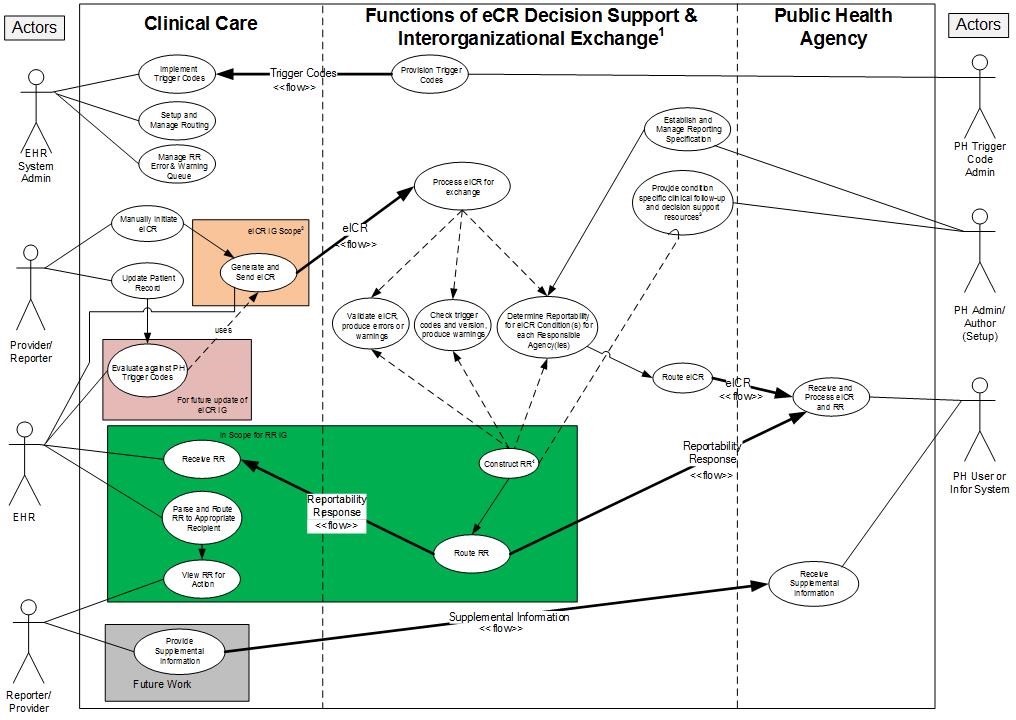 |
The left side of the eCR context flow diagram shows the generation and sending of the eICR including:
The center section, "Functions of eCR Decision Support and Interorganizational Exchange", shows the functions that need to occur in order for a Reportability Response to be constructed and routed appropriately. Some or all of these functions may be operationalized by one or more intermediaries (such as health information exchange organizations, clinical trust networks, or other shared services platforms), by clinical care, and/or by PHAs, under the authority of clinical care, public health, or a combination thereof.
"Determine Reportability for eICR Condition(s) for each Responsible Agency(ies)" is a function to determine if possible condition(s) in the eICR meet jurisdictional reporting requirements and to which responsible agency(ies) the eICR should be sent. This function could be met by:
Once generated, the Reportability Response will be sent to the eICR originating clinical care organization and to a PHA, if generated by an intermediary. Once received by clinical care, the following may take place:
The right side of the eCR context flow diagram shows:
For the generation of an eICR, the following have occurred:
For the generation of a Reportability Response, the following must also be in place:
Following the generation and sending of an eICR:
Following the generation and sending of a Reportability Response:
| Actor | Role |
|---|---|
| Provider (Clinical care provider) |
|
| EHR |
|
| EHR System Administrator |
|
| Reporter (Public Health Reporter) |
|
| PHA User or Information System |
|
| Public Health Jurisdiction User |
|
| Public Health Admin/Author (Setup) |
As set-up steps for public health decision support:
|
| Public Health eRSD / Trigger Code Admin |
|
| Clinical Care (or Clinical Care and Designee) |
|
| Public Health Agency (or PHA and Intermediary) |
|
The actors for "Functions of eCR Decision Support and Interorganizational Exchange" (as identified in the eCR context flow diagram) could be:
A patient presents to a healthcare provider for a clinical examination. The healthcare provider performs the clinical examination and may record a clinical diagnosis or order a laboratory test consistent with the findings. Additionally, a laboratory test result may be returned for that patient's clinical encounter.
The generation of an eICR may be initiated by a variety of methods based on the clinical documentation and/or clinical impression. This patient encounter could be evaluated against a set of trigger codes (including SNOMED CT, ICD-10, and LOINC) that are locally implemented within the EHR system. The trigger codes are designed to identify reportable conditions. In most circumstances, secondary analysis or inspection may be needed to confirm reportability. A diagnosis, laboratory order (at times, based on suspicion of a condition), laboratory test, or laboratory result code is matched with the trigger codes, and an eICR is generated and should be reviewed against all PHA reporting requirements to confirm reportability. The clinical provider could also manually initiate the generation and sending of the eICR.
The eICR contains the data elements necessary to initiate a public health investigation or other appropriate public health action.
When determined reportable, the eICR is received by one or more appropriate PHAs and a Reportability Response is returned to the sending EHR system. The Reportability Response includes the confirmation of reportability, information about the responsible PHA(s), and over time, a request for supplemental information about the event if needed and/or information about the status of disease in the community.
A mother brings her 6-year-old child, Patient A, to Dr. B at Facility C after several days of fever and a progressive rash starting on the face and spreading to the trunk. Patient A presents to Dr. B, practicing at Facility C, with symptoms consistent with varicella infection. After completing the clinical examination, Dr. B records a clinical diagnosis of varicella in the problem list of the patient's record. This patient encounter is evaluated against a set of trigger codes for public health reportable conditions that have been implemented within the EHR system at Facility C. Upon matching the coded clinical diagnosis of varicella to the trigger codes, eICR processing is started, ultimately resulting in an eICR being generated and reviewed against all PHA reporting requirements to confirm reportability before sending to the PHA with authority over Facility C.
The trigger codes are designed to match patient encounters that are presumed to be reportable. A public health decision support tool may be used to confirm the reportability of the case from the EHR system at Facility C. The decision support tool utilizes jurisdictionally determined rules and identifies that a clinical diagnosis of varicella is reportable to a public health jurisdiction(s), and a Reportability Response is provided to the EHR system at Facility C. The eICR is sent to the PHA(s) and integrated into the PHA's surveillance system for follow-up by a public health investigator. The investigator may contact Patient A to identify close contacts and verify immunity. The public health investigator may also contact Dr. B to follow up on clinical findings.
The PHA may employ an intermediary's decision support tool to receive the eICR and confirm its reportability. This intermediary would determine reportability based on the location of the healthcare facility, laboratory, and/or patient's residence and the correct PHA to which to route the eICR. Pertinent information includes patient address and facility location to determine the jurisdiction with authority to receive this information. The PHA determines whether or not an intermediary will be used.
A patient presents to a healthcare provider for a clinical examination. The healthcare provider performs the clinical examination and may record a differential clinical diagnosis or order a laboratory test consistent with the findings. Additionally, a laboratory test result may be returned for that patient's clinical encounter. This patient encounter is evaluated against a set of trigger codes that are implemented within the EHR system. The trigger codes are designed to identify reportable conditions. In some circumstances, secondary analysis or inspection may be needed to confirm reportability. A diagnosis, laboratory order (at times, based on suspicion of a condition), laboratory test, or a laboratory result code is matched with the trigger codes, and an eICR is generated and sent to a centralized public health cloud-based intermediary designated by the PHA.
The intermediary receives the eICR from the EHR system and evaluates the document against centrally hosted public health decision logic to determine the potential public health reportability based on the facility, provider, and/or patient address and patient encounter characteristics. The intermediary will route the eICR to the correct PHA(s) consistent with the results of the public health decision support.
A Reportability Response inclusive of the results of the public health decision support will be routed back to the sending EHR system.
The eICR is received by one or more appropriate PHAs based on the business rules administered by the intermediary. The receiving PHA may contact the sending facility or provider for additional follow-up information pertinent to a public health investigation. This follow-up could utilize methods such as a structured data capture form, a phone call, or a query through an HIE.
The clinical provider may manually initiate the sending of the eICR if the provider suspects that the patient has a condition of public health interest. This ability to manually initiate an eICR is important for patient encounters with non-specific symptomology that may not otherwise be automated by triggers. Business rules in any public health reporting decision support tool should be able to differentiate between a manually initiated eICR and one automated from triggers. This will allow public health to triage these reports differently with decision support and investigation initiation. See the eICR Initiation Type extension for how manual and alternate initiation are indicated in the eICR.
The Reportability Response supports a number of functions in clinical care and public health. It will play a key role in communicating information in circumstances that can include several different roles in clinical care, multiple reportable conditions, trust networks and health information exchanges, public health intermediaries, and multiple PHAs. Listed below are a number of common Reportability Response scenarios. They do not represent all of the possible scenarios or permutations thereof. Example narrative text for many of these scenarios is provided in Reportability Response Narrative Guidance.
In this scenario, the Reportability Response will communicate, for one or more PHAs, which condition(s) is/are reportable, provide information about what clinical next step activities may need to occur, and other relevant resources.
In this case, a clinical care provider enters information into an EHR about a patient that matches one or more of the RCTC trigger codes in the eRSD, the EHR generates an eICR, the eICR is securely shared with public health (or an intermediary), and a public health decision support system confirms if it meets a PHA's reporting requirements in order to indicate that reporting to the specific PHA is necessary.
The eICR and, at times, the Reportability Response are shared with the appropriate PHA(s) (if they did not originate it), and the Reportability Response is shared with the originating clinical care organization. Inside of the clinical care organization, the Reportability Response is associated with the appropriate patient encounter and provides status of legally required reporting. For a Reportability Response that requires action, the EHR may also queue (or be noted via a secure e-mail inbox) the action to notify the Provider of the condition(s) and applicable requested follow-on processing. In unusual circumstances, one potential action might be to alert the provider. Based on internal workflows, at times, the Reportability Response may need to be directly routed to a clinical care staff Reporter's work queue, or will be forwarded to them by the provider, for notification and follow-up. EHR system administrators will also be able to ensure that there have been no issues with the reporting process.
There are circumstances where not all data that are needed to determine reportability are available from an eICR.
In this case, a clinical care provider or supporting system enters information into an EHR about a patient that matches one or more of the RCTC trigger codes in the eRSD, the EHR generates an eICR, the eICR is securely shared with public health (or an intermediary), and a public health decision support system uses the appropriate set of rules, but reportability cannot be confirmed for the relevant PHA(s) because necessary data are not available.
The related eICR is deleted and the Reportability Response may, or may not, be shared with the appropriate PHA(s) based on preferences (and if they are not originating it). A Reportability Response is shared with the involved clinical care organization to "close the loop" on the eICR that had been shared, and providers and/or reporters are notified that one or more reportable conditions may be present depending on the information in unavailable data. The Reportability Response may include guidance for the Provider or Reporter about how to provide the missing data (e.g., by direct follow-up with the relevant PHA, as part of a supplemental data request, or by manually initiating an eICR with an explanation that includes the missing data). Manually initiated eICRs, representing significant Provider / Reporter suspicion of a reportable condition, are always shared with the relevant PHA(s).
Trigger codes are designed to trigger an eICR for reportable conditions, but specific reporting rules can vary between PHAs. There are circumstances where an eICR will be determined not to be reportable because it is not on the list of reportable conditions for the relevant PHA or the information provided at the time of this report does not meet reporting criteria.
In this case, a clinical care provider enters information into an EHR about a patient that matches one or more of the RCTC trigger codes in the eRSD, the EHR generates an eICR, the eICR is securely shared with public health (or an intermediary), and a public health decision support system uses the appropriate set of rules, but no reportability is determined for the relevant PHA(s).
The related eICR is processed based on PHA input recorded in decision support (if the eICR is being processed by an intermediary). The Reportability Response may, or may not, be shared with the appropriate PHA(s) also based on PHA input (and if they are not originating it). The Reportability Response will always be shared with the involved clinical care organization to "close the loop" and for audit purposes on the eICR that had been shared, but it is recommended that neither Providers nor Reporters receive notification unless they specifically ask for it.
All eICRs are intended for machine processing and archiving on receipt including electronic decryption, content parsing and validation, decision support processing and, when necessary, sending, parsing and consumption by a separate public health surveillance system. To be able to maintain the reporting process, to have comparable data at all of the different steps of this process, and to ensure that EHRs are using current RCTC versions and codes from the eRSD, it is important to be able to communicate reporting warnings and errors back to EHR system administrators.
In this case, a clinical care provider enters information into an EHR about a patient that matches one or more of the RCTC trigger codes in the eRSD, the EHR generates an eICR, and the eICR is securely shared for public health assessment.
But on receipt, the eICR may be found to be corrupt, it may not be decryptable, the content may be malformed or not processable, some required eICR data may not be found, an outdated version of the RCTC may have been used to trigger it, or an old trigger code may still be in place in the EHR. In these and other circumstances, a Reportability Response will be generated and, if possible, sent back. The Reportability Response will include information about the technical problem: the appropriate error, if the eICR was not able to be processed; the appropriate warning, if the eICR was able to be processed; and/or notice of the use of an outdated code set or code.
Reportability Responses with eICR processing errors (the eICR was not processed) are shared with EHR system administrators, and follow-up by Reporters or Providers using alternate reporting mechanisms may be necessary to complete legally required reporting requirements. Reportability Responses with warnings or notifications of outdated trigger code sets (the eICR was still processed) are managed by clinical care in accordance with determined routing and notification based on the determination of reportability and other supporting information as in the scenarios above. In situations where there is a decision support intermediary and the eICR cannot be processed, the appropriate PHA(s) may not be able to be determined. In the situation where the eICR can be processed but a warning was identified, the Reportability Response would be shared with the PHA if requested by the PHA. If the relevant PHA(s) can be determined, the Reportability Response will be shared, for PHAs that want to receive it, as an early indication that there may be something on which to follow up.
IG © 2025+ HL7 International / Public Health.
Package hl7.fhir.us.ecr#3.0.0-ballot based on FHIR 4.0.1.
Generated
2026-11-16
Links: Table of Contents |
QA Report
| Version History |
 |
Propose a change