This material contains content that is copyright of SNOMED International. Implementers of these specifications must have the appropriate SNOMED CT Affiliate license - for more information contact https://www.snomed.org/get-snomed
or info@snomed.org
.
AU eRequesting Implementation Guide, published by HL7 Australia. This guide is not an authorized publication; it is the continuous build for version 1.0.1-ci-build built by the FHIR (HL7® FHIR® Standard) CI Build. This version is based on the current content of https://github.com/hl7au/au-fhir-erequesting/ and changes regularly. See the Directory of published versions ( src
)
HL7 FHIR® Licensing and Legal Terms should also be referenced as the underlying standards published terms on which HL7 Australia FHIR Implementation Guides depend. ( src
)
HL7®, HEALTH LEVEL SEVEN®, FHIR® and the FHIR logo are trademarks owned by Health Level Seven International, registered with the United States Patent and Trademark Office. ( src
)
Most trademarks used in conjunction with HL7® products, services and activities are registered and/or owned by HL7 International, rather than by HL7 Australia, and their use is subject to the associated HL7 International IP policies and licensing terms. ( src
)
AU eRequesting Implementation Guide, published by HL7 Australia. This guide is not an authorized publication; it is the continuous build for version 1.0.1-ci-build built by the FHIR (HL7® FHIR® Standard) CI Build. This version is based on the current content of https://github.com/hl7au/au-fhir-erequesting/
and changes regularly. See the Directory of published versions
The codes SHALL be taken from For codes, see
Pathology Fasting Status
( required
to https://healthterminologies.gov.au/fhir/ValueSet/pathology-fasting-status-1
)
This profile sets minimum expectations for a Consent resource to record, search, and fetch a My Health Record (MHR) consent withdrawal. It represents a patient's withdrawal of consent to upload to MHR in accordance with paragraph 45(d) of the My Health Records Act 2012
. It is based on the Consent
resource and identifies the additional mandatory core elements, extensions, vocabularies and value sets that SHALL
be present in the Consent when conforming to this profile.
When selecting a code for Organization type, if a system is unable to provide a code from the preferred value set Healthcare Organisation Role Type
because the implementation context is not restricted to healthcare practitioner providers then it is recommended to select from the wider set available in SNOMED CT. If a suitable code from SNOMED CT is not available, a code from the code system Australian and New Zealand Standard Industrial Classification (ANZSIC), 2006 (Revision 2.0)
may be used.
When selecting a code for Organization type, if a system is unable to provide a code from the preferred value set Healthcare Organisation Role Type
because the implementation context is not restricted to healthcare practitioner providers then it is recommended to select from the wider set available in SNOMED CT. If a suitable code from SNOMED CT is not available, a code from the code system Australian and New Zealand Standard Industrial Classification (ANZSIC), 2006 (Revision 2.0)
may be used.
The codes SHOULD be taken from For example codes, see
Healthcare Organisation Role Type http://hl7.org/fhir/ValueSet/organization-type|4.0.1
( preferred
to https://healthterminologies.gov.au/fhir/ValueSet/healthcare-organisation-role-type-1
)
The individual's gender identity is populated in the extension:value.value[x]
of the Individual Gender Identity
extension and shall contain one of the codes from the Gender Identity Response
value set if any of the codes within the value set can apply.
The individual's pronouns are populated in the extension:value.value[x]
of the Individual Pronouns
extension and shall contain one of the codes from the Australian Pronouns
value set if any of the codes within the value set can apply.
The codes SHOULD be taken from
Clinical Specialty http://hl7.org/fhir/ValueSet/c80-practice-codes|4.0.1
( preferred
to https://healthterminologies.gov.au/fhir/ValueSet/clinical-specialty-1
)
The codes SHOULD be taken from For example codes, see
RANZCR Radiology Referral http://hl7.org/fhir/ValueSet/procedure-code|4.0.1
( preferred
to https://ranzcr.com/fhir/ValueSet/radiology-referral-1
)
Work is underway within RANZCR
to finalise the development of the Radiology Referral Set (RRS) with the aim of including all radiology procedures performed in Australia. The RANZCR Radiology Referral
value set published in the NCTS
is an evolving draft that is derived from the latest agreed set of concepts from the RRS. Implementers are advised to take note that concepts within the value set will continue to expand and evolve when further iterations of the Radiology Referral Set are available.
Work is underway within RANZCR
to finalise the development of the Radiology Referral Set (RRS) with the aim of including all radiology procedures performed in Australia. The RANZCR Radiology Referral
value set published in the NCTS
is an evolving draft that is derived from the latest agreed set of concepts from the RRS. Implementers are advised to take note that concepts within the value set will continue to expand and evolve when further iterations of the Radiology Referral Set are available.
Work is underway within RANZCR
to finalise the development of the Radiology Referral Set (RRS) with the aim of including all radiology procedures performed in Australia. The RANZCR Radiology Referral
value set published in the NCTS
is an evolving draft that is derived from the latest agreed set of concepts from the RRS. Implementers are advised to take note that concepts within the value set will continue to expand and evolve when further iterations of the Radiology Referral Set are available.
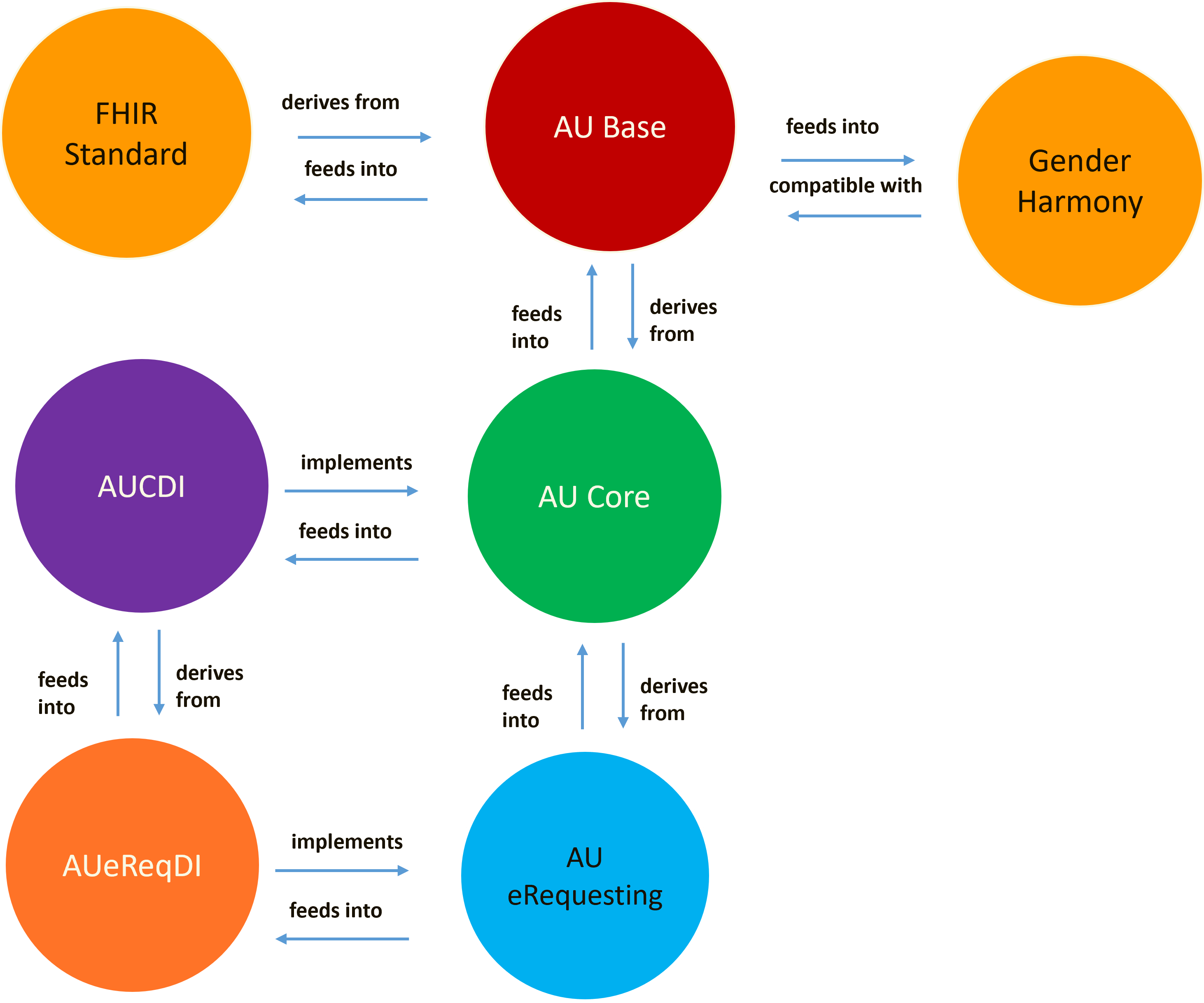
The primary intent of AUeReqDI is to design and govern a collection of coherent, reusable building blocks known as ‘data groups’. These data groups define what clinical information is required to support eRequests. However, they do not specify how the data is exchanged; this is the role of the FHIR standard. AUeReqDI is not required to be implemented as a whole single product. AUeReqDI builds upon and complements the foundational Australian Clinical Data for Interoperability (AUCDI)
and focuses on the specific use case of eRequesting.
In addition to the examples defined in this implementation, synthetic (realistic but not real) test data for developers and testers that conforms to HL7 Australia FHIR implementation guides is maintained in the HL7 AU FHIR Test Data
repository.
This implementation guide is under development through the AU eRequesting project as part of the Sparked AU FHIR Accelerator
. The Sparked AU FHIR Accelerator is a collaborative community of government, technology vendors, provider organisations, peak bodies, practitioners, and domain experts, working together to accelerate the creation and use of national FHIR standards for health information exchange and workflow.
The Australian eRequesting Data for Interoperability (AUeReqDI)
is focused on an agreement of the minimum data required to support standardised eRequesting within the Australian health context, and forms a common language foundation that allows systems to exchange semantically accurate data for eRequests. AUeReqDI outputs form a set of data requirements to be considered and referred to as part of the development and definition of AU eRequesting.
National Electrical Manufacturers Association ( NEMA
). This specification may reference content from DICOM, which is copyright NEMA, and distributed by agreement between NEMA/DICOM and HL7. Implementer use of DICOM is not covered by this agreement
Australian eRequesting Data for Interoperability (AUeReqDI)
builds upon and complements the foundational Australian Clinical Data for Interoperability (AUCDI) and focuses on the specific use case of eRequesting. The first release of AUeReqDI is focused on electronic pathology and medical imaging requests in primary and community-based care provision.
Updates to AU eRequesting depend upon community input and we encourage our audience to submit questions and feedback to AU eRequesting specifications by clicking on the Propose a change link in the footer of every page. In addition, we encourage requesting any necessary clarifications to AUeReqDI through the AUeReqDI process
that helps inform future updates to AU eRequesting.
 (
required
)
(
required
)