


Verifiable Health Links
1.0.0-comment - ballot

Verifiable Health Links
1.0.0-comment - ballot
Verifiable Health Links, published by IHE IT Infrastructure Technical Committee. This guide is not an authorized publication; it is the continuous build for version 1.0.0-comment built by the FHIR (HL7® FHIR® Standard) CI Build. This version is based on the current content of https://github.com/IHE/ITI.VHL/ and changes regularly. See the Directory of published versions
| Official URL: https://profiles.ihe.net/ITI/VHL/ExampleScenario/UseCaseHajjPilgrimage | Version: 1.0.0-comment | |||
| Active as of 2026-06-14 | Computable Name: HajjPilgrimage | |||
During the Hajj pilgrimage, the Kingdom of Saudi Arabia (KSA) hosts approximately two million pilgrims from across the globe as part of a mass gathering event. Temporary hospitals and clinics, comprising over a thousand beds, are established to provide care to the pilgrims over the four-week period of Hajj.
Starting with Hajj 1445 AH (2024 CE), pilgrims from Oman, Malaysia, and Indonesia were able to share their health records utilizing the International Patient Summary (IPS) with verification of health documents provided through the WHO Global Digital Health Certification Network (GDHCN) infrastructure.
Key Features:
Some of the challenges faced during the pilot implementation, though not necessarily to be taken up in this profile, include:
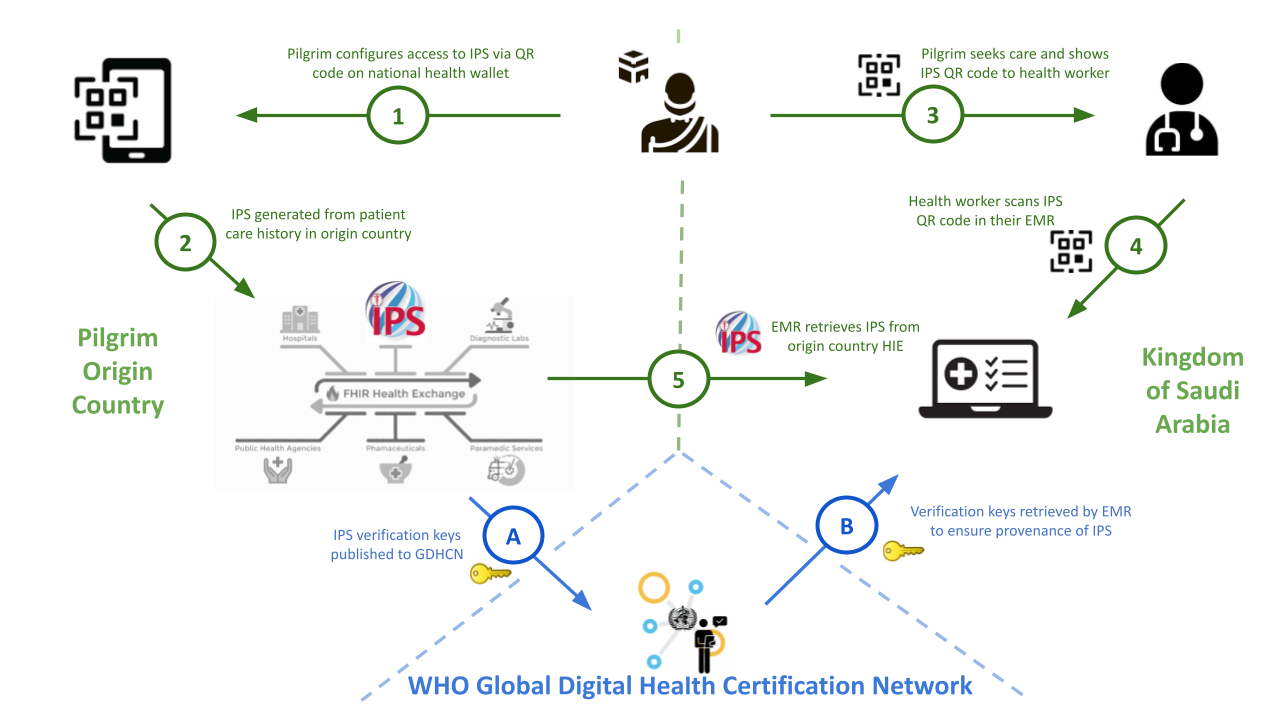
Pre-conditions:
Pilgrim has received health assessment in home country. Home country has registered PKI material with WHO GDHCN Trust Anchor. Pilgrim has provided consent (verbal or digital) to share health records.
Main Flow:
Pilgrims begin their journey in their home country where they receive a health check and are educated on the use of QR codes (a version of Verifiable Health Links) and provide the consent to share their health records. This consent may be provided verbally or recorded digitally. When recorded, there are two notions of consent recorded:
The verifiable health link is provided by their home jurisdiction during their health check as a QR code. Depending on the digital infrastructure pilgrim's origin country, jurisdictional policies and digital capabilities (e.g. access to smart phones) of the pilgrim's origin country, the verifiable health link may be:
During a care encounter in KSA, the pilgrim provides their verifiable health link as a QR code to their care provider. Once a VHL is shared by a pilgrim during a care encounter in KSA:
Post-conditions:
KSA healthcare providers can access pilgrim health records as IPS.
IG © 2024+ IHE IT Infrastructure Technical Committee. Package ihe.iti.vhl#1.0.0-comment based on FHIR 4.0.1. Generated 2026-06-14
Links: Table of Contents |
QA Report
| New Issue | Issues
Version History |
 |
Propose a change
|
Propose a change