|
Type
|
Reference
|
Content
|
|
web
|
github.com
|
Terminology Fundamentals, published by HL7 International / Terminology Infrastructure. This guide is not an authorized publication; it is the continuous build for version 1.0.0-ballot built by the FHIR (HL7® FHIR® Standard) CI Build. This version is based on the current content of https://github.com/HL7/terminology-fundamentals-ig/
and changes regularly. See the Directory of published versions
|
|
web
|
confluence.ihtsdotools.org
|
SNOMED CT Expression Constraint Language (ECL)
|
|
web
|
en.wikipedia.org
|
Structured Query Language (SQL)
|
|
web
|
apelon.com
|
Apelon Terminology Query Language (TQL)
|
|
web
|
infocentral.infoway-inforoute.ca
|
Examples of a Code System Supplement include pCLOCD
, but can also be as simple as frequency counts that describe usage statistics for concepts in a particular context.
Because this supplemental information can be directly tied to individual concepts, Code System Supplements can be used as part of a Value Set Definition Content Expression to determine Value Set
Expansion Code Set membership. Code System Supplements must have some sort of identifying information so that they may be uniquely identified and accessed and must identify the Code System to which they are associated.
|
|
web
|
www.omg.org
|
The Common Terminology Services – Release 2 (CTS 2) specification
is intended to mediate among disparate
terminology sources by defining a common information model and
computational model. The information model specified in the CTS 2 Platform Independent Model (PIM) outlines the structural definition, attributes and associations of the
elements common across structured terminologies and terminology elements such as Value Sets. CTS 2 does not mandate specific terminology components, but provides the
infrastructure to support a diverse array of structured terminology representations.
|
|
web
|
cdn.who.int
|
In the WHO-FIC Classifications and Terminology Mapping Guide
, ISO/TR 12300:2014 defines terminology mapping as the "process of defining a relationship between concepts in one coding system to concepts in another coding system, following a documented rationale, for a given purpose."
|
|
web
|
www.rfc-editor.org
|
The intention is to use the IETF language tags preference referenced by the current RFC for BCP 47
.
|
|
web
|
apelon.com
|
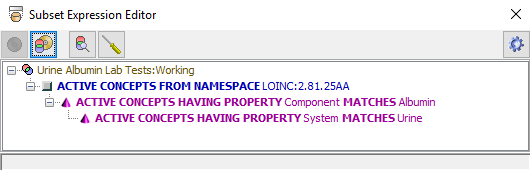
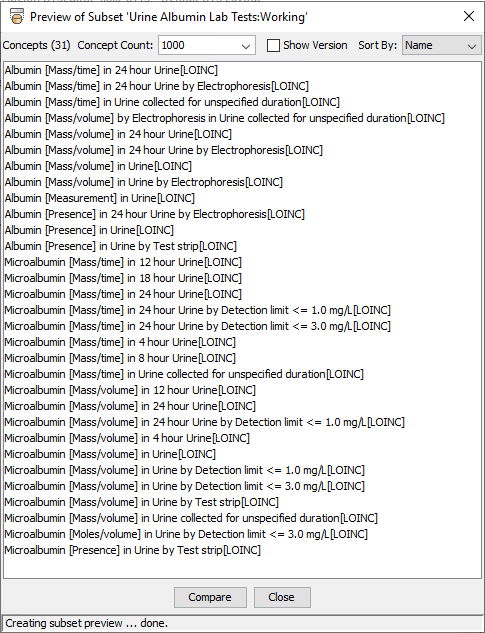
The Urine Albumin Lab Test Value Set in this example uses LOINC properties to create an expression to capture all LOINC codes that measure albumin in a urine specimen. The expression below was created using
Apelon's Distributed Terminology System (DTS)
.
|
|
web
|
www.omg.org
|
This standard has already explicitly noted that "a Value Set is only persisted as its Value
Set Definition, which is a machine-processable set of one or more expressions that permit a specific collection of coded concepts at a given point in time to be reliably
reproduced." The Common Terminology Services – Release 2 (CTS 2)
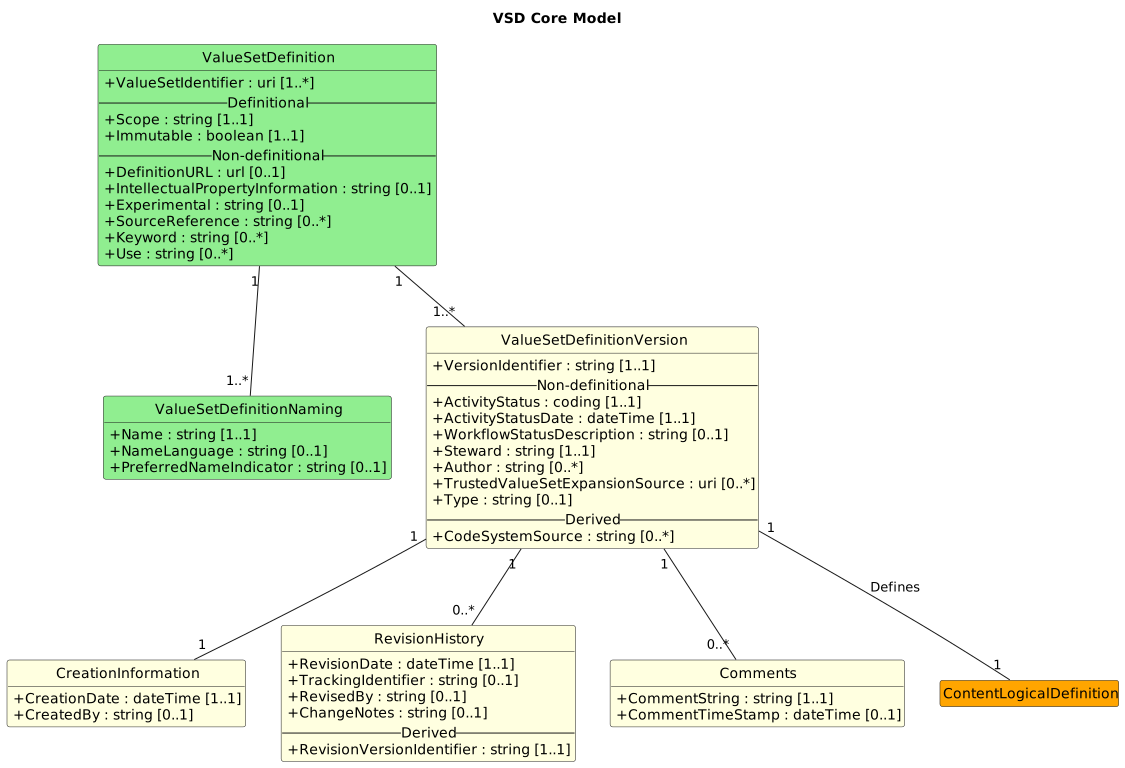
standard also describe various mechanisms and functions to produce Value Set Expansions from Value Set Definitions. This standard provides an explicit list of the precise data items needed for the Value Set Definition.
|