
Show Usage
This fragment is available on en/about.html
This publication includes IP covered under the following statements.
| Type | Reference | Content |
|---|---|---|
| web | examplehealth.org | source: https://examplehealth.org/.well-known/vlei/oobi/EBfdlu8R27Fbx-ehrqwImnK-8Cm79sqbAQ4MmvEAYqao |
| web | tel:+1-617-555-0142 | telecom : +1-617-555-0142 |
| web | tel:+1-617-555-0187 | +1-617-555-0187 |
| web | github.com | Interoperable Digital Identity and Patient Matching, published by HL7 International / Patient Administration. This guide is not an authorized publication; it is the continuous build for version 3.0.0-current built by the FHIR (HL7® FHIR® Standard) CI Build. This version is based on the current content of https://github.com/HL7/fhir-identity-matching-ig/ and changes regularly. See the Directory of published versions |
| web | www.omg.org | ServD |
| web | www.omg.org |
ServD
|
| web | en.wikipedia.org | Both Bundle.link and Bundle.entry.link are defined to support providing additional context when Bundles are used (e.g. HATEOAS ). |
| web | github.com | The source code for this Implementation Guide can be found on HL7 FAST Identity Github Repo . |
| web | www.iso.org |
ISO Maintains the copyright on the country codes, and controls it's use carefully. For futher details see the ISO 3166 web page: https://www.iso.org/iso-3166-country-codes.html
Show Usage
|
| web | www.gleif.org | The Legal Entity Identifier (LEI) is a unique identifier for legal entities that engage in transactions. It is a 20-character alphanumeric code that is based on the ISO 17442 standard. The LEI is issued by authorized issuers, known as Local Operating Units (LOUs) , and is maintained by the Global Legal Entity Identifier Foundation (GLEIF) . The LEI can be used in healthcare transactions to identify the organization or individual that is providing care or services or receiving care services. The LEI can also be used for auditing and accountability, to ensure that actions taken by organizations can be traced back to the correct entity. |
| web | www.iso.org | The Legal Entity Identifier (LEI) is a unique identifier for legal entities that engage in transactions. It is a 20-character alphanumeric code that is based on the ISO 17442 standard. The LEI is issued by authorized issuers, known as Local Operating Units (LOUs) , and is maintained by the Global Legal Entity Identifier Foundation (GLEIF) . The LEI can be used in healthcare transactions to identify the organization or individual that is providing care or services or receiving care services. The LEI can also be used for auditing and accountability, to ensure that actions taken by organizations can be traced back to the correct entity. |
| web | www.gleif.org | vLEIs are verifiable credentials that are based on the LEI and can be used to provide additional information about the legal entity, such as its organizational structure, ownership, and other relevant information. The vLEI is issued by Qualified vLEI Issuers (QVIs) , which are authorized by GLEIF to issue vLEI credentials. The vLEI can be used in healthcare transactions to provide additional information about the organization or individual that is providing care or services or receiving care services. The vLEI can also be used for auditing and accountability, to ensure that actions taken by organizations can be traced back to the correct entity and that the information about the entity is accurate and up-to-date. |
| web | ahima.org | AHIMA Naming Policy Recommendations white paper |
| web | diacc.ca | Canadian Digital Identity Ecosystem 's Digital Trust And Identity and National Technical Specification for digital credentials and digital trust services |
| web | www.carinalliance.com | CARIN Digital Identity |
| web | directtrust.app.box.com | DirectTrust Guidance for Authentication of Individual Identity |
| web | www.ecri.org | ECRI Health IT Safe Practices: Toolkit for the Safe Use of Health IT for Patient Identification |
| web | oikeusministerio.fi | Finland and Germany Self-sovereign Identity-based Collaboration in the EU |
| web | gainforum.org | Global Assured Identity Network (GAIN) |
| web | openid.net | OpenID for Identity Assurance |
| web | patientidnow.org | Patient ID Now Coalition Framework for a National Strategy on Patient Identity (The Framework identified nine areas for definition of a national patient identity strategy) |
| web | wiki.directproject.org | Direct Standard - Implementation Guide for Expressing Context in Direct Messaging |
| web | profiles.ihe.net | Overview: IHE whitepaper on Document Sharing Health Information Exchanges |
| web | profiles.ihe.net | IHE - Patient Demographics Query for Mobile (PDQm) |
| web | profiles.ihe.net | IHE - Patient Identifier Cross-reference for Mobile (PIXm) |
| web | profiles.ihe.net | IHE - Patient Master Identity Registry (PMIR) |
| web | profiles.ihe.net | IHE - Cross-Community Patient Discovery (XCPD) |
| web | profiles.ihe.net | IHE - Patient Administration Management (PAM) |
| web | profiles.ihe.net | IHE - Patient Demographics Query (PDQ) |
| web | profiles.ihe.net | IHE - Patient Identifier Cross-Referencing (PIX) |
../assets/images/usa.svg 
|
identity-venn.svg 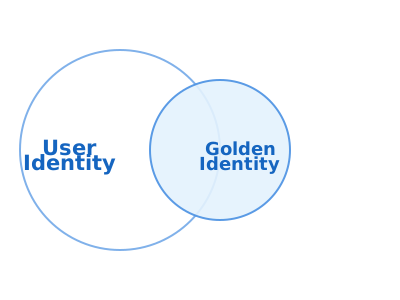
|
tree-filter.png 
|